Lift stations, feed rooms and galleries, watched between rounds.
VisionAery Liquid Leak Detection runs on the cameras already at the plant and at the remote stations. It marks sewage overtopping a wet well, hypo pooling in a feed room, polymer on a walkway or spray from a flange in the dry well, and alarms into the VMS and SCADA in seconds.
Water treatment plant with the V4 overlay marking a puddle on the walkway beside the process tanks.
Where leaks start in water and wastewater
A utility runs hundreds of pumps and thousands of joints across sites that are staffed for one shift or not at all. Raw sewage arrives at the headworks and the lift stations; sodium hypochlorite, ferric, polymer and caustic arrive by tanker and sit in day tanks and totes; sludge moves from clarifiers to digesters to dewatering. Releases start at pump seals and check valves in the dry well, at feed-pump tubing and tote valves in the chemical room, at flanges on force mains and recirculation lines, and at the lip of a channel or wet well when the pumps fall behind. At a remote lift station the first person to know is usually a neighbor.
Sites and assets
Lift and pump stations, wet wells and dry wells
Headworks, screens and grit channels
Primary and secondary clarifiers and RAS/WAS pump galleries
Chemical feed rooms: hypo, ferric, polymer, caustic, alum
Chlorine and sulfur dioxide cylinder and ton-container rooms
Digesters, sludge pumping and dewatering buildings
High-service and raw-water pump galleries and their VFD rooms
Reservoirs, booster stations and PRV vaults
Fuel and generator pads at remote stations
What V4 watches for
Puddle: sewage overtopping a wet well or channel, process water on a gallery floor, sludge from a seal or a press, hypo or ferric in a containment, polymer on a walkway.
Spray: a pressurized fan from a flange, a pump seal, a feed-pump fitting or a failed hose, in the dry well, the gallery or the feed room.
Vapor: visible fuming at a hypo or ferric tank, steam at a digester heat loop, or a chlorine or sulfur dioxide release when it forms a visible cloud. V4 does not detect an invisible gas, and it does not identify which liquid it sees.
Use cases
01
Lift stations and wet wells
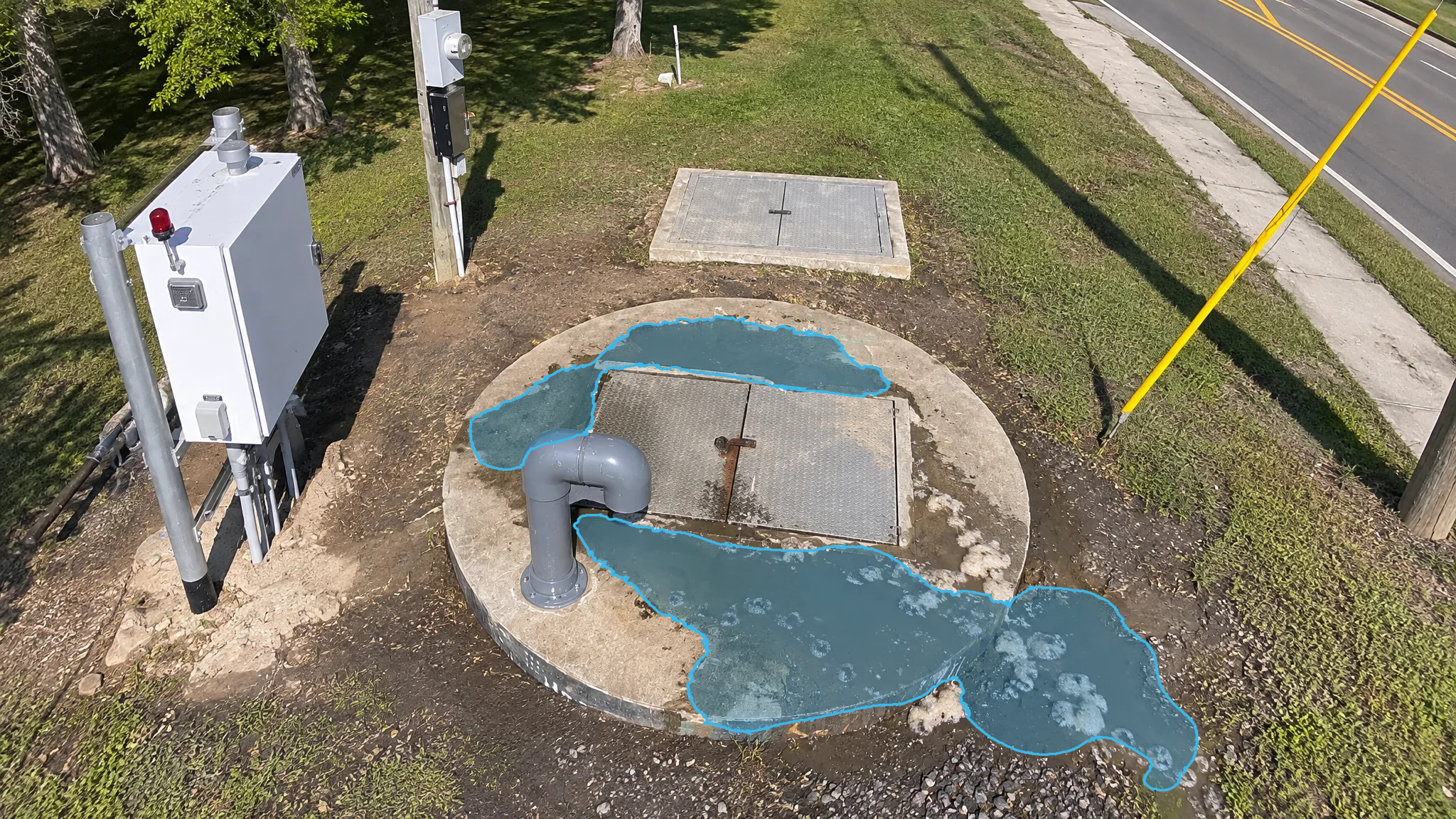
A lift station is checked when a crew drives to it. Between visits a tripped pump, a stuck float or a plugged force main can bring the wet well up and over the hatch, or surface as an SSO at the lowest manhole on the street. V4 runs on the pole camera already covering the station, with an interest zone on the hatch, the valve vault and the ground around them. The alarm stages up as the overflow spreads and reaches SCADA over MQTT alongside the wet-well level tag, with the snapshot that shows what is on the ground.
Lift station wet well — puddle detected
02
Chemical feed rooms
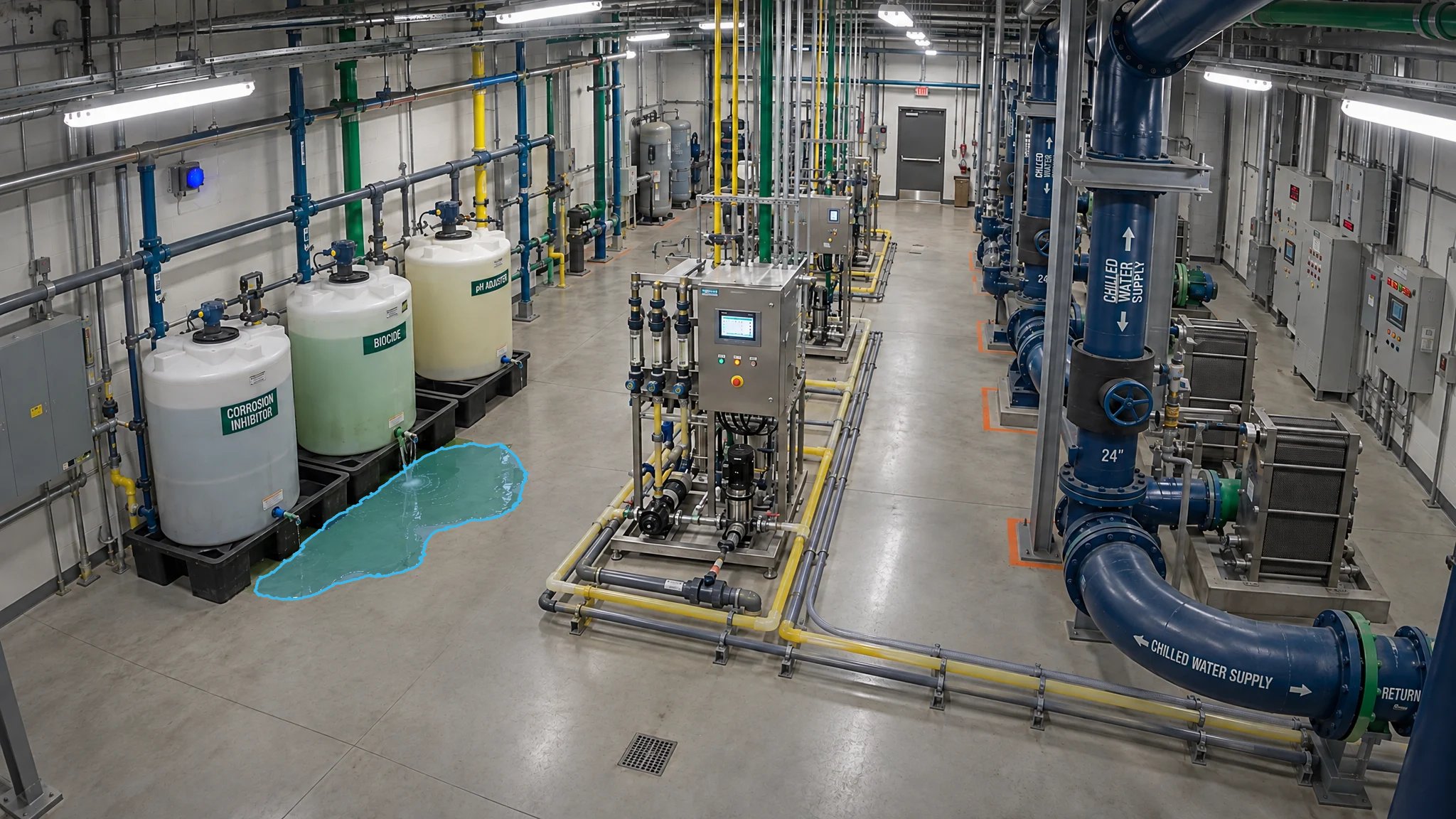
Hypo, ferric and polymer leak quietly. A fitting on a peristaltic feed pump, a tote valve, a bulk tank flange or a day-tank overflow puts liquid in the containment or on the floor, where it is found at the next shift change. Polymer is the worst: a clear film that an operator cannot see until it is underfoot. The ceiling camera in the feed room gives V4 a view of the containment, the pump skid and the walkway, and the color-confidence check tells wet floor from old stain. The alarm reaches the VMS and, by webhook, the operator on call.
Hypochlorite feed room — puddle detected
03
Dry wells and pump galleries
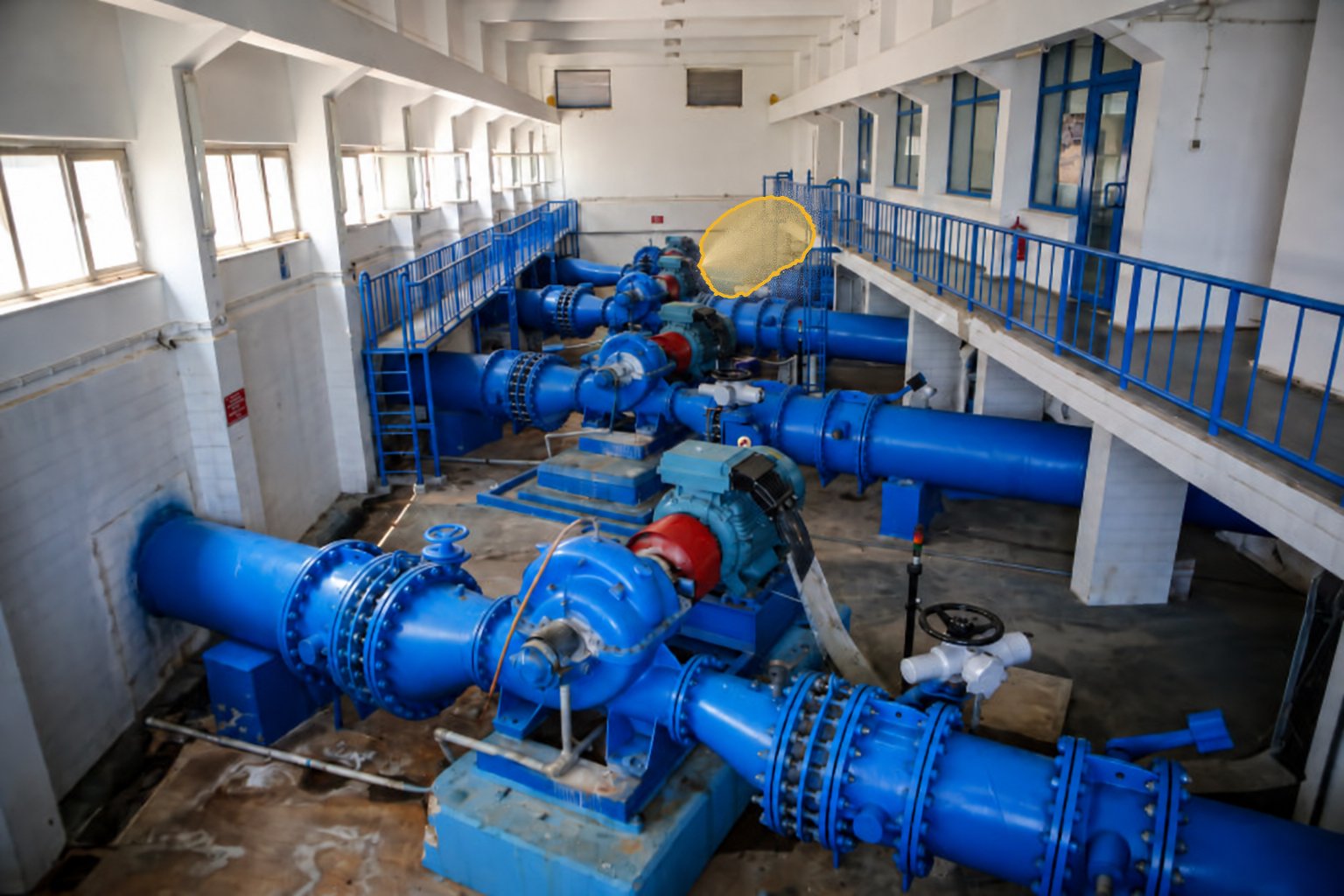
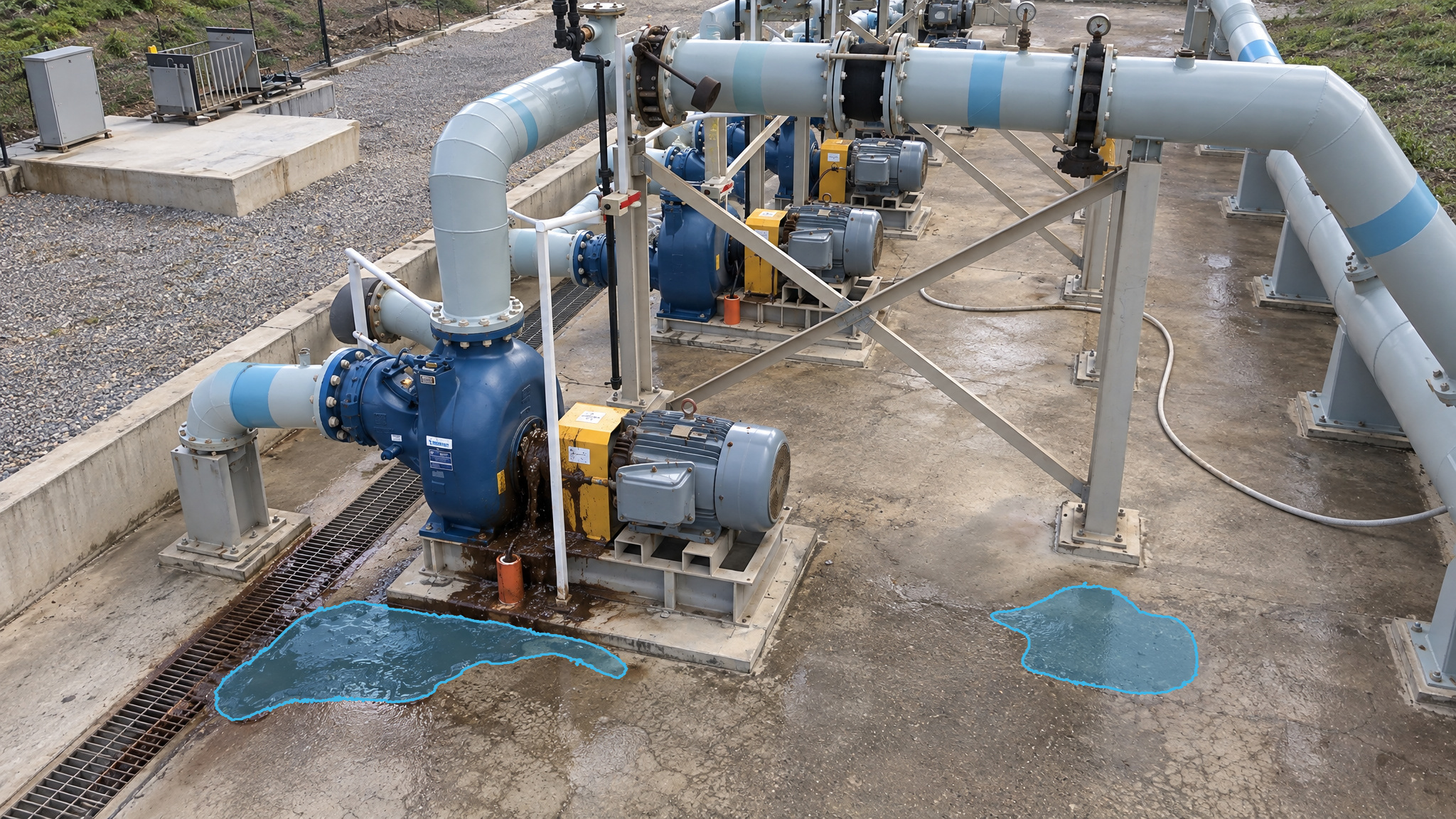
A pump gallery holds the pressure. A seal, a check valve or a flange on a header fails as a spray before it is a puddle, and in a dry well the puddle has nowhere to go but the sump and the motor pedestals. V4 detects both signatures on the camera in the gallery or on a PTZ on a tour of several, with an interest zone on each pump and its discharge flange. Spray is reported in seconds, with the snapshot that tells the on-call operator which pump before they leave the house.
Pump station gallery — spray detected
04
Sludge handling, digesters and dewatering
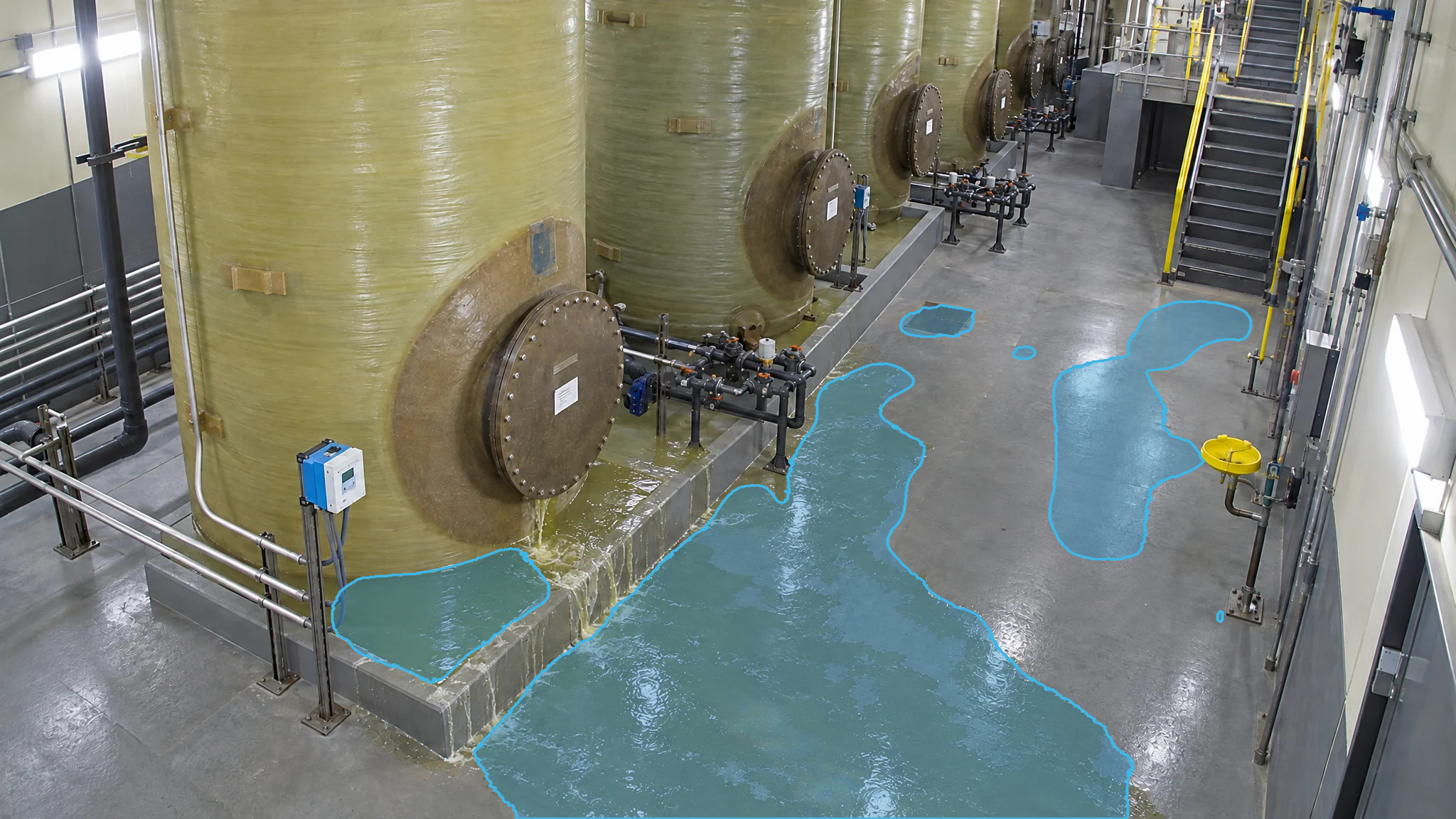
Sludge pumps, grinder discharge lines, belt-press feed lines and digester recirculation loops run thick, abrasive liquid through pumps and joints all day. A leaking seal on a sludge pump or a torn belt-press pan puts sludge on the floor of a building that is walked once a shift. The cameras already in the dewatering building and at the digester control building give V4 a view of the pump pedestals and the press floor; a puddle that appears and grows is reported to the VMS and to SCADA with a timestamp.
Dewatering building — puddle detected
05
Headworks and clarifiers
Channels, weirs and launders overflow when a screen blinds, a gate sticks or flow outruns the RAS pumps. The result is sewage or mixed liquor on a walkway, running toward a drain that may lead off site. A fixed camera on the headworks building or a PTZ touring the clarifiers gives V4 a view of the channel lips and the walkways, with exclusion zones on the open water surface so the process itself does not alarm. An overtopping channel is reported as a puddle the moment it wets the concrete.
Treatment plant walkway — puddle detected
Why it matters in water and wastewater
An overflow is a report with a clock on it.
An NPDES permittee must report any noncompliance that may endanger health or the environment orally within 24 hours of becoming aware of it, and in writing within 5 days. EPA estimates there are at least 23,000 to 75,000 sanitary sewer overflows a year in the United States, not counting backups into buildings.
States set the categories and the deadlines.
California's Sanitary Sewer Systems General Order (WQ 2022-0103-DWQ) treats a spill of any volume that reaches surface water as Category 1 and a spill of 1,000 gallons or more that does not as Category 2. Texas requires notice to the TCEQ regional office within 24 hours, a written report within five working days, and public notice within 24 hours for a discharge of 100,000 gallons or more.
The record is written the moment it is seen.
Every V4 alarm carries a timestamp and the original and overlay snapshots, so the time an overflow or a chemical release started is on file before the first phone call. That record is also the one that shows the chemical room floor was dry on the shifts when nothing happened.
How it is deployed in water and wastewater
On-camera
Axis ARTPEC-9 cameras run V4 now; Hanwha Wisenet 9 cameras ship November 15, 2026. This is the fit for remote lift stations, booster stations and reservoir sites, where the pole camera is the only equipment with a processor and the link back is a cellular modem or a radio. The alarm leaves as a native camera event, and the camera can also publish MQTT straight to the SCADA broker over the station's own link. Interest zones and exclusion zones are drawn on the camera's own picture. Nothing is processed in the cloud, and no video leaves the site unless you send it.
On-server
At the plant, where cameras from several makes and several years already feed one VMS, one server watches many camera channels: an Emerson PACEdge industrial PC, an x86 server with an integrated Intel GPU or an NVIDIA GPU, or an NVIDIA Jetson, all shipping November 15, 2026, taking RTSP from any H.264 camera. The server sits in the control room with the VMS and the SCADA server, and an overlay RTSP stream per channel can go onto the operator wall. A plant on Ignition gets tags that auto-discover; a plant on another SCADA takes the alarm as JSON over MQTT or as a webhook.
Integrations
Native camera events into the VMS (Axis event engine, Hanwha camera events); on-server, alarm triggers into Nx Witness, Wisenet WAVE, Milestone and AXIS Camera Station and an overlay RTSP stream per channel; MQTT as JSON or Sparkplug B, pre-mapped for Ignition, and into DeltaV over MQTT on Emerson; HTTPS webhooks to email, SMS, ticketing or a BMS.
Rain
Outdoor stations get a rain gate that pauses detection while it rains and is forgiving for a window afterwards, fed by a rain sensor on the camera's I/O port, an I/O module or a weather service; a failed weather lookup never blocks detection.
Measured, not promised
Measured on 9,147 previously unseen frames, including true positives and negatives, out of the box with no per-site training, before the alarm engine is applied.
F-score
Detection rate
False positive rate
Puddle
0.889
97.1%
0.8%
Spray and visible vapor
0.923
98.1%
3.7%
F-score is the pixel-level harmonic mean of precision and recall. Frame-level figures; the alarm engine's staging, persistence and color-confidence checks exist so that a false frame does not become a false alarm.
Scenarios outside those tested are not covered by these figures.
Detection within seconds · Installed and configured in under 30 minutes · About 25 pixels per foot on target, nothing else
Detection depends on the view, lighting and image detail. VisionAery Liquid Leak Detection does not identify chemical composition, detect invisible gas or measure concentration, depth or volume. It supports, not replaces, inspections, required instrumentation, cleanup protocols and safety procedures.
Questions
Frequently asked questions
Will the open water in a clarifier or a channel set it off?
No. Detection only happens inside an interest zone. Draw the interest zones on the walkways, the channel lips and the pump pedestals, and exclusion zones on the water surface, the weir and the spray from a scum sprayer. A wet walkway after a hose-down is handled by the persistence check and the color-confidence check, and a single frame never becomes an alarm.
Can it see a chlorine or sulfur dioxide release?
Only when a release forms a visible cloud. V4 detects what the camera can see: a puddle, a pressurized spray or vapor that is visible in the picture. It does not detect an invisible gas and is not a substitute for the gas detectors in the cylinder room. Where a release is visible, V4 flags it like any other leak.
How does it reach SCADA at a remote station?
Over MQTT, as JSON or Sparkplug B, to your broker or to an embedded broker on the camera that bridges to yours. Sparkplug B publishes the camera or server as an edge node with zone and alarm metrics as a tag tree, pre-mapped for Ignition so the tags auto-discover in MQTT Engine. For another SCADA, an HTTPS webhook posts JSON, with snapshots if you want them, to any URL.
Does it tell me how many gallons overflowed?
No. V4 reports that liquid appeared inside a zone, when, and how the alarm staged as it spread. The snapshots give the on-call operator the picture; the volume estimate for the report stays with the operator and the wet-well level record.
Does it replace my overflow response plan or my inspections?
No, and VisionAery makes no regulatory claims. V4 watches continuously between visits and gives you a timestamped record for every alarm. What that means for your response plan, your reporting and your rounds is your decision.
Put a continuous watch on the stations you can't visit every day and the rooms you walk once a shift.