The pad, the station and the right-of-way, watched every few seconds.
From a single-well pad to a tank farm, VisionAery Liquid Leak Detection runs on the security camera that already watches the site and reports a puddle, a pressurized spray or visible vapor the moment it appears, without anyone driving out to see it.
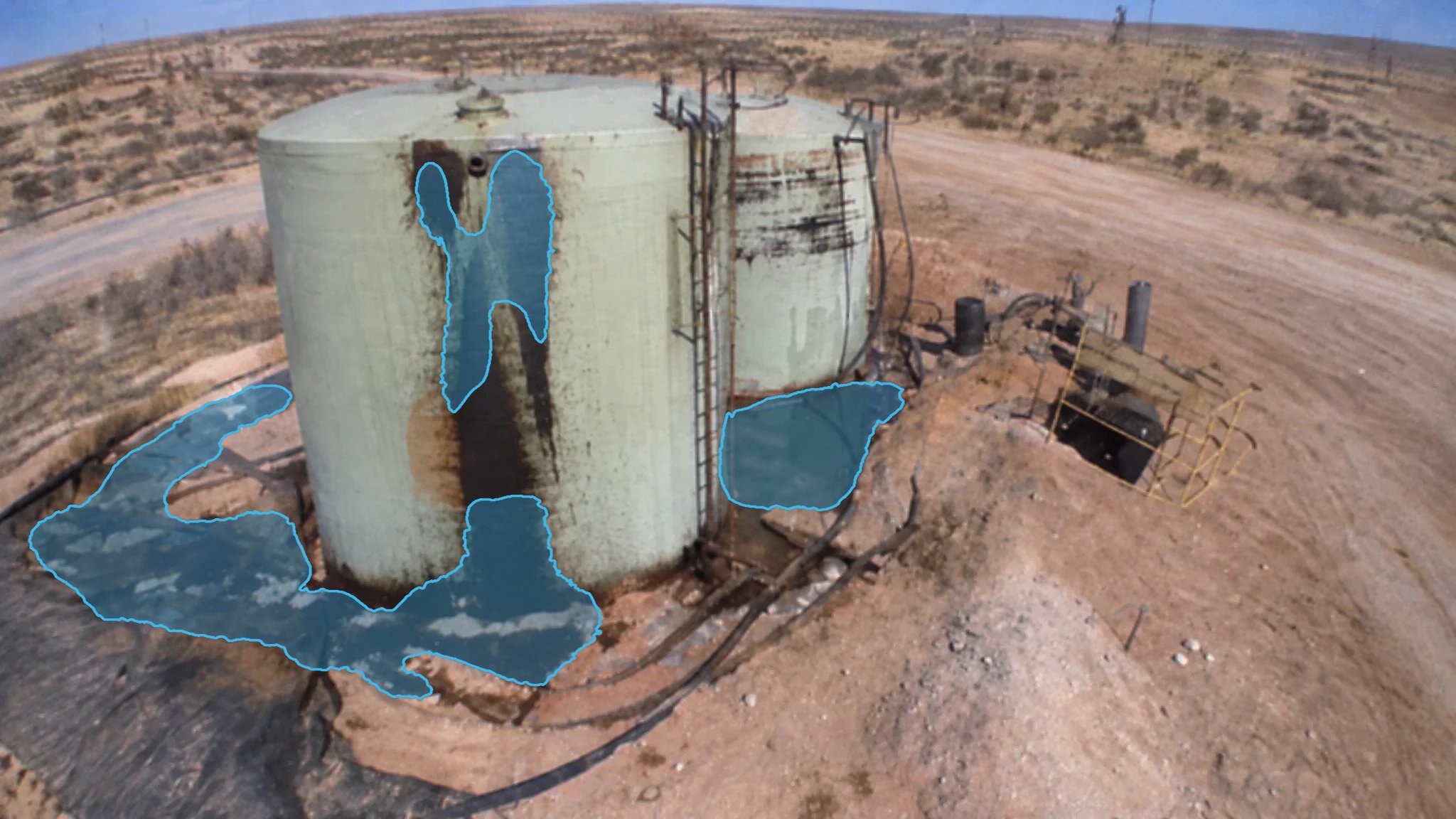
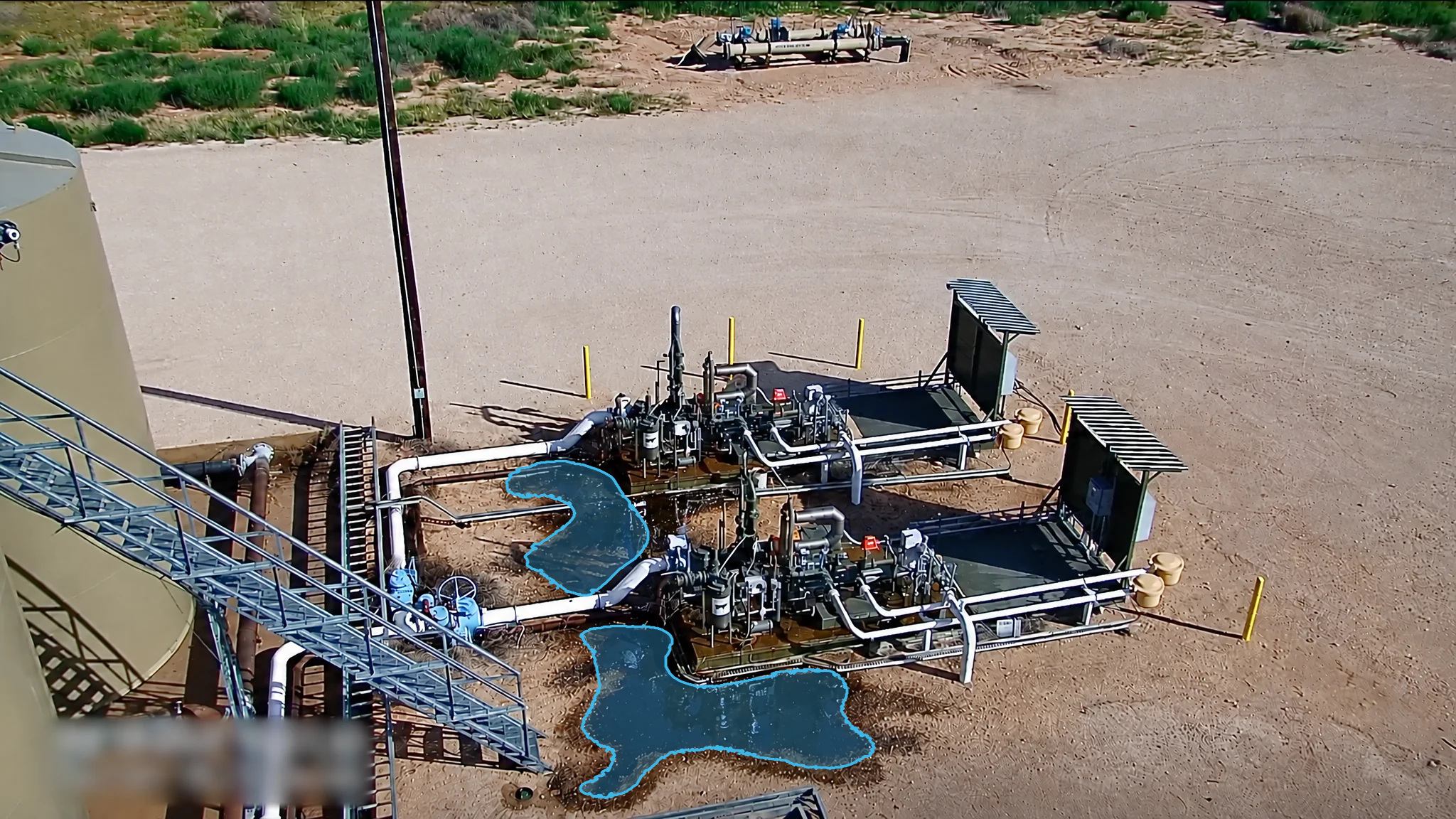
Aerial view of a tank battery with the V4 overlay marking a puddle inside the containment.
Where leaks start in oil and gas
Liquid is everywhere between the wellhead and the refinery gate: crude, condensate, produced water, glycol, methanol, lube oil and diesel. Most of it moves through fittings, seals and flanges that were tightened years ago. A stuffing box on a pump jack starts to weep. A dump valve on a separator sticks and a tank overfills. A flowline pinholes at a bend, a LACT meter run drips at the strainer, a load-out hose is dropped in a hurry. None of this is loud. It is a wet spot on the pad that grows until a pumper, a landowner or a regulator notices it, and every extra mile on the pumper's route to check for one is LOE.
Sites and assets
Well pads: pump jacks, wellheads, stuffing boxes, chemical injection skids
Tank batteries and CTBs: oil and water tanks, containment, thief hatches, drains
Saltwater disposal (SWD) facilities and produced-water handling
Flowlines, gathering lines and pipeline right-of-way, valve sites, pig launchers and receivers
Pump and compressor stations
Terminals, loading racks and shore or rail transfer points
Refinery units and tank farms
What V4 watches for
Puddle: crude, condensate or produced water pooling on the pad, inside or outside containment, under a tank, at a valve set, along a flowline or in a ditch
Spray: a directional jet from a seal, packing, flange, gasket or hose under pressure
Vapor: a plume that is visible to the camera at a compressor, a pressure relief, a hot-oil line or a flashing condensate release
Use cases
01
Tank batteries and SWDs
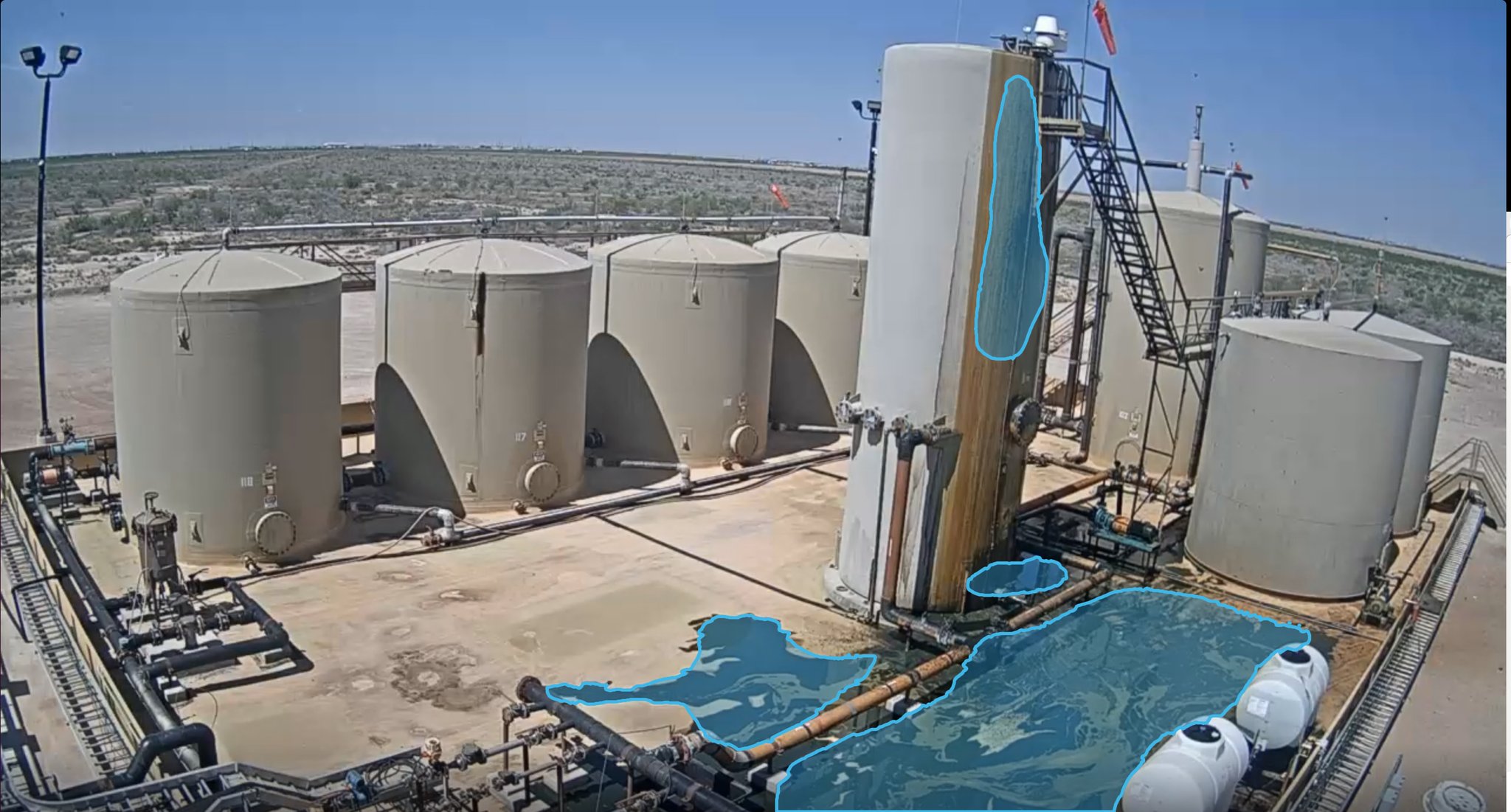
A tank battery or saltwater disposal is checked when someone drives to it. Between visits, a weeping fitting, a failed seal or an overfilled tank has hours or days to put product on the ground. V4 runs on the camera that already watches the pad, or on a server fed by it, and looks at the containment, the load-out and the piping every few seconds. When a puddle appears and grows, the alarm stages up from green to red and lands in your VMS and your SCADA with a snapshot attached.
Tank battery — puddle detected
02
Aging remote infrastructure
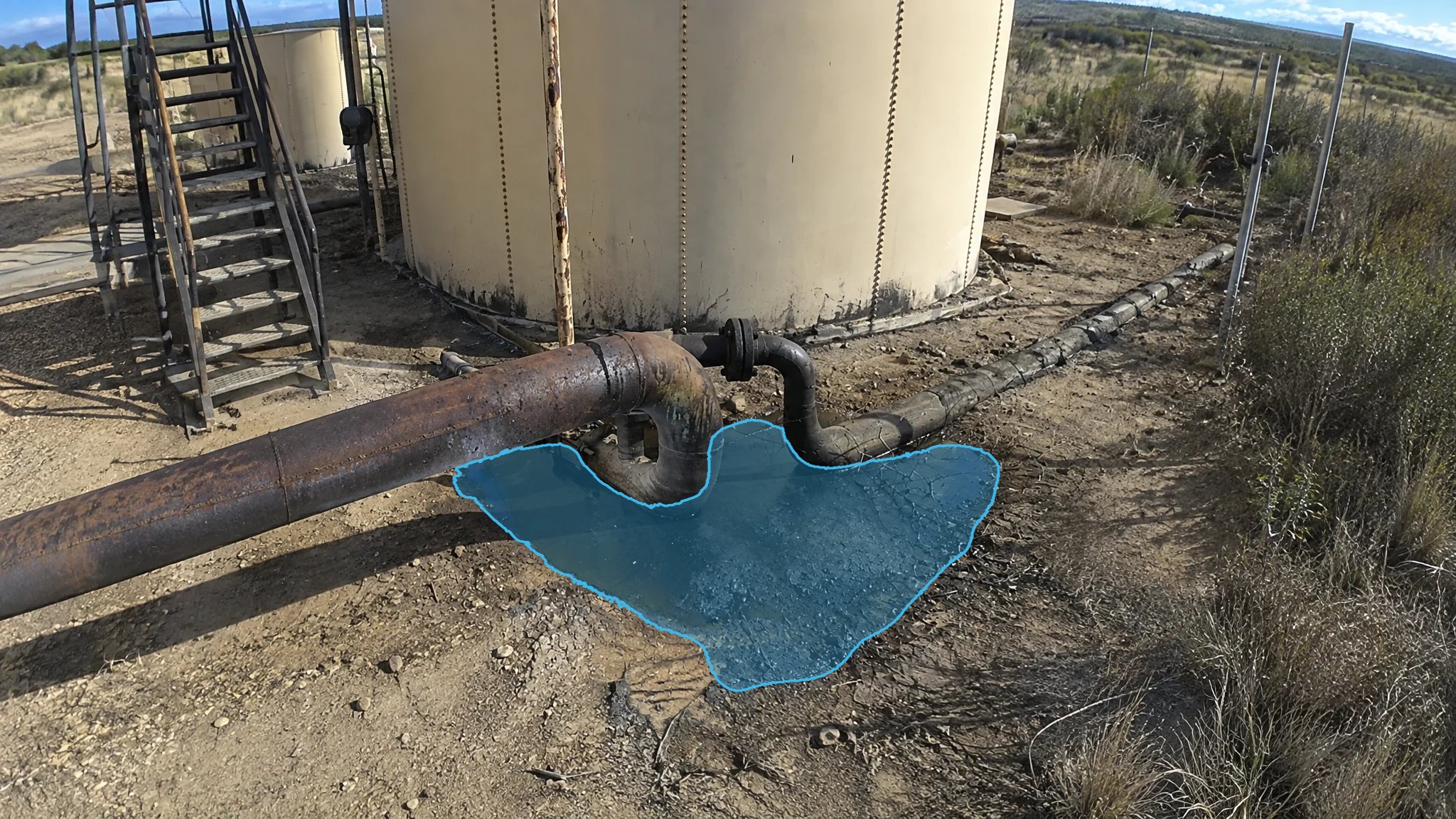
The sites most likely to leak are the oldest ones, and the oldest ones are usually the farthest from a road. A pumper's route cannot visit all of them every day. V4 gives each one a continuous watch without new hardware: one camera channel per site, nothing processed in the cloud, no per-site training. The camera reports in over whatever link the site already has, and a release that would have waited for the next visit is reported in seconds.
Remote well site — puddle detected
03
Midstream pump stations
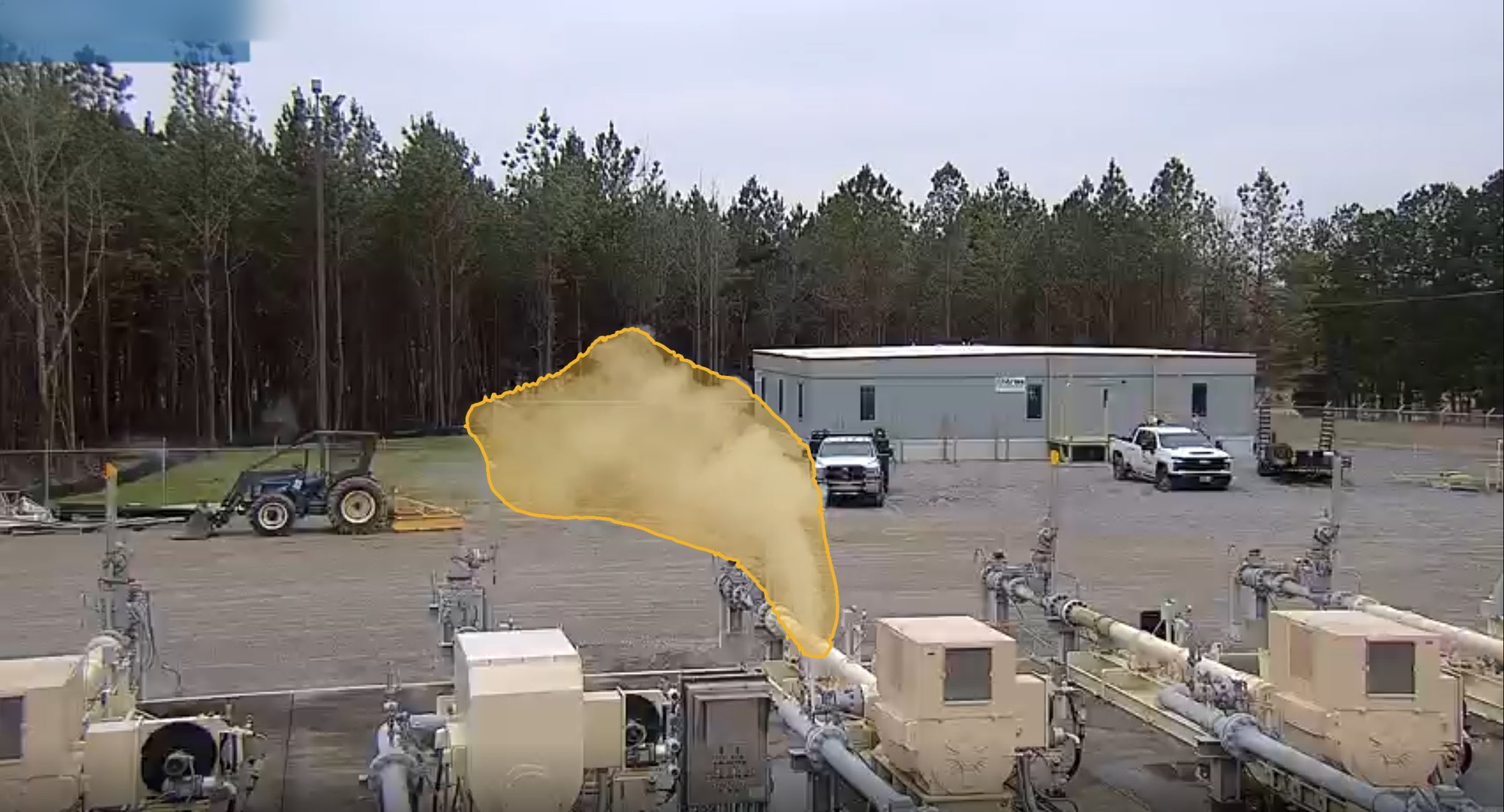
Pump and compressor stations hold the pressure, so a failure here is a spray or a vapor plume before it is a puddle. V4 detects all three signatures in one license: pooling liquid, directional spray from seals, fittings and flanges, and vapor that is visible to the camera. Alarms publish over MQTT as JSON or Sparkplug B, pre-mapped into Ignition, so the control room sees the event on the same screens it already watches.
Compressor station — visible vapor detected
04
LACT units and truck load-out
Custody transfer is where crude leaves the lease, and where hoses get dropped, camlocks get crossed and strainers get opened in a hurry. A drip at the LACT skid or under the trailer runs until the driver looks down. The camera on the load-out canopy or the LACT pole already frames the rack. V4 draws an interest zone around the skid, the hose connection and the apron under the trailer, and an exclusion zone over the truck lane. A puddle under the hose lands in the VMS and, through a webhook, with the gauger or the hauler's dispatcher.
LACT and truck load-out — puddle detected
05
Pipeline right-of-way and valve sites
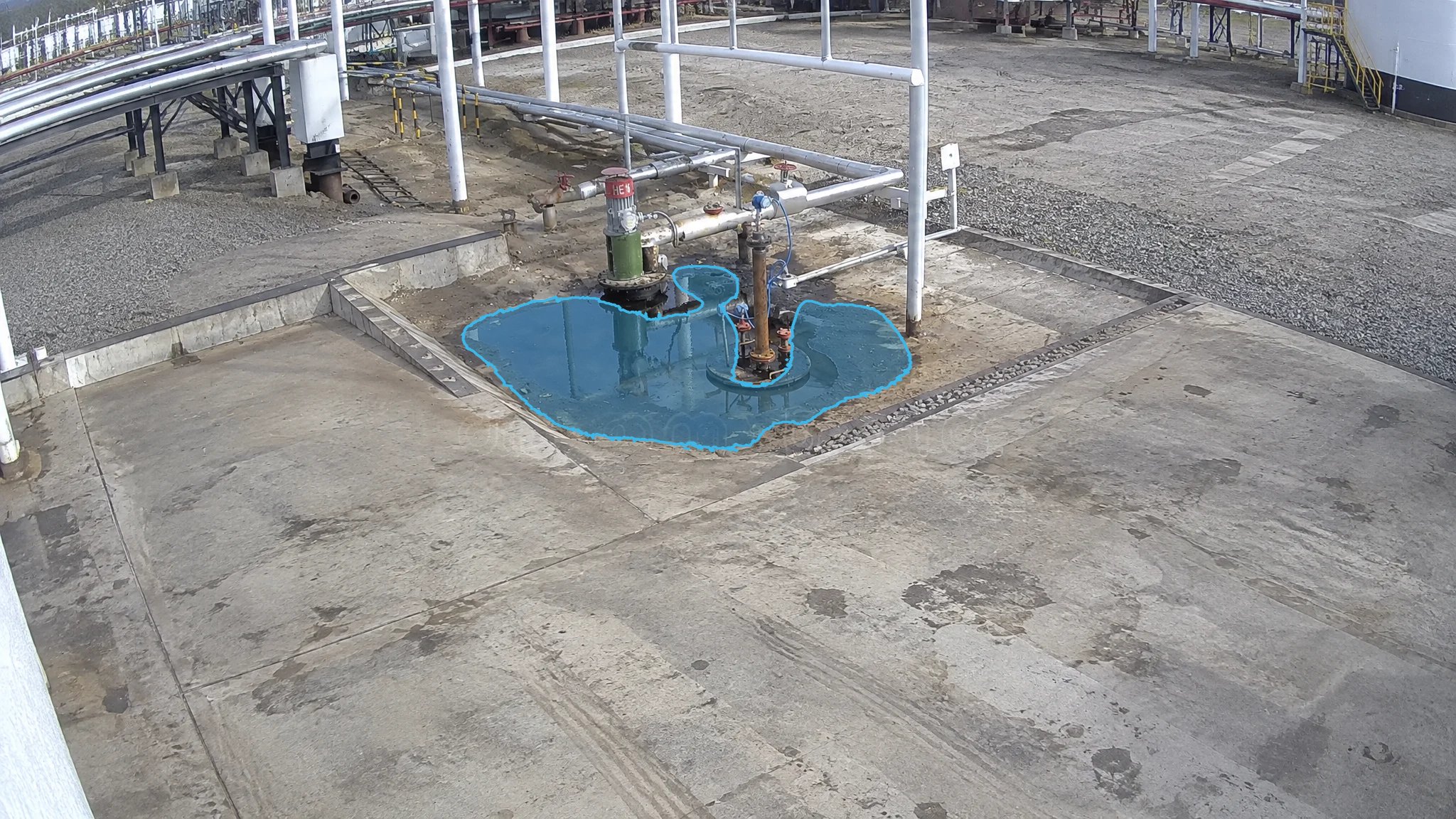
A mainline valve site or a pig launcher sits in a fenced yard with a camera on the pole for security. The same camera can watch the ground around the valve set, the launcher door and the low spot in the ditch where a weeping flange drains to. V4 watches that view every few seconds. A puddle below the flange, a spray from a packing gland or visible vapor at a blowdown is reported into the pipeline control center over MQTT, with the overlay snapshot, before it reaches the fence line.
Pipeline right-of-way — puddle detected
Why it matters in oil and gas
The reporting clock starts at one barrel.
In Colorado, one barrel or more of oil or E&P waste spilled outside berms or secondary containment must be reported within twenty-four hours of discovery. In Texas, an oil loss of more than five barrels must be reported, and New Mexico requires a written release report above five barrels and 24-hour notice at twenty-five.
Time undetected is the cost driver.
One midstream produced-water leak in North Dakota ran 143 days before the operator confirmed it, and the operator pleaded guilty to negligently discharging and failing to report, paying $35 million in criminal and civil penalties. SPCC plans already require operators to inspect containers, valves and piping on a regular schedule and to promptly correct visible discharges; a camera that never stops watching is the gap-filler between those inspections, not a replacement for them.
Every alarm is evidence.
Each alarm carries a timestamp, the original frame and the overlay frame, written the moment the release is detected. When the question is what was seen and when, the record already exists.
How it is deployed in oil and gas
On-camera
Most pads already have one or two Axis cameras on the pole for security. VisionAery Liquid Leak Detection installs on Axis ARTPEC-9 cameras today, with Hanwha Wisenet 9 following on November 15, 2026. Interest zones go around the containment, the separator skid, the wellhead and the load-out; exclusion zones cover the road and the parking spot. A PTZ on a tour gets its own zones at each preset and detects as the tour reaches that stop. Nothing leaves the site except the alarm and its snapshots, so the link that already carries the SCADA poll is enough.
On-server
Stations, terminals and refineries with a mixed camera fleet or an existing VMS run V4 on-server: Emerson PACEdge industrial PCs, an x86 box with an integrated Intel GPU or an NVIDIA GPU, or an NVIDIA Jetson, all shipping November 15, 2026. The server takes RTSP from any H.264 camera, including cameras in rated housings in classified areas, so the fleet does not change. One server watches many channels and returns an overlay stream per channel to the VMS.
Integrations
On-camera, alarms are native camera events into the VMS through the Axis event engine or Hanwha camera events. On-server, alarm triggers go into Nx Witness, Wisenet WAVE, Milestone and AXIS Camera Station with an overlay RTSP stream per channel. Alarms publish over MQTT as JSON or Sparkplug B, pre-mapped for Ignition, and into DeltaV over MQTT on Emerson; HTTPS webhooks reach email, SMS, ticketing or a BMS.
Rain
A rain gate pauses detection while it rains and for a forgiving window afterwards. It takes its signal from a rain sensor on the camera's I/O port, an I/O module or a weather service, and a failed weather lookup never blocks detection.
Measured, not promised
Measured on 9,147 previously unseen frames, including true positives and negatives, out of the box with no per-site training, before the alarm engine is applied.
F-score
Detection rate
False positive rate
Puddle
0.889
97.1%
0.8%
Spray and visible vapor
0.923
98.1%
3.7%
F-score is the pixel-level harmonic mean of precision and recall. Frame-level figures; the alarm engine's staging, persistence and color-confidence checks exist so that a false frame does not become a false alarm.
Scenarios outside those tested are not covered by these figures.
Detection within seconds · Installed and configured in under 30 minutes · About 25 pixels per foot on target, nothing else
At a Permian Basin producer, VisionAery Liquid Leak Detection runs fully at the edge, integrated with the site's Genetec video platform and alarming into the SCADA control room. In under a year it caught and reported three real leaks.
Detection depends on the view, lighting and image detail. VisionAery Liquid Leak Detection does not identify chemical composition, detect invisible gas or measure concentration, depth or volume. It supports, not replaces, inspections, required instrumentation, cleanup protocols and safety procedures.
Questions
Frequently asked questions
Does this replace my pumper's route or my AVO inspections?
No. Federal rules set audio, visual and olfactory inspections at fixed intervals for sites covered by them, and your state and company programs set their own. V4 watches between those visits, every few seconds, day and night. What that means for your inspection schedule is your decision; VisionAery makes no regulatory or compliance claim.
Can it tell crude from produced water?
No. V4 reports a puddle, a spray or visible vapor and where in the frame it is. It does not identify the liquid, measure its volume or estimate a barrel count. The snapshot tells your people what to go look at; the person on site decides what it is and whether it is reportable.
Will it alarm on a rain puddle, a shadow or a stained pad?
The rain gate pauses detection while it rains and for a window afterwards. A color-confidence check separates liquid from shadow and stain, and the alarm engine requires a detection to persist and grow before it stages up from green to red. V4 was field-tested through all four seasons, day and night, in rain, snow, wind and fog.
Can one camera cover a tank battery?
Often. V4 needs about 25 pixels per foot on the area you want to watch; distance and leak size do not matter on their own. A 4 MP camera on the existing pole watching a 60-foot-wide pad is typical. A larger battery or a station is covered by a second camera or a PTZ on a tour with zones at each preset.
How does the alarm reach the control room?
Over MQTT as JSON or Sparkplug B, to your broker or to an embedded broker on the camera that bridges to yours. Sparkplug B publishes the camera or server as an edge node with zone and alarm metrics as a tag tree, pre-mapped for Ignition so the tags auto-discover in MQTT Engine. On Emerson PACEdge the same feed goes into DeltaV. A webhook posts JSON, with snapshots if you want them, to any URL.
Put a continuous watch on every pad, station and valve site you cannot visit every day.