Bunds, pump pads and loading racks, watched every few seconds.
VisionAery Liquid Leak Detection runs on the cameras already covering your tank farm, process units and transfer points. It marks a puddle inside a bund, spray at a flange or mechanical seal, and visible vapor at a vent or valve, and alarms into the VMS and the control system in seconds.
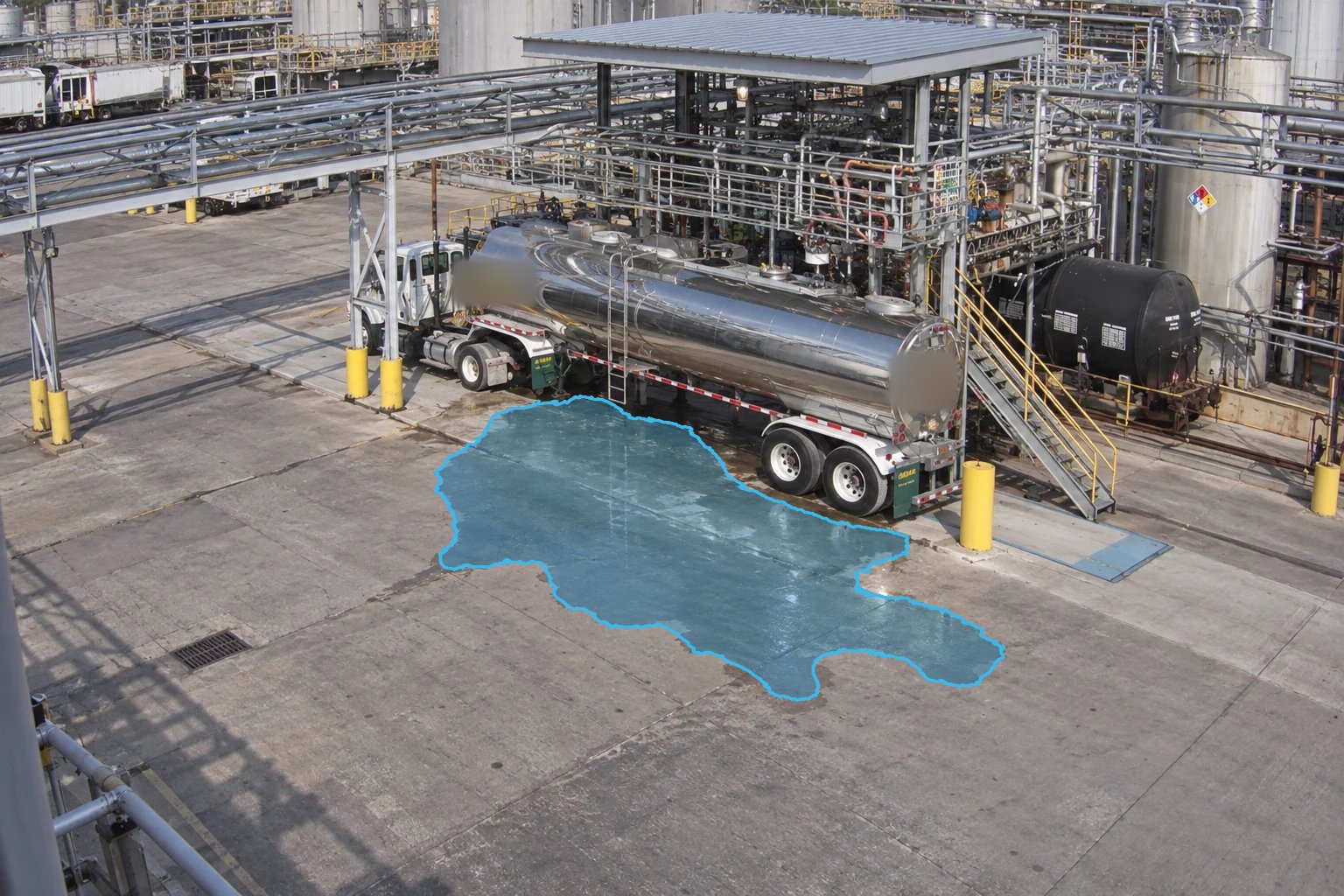
Tanker loading bay at a chemical plant with the V4 overlay marking a puddle under the transfer hose.
Where leaks start in chemical and petrochemical
A chemical site moves liquid through more joints than anyone can walk in a shift. Acid, caustic, solvent and monomer sit in tanks inside bunds; pumps move them across pads and up pipe racks; tankers and rail cars take them on and off at loading racks; drums and IBC totes hold the rest. Releases start where something moves or is disturbed: a flange gasket that relaxed after a thermal cycle, a mechanical seal on a pump, a hose coupling at the rack, a tote valve nudged by a forklift, a sample point left cracked open. Most are small at first, and most are found by the next person to walk past.
Sites and assets
Tank farms and bunded containment
Pump pads and pipe racks
Truck loading racks and tanker transfer bays
Rail car unloading spots
Drum and IBC tote storage, indoors and out
Process units and unit battery limits
Cooling towers and circulating-water pump pads
Chemical feed and dosing skids
Sumps, trenches and containment drains
What V4 watches for
Puddle: acid, caustic, solvent, monomer, process water or cooling-tower water pooling on a pad, in a bund corner, under a tote or between the rails at an unloading spot.
Spray: a pressurized fan from a flange, a gasket, a mechanical seal, a hose coupling or a pinhole in a process line.
Vapor: a visible plume at a vent, a relief, a valve stem or a leaking line, including a fuming acid surface or a release that forms a visible cloud. V4 does not detect a gas that cannot be seen, and it does not identify which liquid it is looking at.
Use cases
01
Bunded tank farms
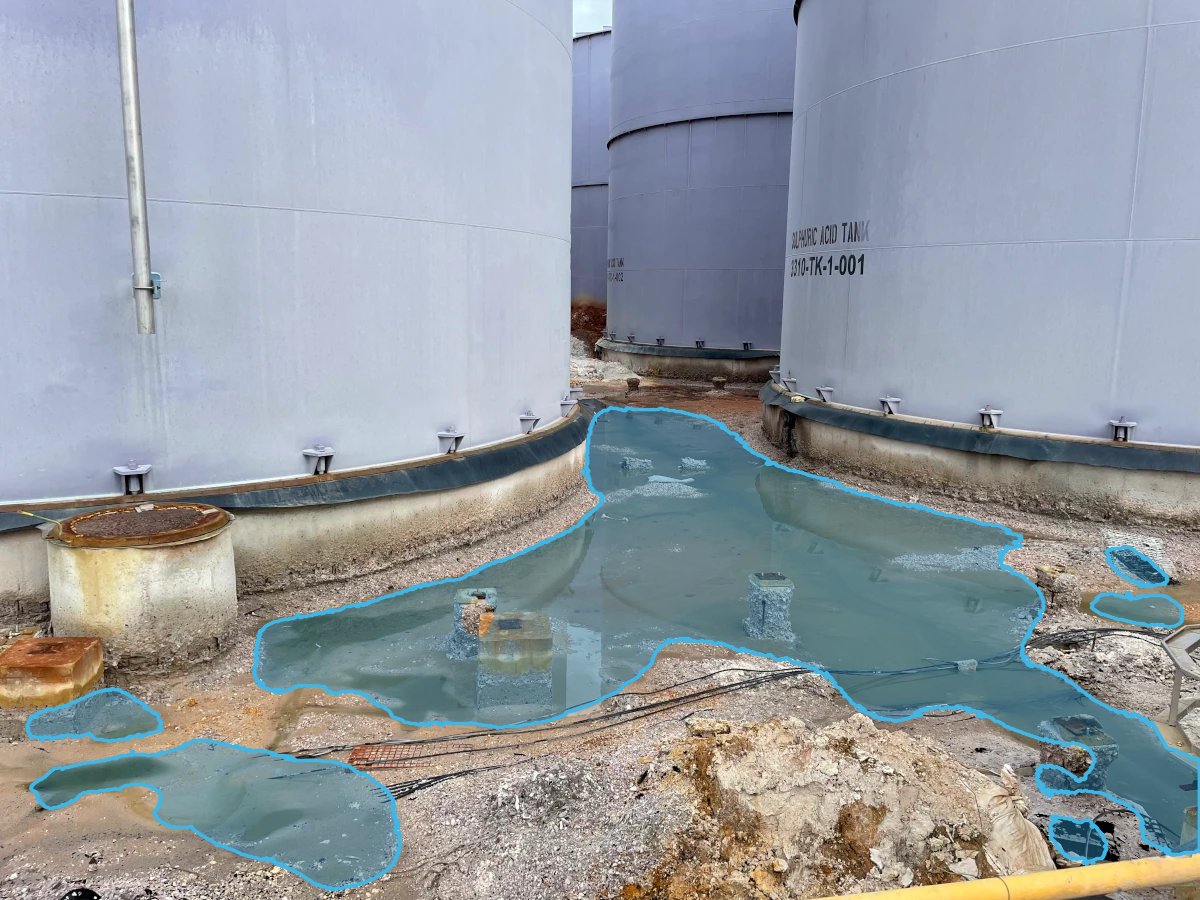
Containment does its job, and nobody knows until the next round. A weeping tank nozzle or a bund drain valve left cracked puts liquid in the low corner of the bund, where it sits until an operator looks over the wall. V4 watches the bund floor from the pole camera that already covers the farm, with an interest zone drawn on the containment and an exclusion zone on the road outside it. When liquid appears and grows, the alarm stages up from green to red and lands in the VMS with the snapshot that shows which bund and which corner.
Acid tank containment — puddle detected
02
Pump pads and mechanical seals
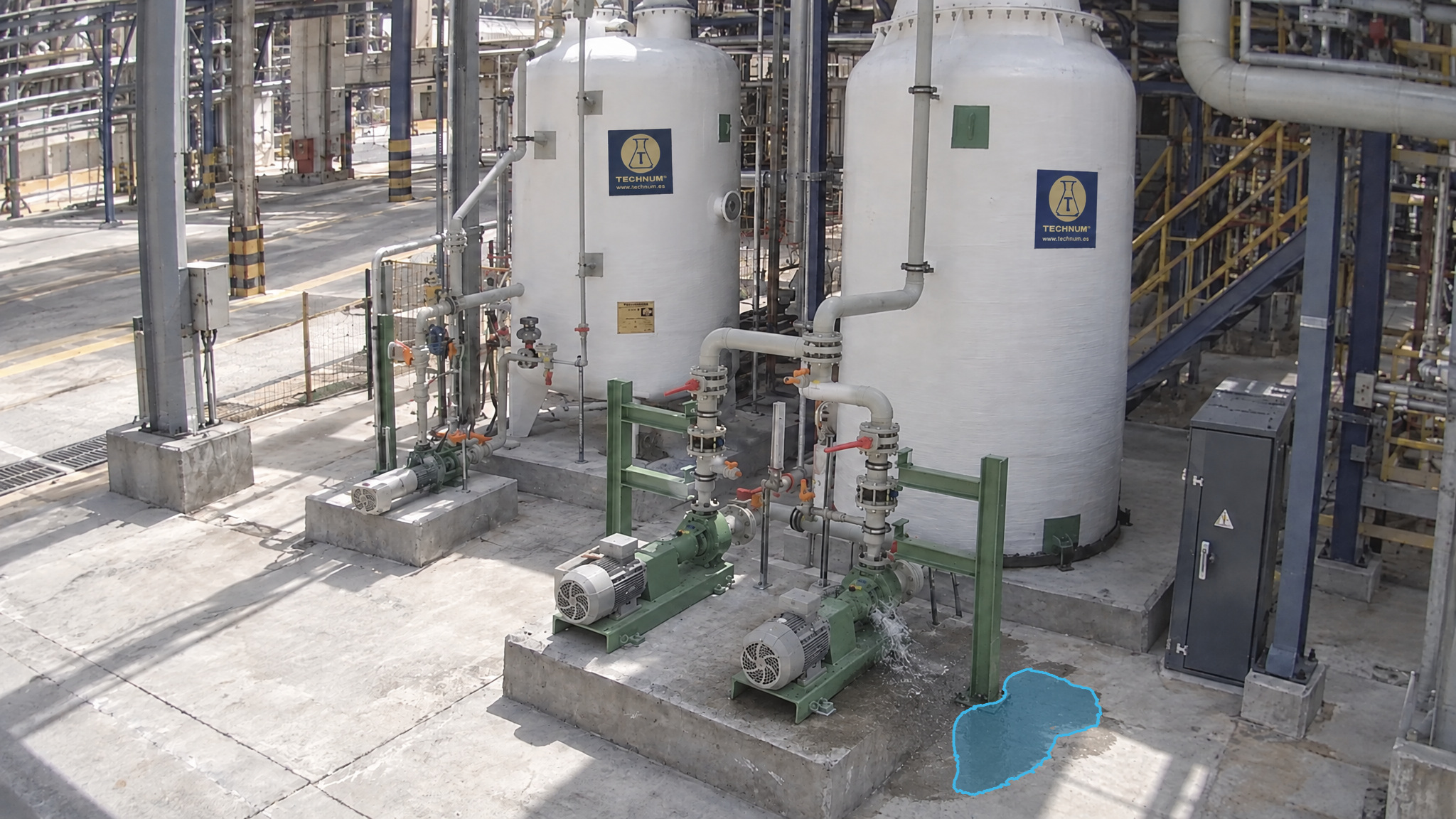
A mechanical seal fails as a drip, then a stream, then a spray. On a pad with a dozen pumps the unit operator's rounds may be hours apart, and the pad is often behind a sound wall or under a pipe rack. A fixed camera side-on to the pump row gives V4 a view of every seal and every discharge flange; a PTZ on a tour covers several pads with its own interest zones at each preset. Spray is reported within seconds of appearing, and the alarm reaches the control room over MQTT next to the pump's own tags.
Pump pad — spray and puddle detected
03
Loading racks and tanker transfer
Hose couplings and loading arms are connected and broken many times a day, and every disconnect is a chance for liquid on the ground. The driver is at the cab, the operator is at the panel, and a dripping coupling behind the trailer can run for the whole transfer. A canopy or pole camera over the rack gives V4 a view of the transfer point and the spill pad under it. A puddle under the coupling is reported before the tanker pulls away, with a timestamped snapshot that records which bay and which load.
Tanker loading bay — puddle detected
04
Drum and tote storage
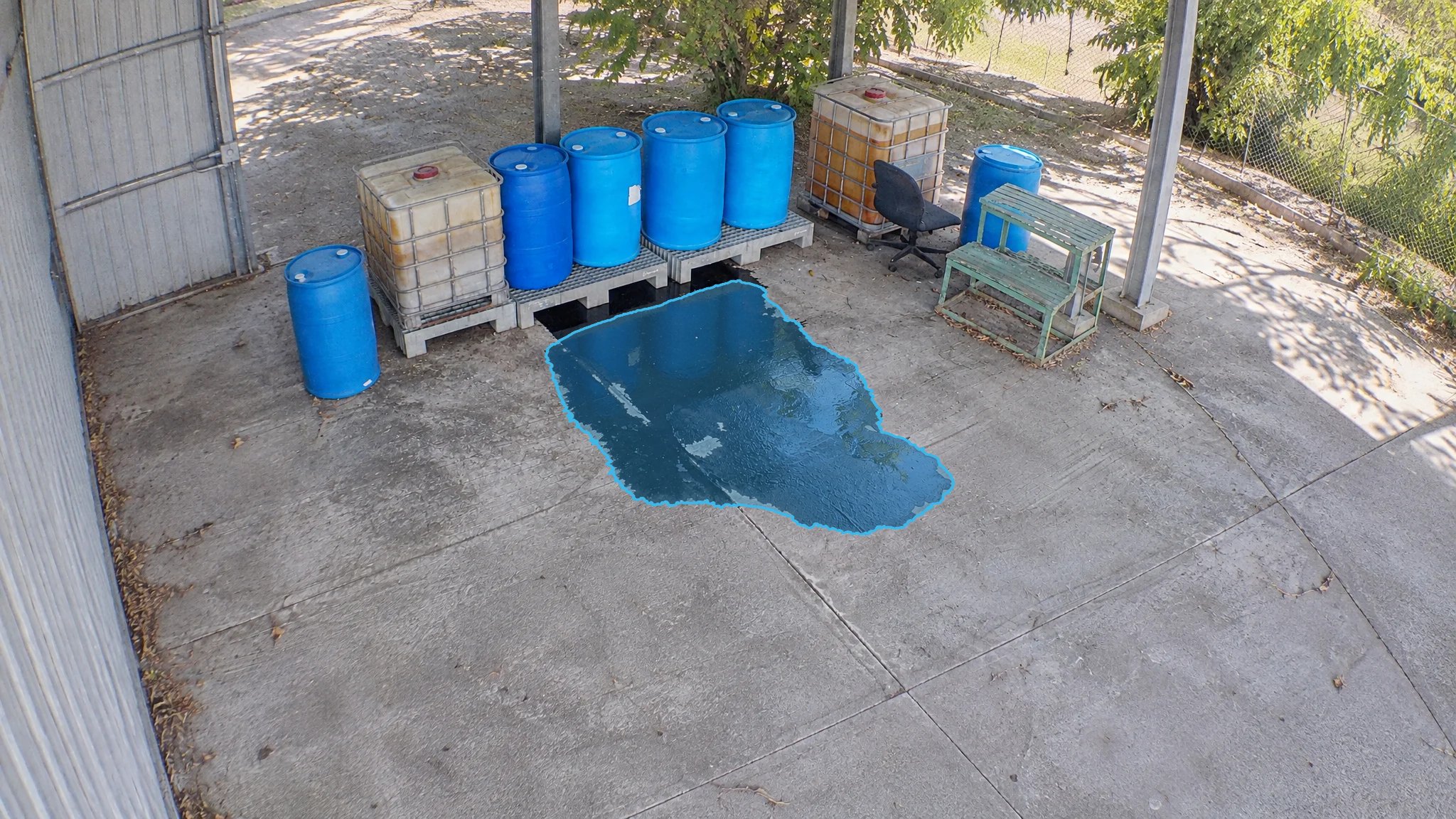
A drum bung, a rust-through at the chime or a tote bottom valve weeps slowly on a sealed floor and spreads thin. In a warehouse that is walked once a shift, a solvent puddle can be a meter across before anyone sees it. The ceiling cameras that already watch the racking give V4 a view down each aisle, and the color-confidence check keeps shadow and old floor stain from raising an alarm. The event goes to the VMS and, through a webhook, to the ticketing system that dispatches the spill response.
Drum storage — puddle detected
Why it matters in chemical and petrochemical
Process safety names the equipment that leaks.
OSHA's Process Safety Management standard, 29 CFR 1910.119, applies to a process with a listed chemical at or above its threshold quantity, or 10,000 pounds or more of a flammable liquid with a flash point below 100 °F in one location. Its mechanical integrity paragraph covers storage tanks, piping systems and their valves, relief and vent systems and pumps, and an incident investigation must start no later than 48 hours after the incident.
Containment is required; watching it is up to you.
EPA's Risk Management Program, 40 CFR 68, applies to a stationary source with more than a threshold quantity of a regulated substance in a process; chlorine is listed at 2,500 pounds and anhydrous ammonia at 10,000. Where oil is stored in more than 1,320 gallons aggregate aboveground capacity, the SPCC rule, 40 CFR 112, calls for secondary containment sized to the largest container and regular inspection of containers, valves, piping and appurtenances; neither rule says how the containment is to be watched between inspections.
The record is written the moment it is seen.
Under the Clean Water Act rules an oil discharge that causes a film or sheen on the water is one that may be harmful, and the person in charge must notify the National Response Center immediately; a release of a listed hazardous substance at or above its reportable quantity must be reported immediately to state and local responders. Every V4 alarm carries a timestamp and the original and overlay snapshots, so the record of what was seen, and when, exists before anyone writes the report.
How it is deployed in chemical and petrochemical
On-camera
Axis ARTPEC-9 cameras run V4 now; Hanwha Wisenet 9 cameras ship November 15, 2026. This is the fit for the pole and rack cameras over tank farms, loading racks and rail spots, where the camera is the only equipment on the pole and the alarm leaves as a native camera event. Interest zones and exclusion zones are drawn on the camera's own picture; a PTZ on a tour carries its own zones at each preset. V4 adds no hardware to a rated enclosure; whether a camera is suitable for a classified area is a question for the camera's certification, not for the software. Nothing is processed in the cloud.
On-server
For a mixed fleet, for indoor cameras of any make, or for a unit that already runs on Emerson, one server watches many camera channels: an Emerson PACEdge industrial PC, an x86 server with an integrated Intel GPU or an NVIDIA GPU, or an NVIDIA Jetson, all shipping November 15, 2026, taking RTSP from any H.264 camera. The server sits in the control room or the MCC beside the VMS and the historian, and an overlay RTSP stream per channel can go onto the control room wall. On Emerson PACEdge the same alarm feed goes into DeltaV over MQTT; on Ignition the tags auto-discover.
Integrations
Native camera events into the VMS (Axis event engine, Hanwha camera events); on-server, alarm triggers into Nx Witness, Wisenet WAVE, Milestone and AXIS Camera Station and an overlay RTSP stream per channel; MQTT as JSON or Sparkplug B, pre-mapped for Ignition, and into DeltaV over MQTT on Emerson; HTTPS webhooks to email, SMS, ticketing or a BMS.
Rain
A rain gate pauses detection while it rains and is forgiving for a window afterwards, fed by a rain sensor on the camera's I/O port, an I/O module or a weather service; a failed weather lookup never blocks detection.
Measured, not promised
Measured on 9,147 previously unseen frames, including true positives and negatives, out of the box with no per-site training, before the alarm engine is applied.
F-score
Detection rate
False positive rate
Puddle
0.889
97.1%
0.8%
Spray and visible vapor
0.923
98.1%
3.7%
F-score is the pixel-level harmonic mean of precision and recall. Frame-level figures; the alarm engine's staging, persistence and color-confidence checks exist so that a false frame does not become a false alarm.
Scenarios outside those tested are not covered by these figures.
Detection within seconds · Installed and configured in under 30 minutes · About 25 pixels per foot on target, nothing else
Detection depends on the view, lighting and image detail. VisionAery Liquid Leak Detection does not identify chemical composition, detect invisible gas or measure concentration, depth or volume. It supports, not replaces, inspections, required instrumentation, cleanup protocols and safety procedures.
Questions
Frequently asked questions
Does V4 know whether the puddle is acid, caustic or water?
No. It reports that liquid is pooling, spraying or forming a visible plume inside an interest zone, and where. Which liquid it is, and how much, is for the operator to establish from the snapshot and the process. V4 measures neither volume nor concentration.
Can it see a chlorine or ammonia release?
Only when a release forms a visible cloud. V4 detects what the camera can see: a puddle, a pressurized spray or vapor that is visible in the picture. It does not detect an invisible gas and is not a substitute for a gas detector. Where a release is visible, V4 flags it like any other leak.
Steam and fuming are normal on my unit. Will that alarm all day?
Draw the interest zones on the places you want watched, such as a pump seal, a flange row or a bund floor, and exclusion zones on the vents, steam traps and tower plumes that are always there. Detection only happens inside an interest zone, and the alarm engine's staging and persistence checks mean a single frame does not become an alarm.
How does it reach DeltaV or Ignition?
Over MQTT, as JSON or Sparkplug B, to your broker or to an embedded broker on the camera that bridges to yours. Sparkplug B publishes the camera or server as an edge node with zone and alarm metrics as a tag tree, pre-mapped for Ignition so the tags auto-discover in MQTT Engine. On Emerson PACEdge the same Sparkplug B feed goes into DeltaV. For anything else, an HTTPS webhook posts JSON, with snapshots if you want them, to any URL.
Does it help with my PSM or RMP program?
VisionAery makes no compliance claim and V4 does not satisfy any inspection requirement on its own. What it gives you is a continuous watch between rounds and, for every alarm, a timestamped record with the original and overlay snapshots. How that fits your mechanical integrity program, your containment inspections or your release reporting is your decision.
Put a continuous watch on every bund, pad and rack between rounds.