
VisionAery

    Electrical utilities / Transformer oil leak monitoring

    A watch on the base. Between every visit.

    Transformer oil leak monitoring on the cameras you already have. Watch for visible puddles at remote transformer bases, and give the crew a timestamped view of what changed.

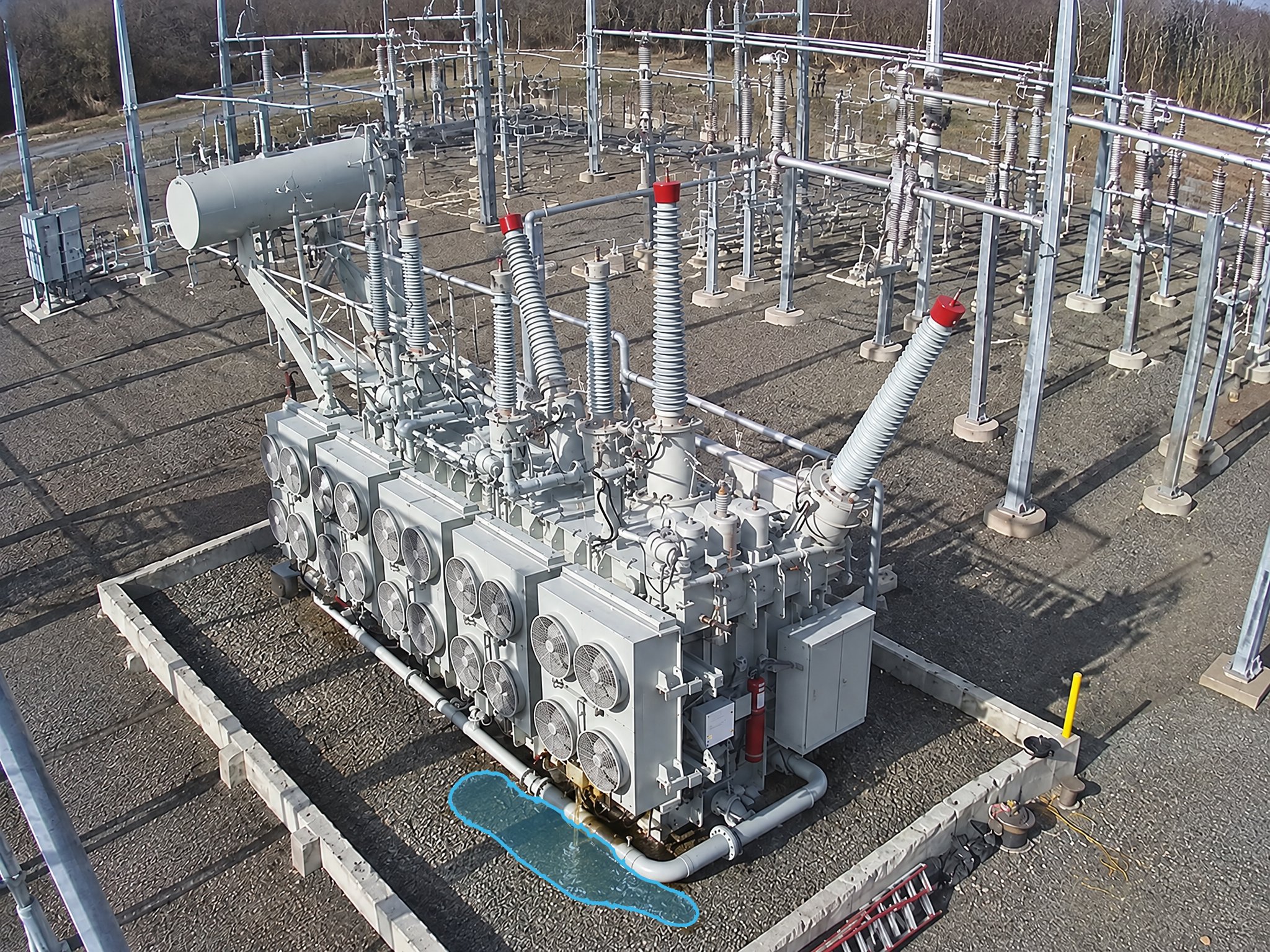
    Frame 01 / Transformer baseV4 overlay
    Substation transformer with the VisionAery overlay marking an oil puddle at its base.
    Substation transformer with the VisionAery overlay marking an oil puddle at its base.
    Transformer base · Detection overlay · 01
    Substation transformer with the VisionAery overlay marking an oil puddle at its base.

    The watch area

    The transformer is remote. The view is already there.

    A power transformer is a steel tank of mineral oil with the places it can leak bolted to the outside: bushing flanges and gaskets, radiator welds and valves, the conservator and its piping, the LTC compartment, pressure relief devices and drain valves. The yard is fenced, remote and walked on a schedule, and gravel hides a slow weep until it reaches the containment or the ditch.

    A radiator weld, a bushing gasket or a packing gland on a drain valve starts to weep. The oil runs down the tank, drips onto the gravel and disappears into it. On the next round the crew finds a dark patch and a conservator level that has been falling for weeks. V4 runs on the yard cameras that are already on the poles, with an interest zone around the base of each unit and an exclusion zone on the tank and radiators. The alarm lands in the VMS and, over MQTT, in SCADA alongside the transformer's own alarms.

    In the camera's view

    Watch where the oil reaches the ground.

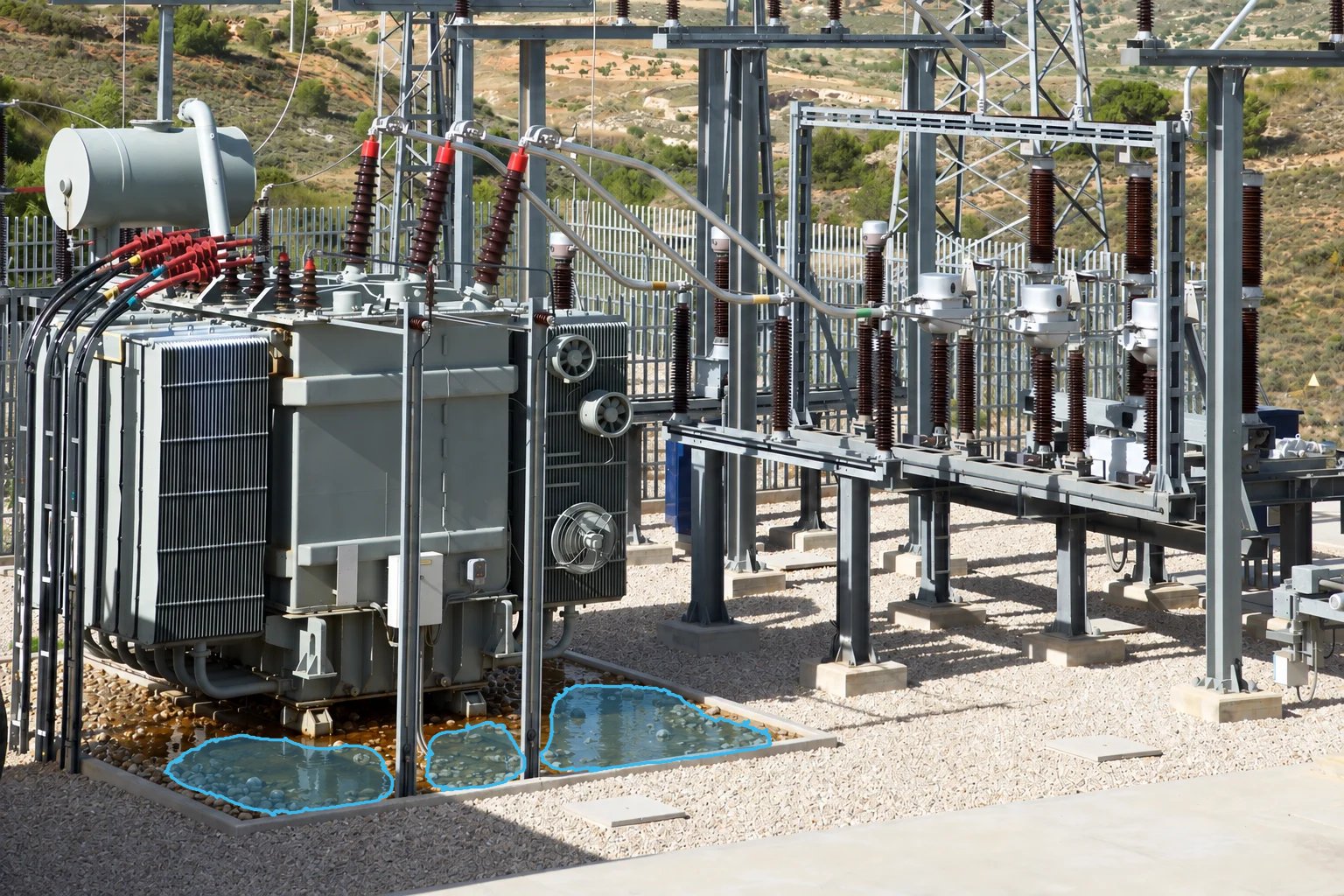
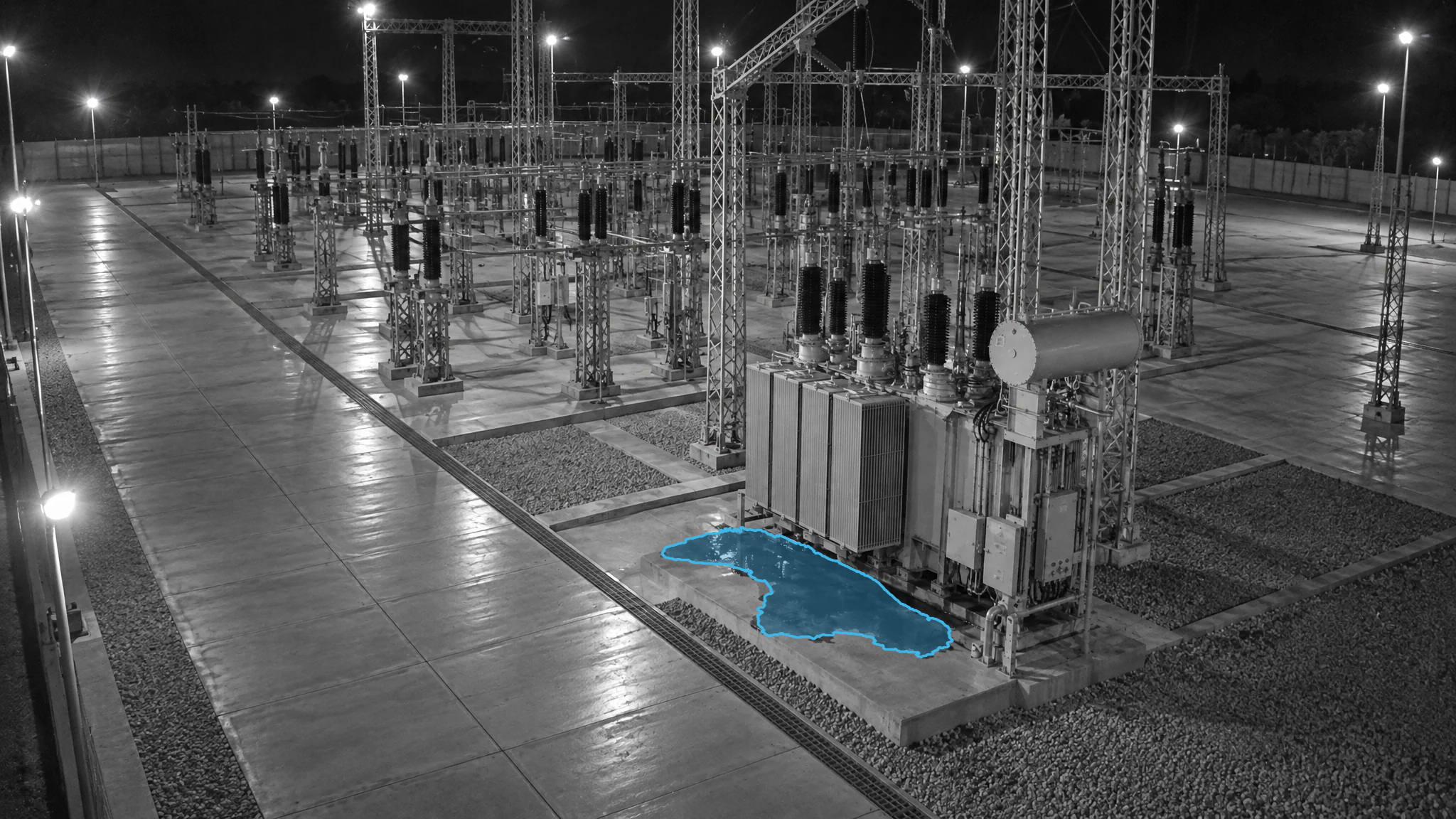
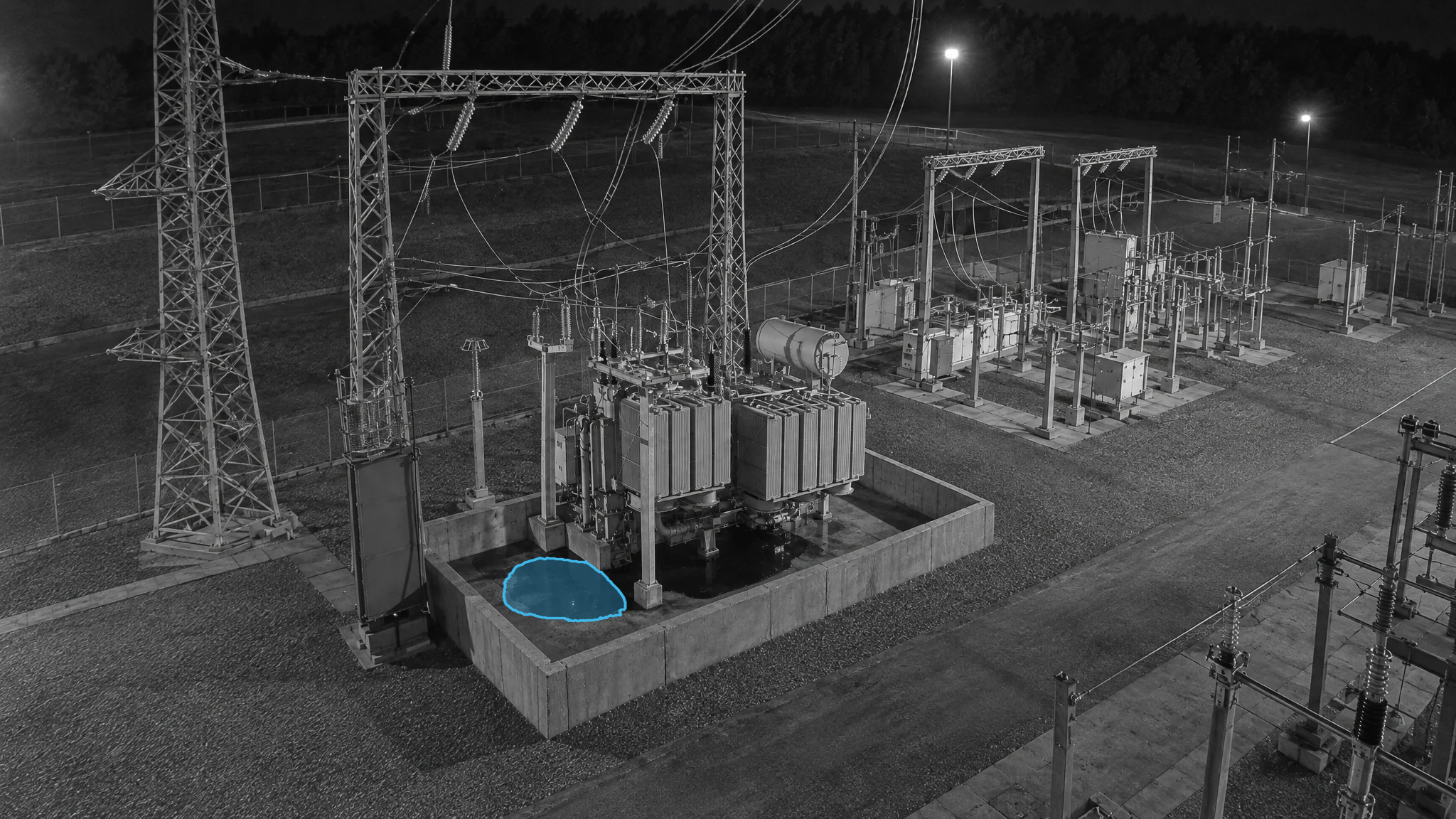
    The blue overlay marks the detected puddle at the transformer base. The full frame preserves the surrounding view for the operator.

    V4 reports a puddle and its location. It does not identify the liquid.

    Frame 02 / Transformer base · Puddle detection overlayV4 overlay
    Substation transformer with a blue detection overlay marking a puddle on the gravel at its base.
    Substation transformer with a blue detection overlay marking a puddle on the gravel at its base.
    Transformer base · Detection overlay · 02
    Substation transformer with a blue detection overlay marking a puddle on the gravel at its base.

    Transformer leaks, day and night

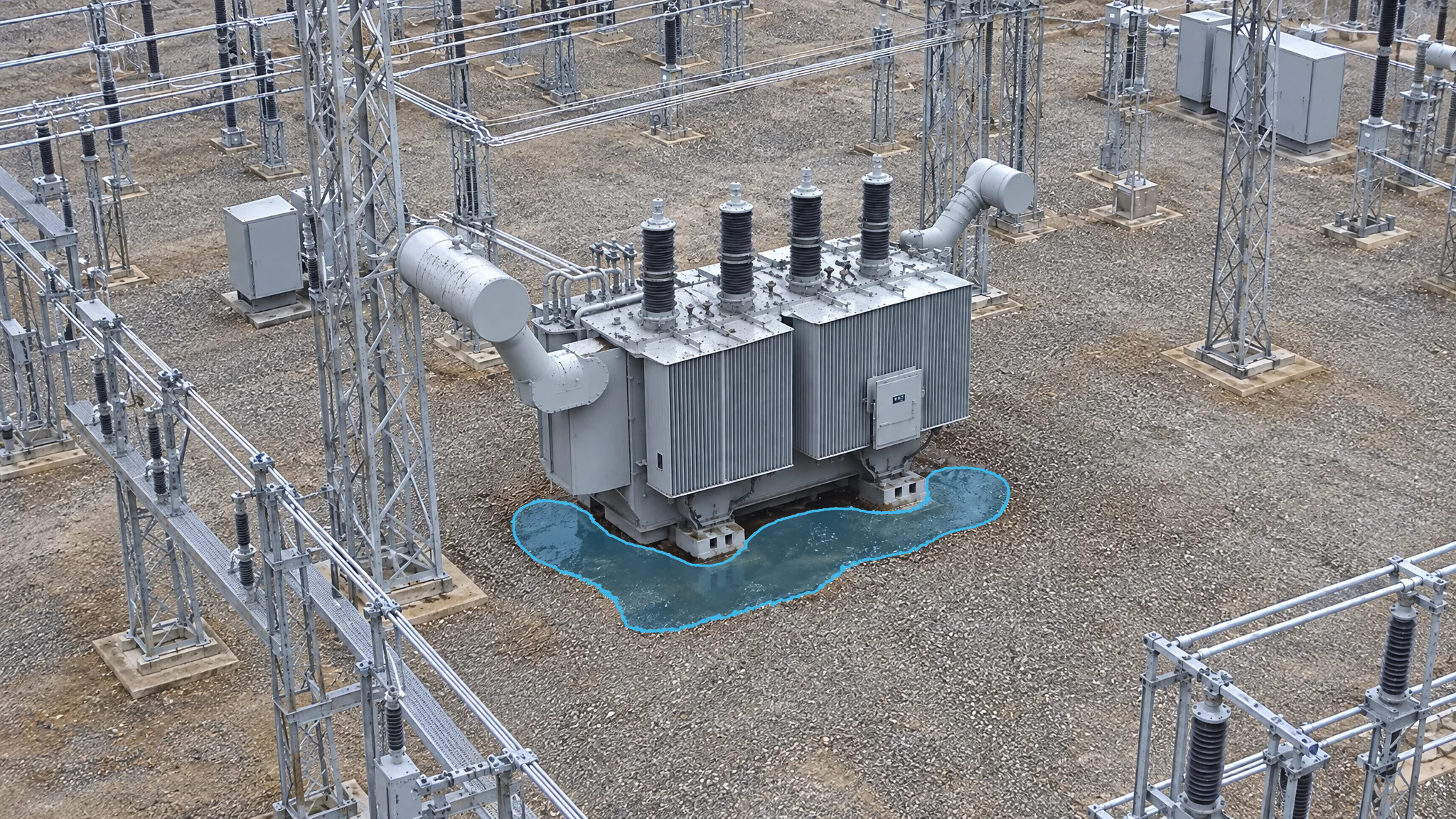
    Frame 03 / Transformer on gravel · DaylightV4 overlay
    Daylight substation view with a blue detection overlay around liquid on the gravel beneath a transformer.
    Daylight substation view with a blue detection overlay around liquid on the gravel beneath a transformer.
    Transformer base · Detection overlay · 03
    Daylight substation view with a blue detection overlay around liquid on the gravel beneath a transformer.
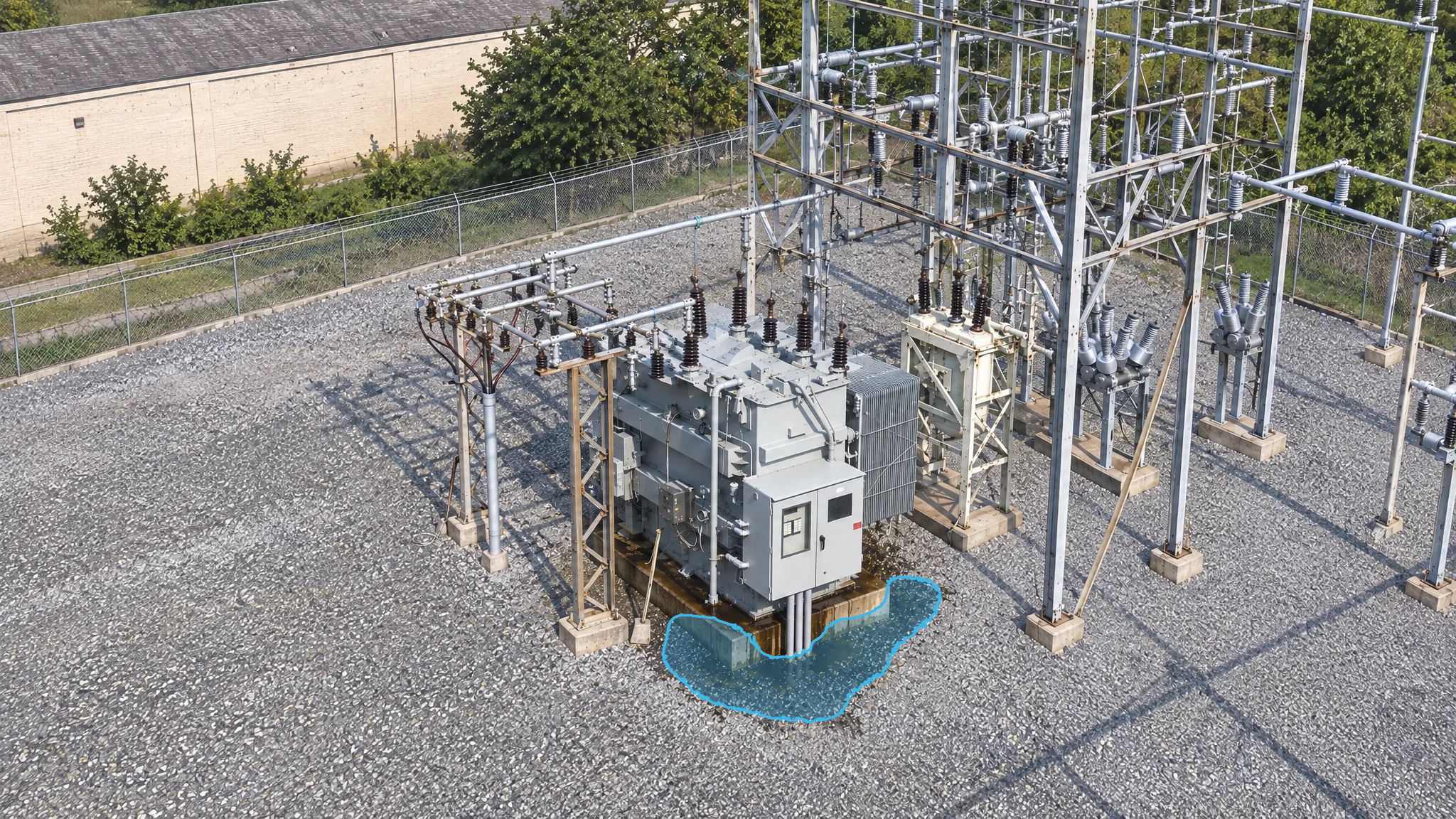
    Frame 04 / Transformer base · DaylightV4 overlay
    Daylight view of a transformer with a blue puddle overlay around its base on the gravel.
    Daylight view of a transformer with a blue puddle overlay around its base on the gravel.
    Transformer base · Detection overlay · 04
    Daylight view of a transformer with a blue puddle overlay around its base on the gravel.
    Frame 05 / Transformer pad · NightV4 overlay
    Monochrome nighttime substation view with a blue puddle overlay on the concrete pad beside a transformer.
    Monochrome nighttime substation view with a blue puddle overlay on the concrete pad beside a transformer.
    Transformer base · Detection overlay · 05
    Monochrome nighttime substation view with a blue puddle overlay on the concrete pad beside a transformer.
    Frame 06 / Transformer containment · NightV4 overlay
    Monochrome nighttime view of a transformer inside concrete containment, with a blue puddle overlay in the corner.
    Monochrome nighttime view of a transformer inside concrete containment, with a blue puddle overlay in the corner.
    Transformer base · Detection overlay · 06
    Monochrome nighttime view of a transformer inside concrete containment, with a blue puddle overlay in the corner.

    From detection to response

    A visible event. A record for the response.

    The transformer counts toward SPCC.

    EPA treats transformers as oil-filled operational equipment, counts any unit of 55 gallons or more toward the SPCC threshold, and applies 40 CFR part 112 to a facility with more than 1,320 U.S. gallons of aggregate aboveground oil. A facility that relies on the qualified oil-filled operational equipment alternative to secondary containment must document inspection procedures or a monitoring program to detect equipment failure or a discharge, and it keeps that status only while it has had no single discharge over 1,000 gallons and no two discharges over 42 gallons in any twelve months over three years (40 CFR 112.7(k)).

    A sheen is a reportable discharge.

    Under 40 CFR 110.3 a discharge of oil that causes a film or sheen on the water or adjoining shorelines is a quantity that may be harmful, and 40 CFR 110.6 requires the person in charge of the facility to notify the National Response Center immediately on learning of it. A substation ditch runs to a creek. The sooner the oil is seen on the gravel, the less of it gets there.

    The record is written at detection.

    Every alarm carries a timestamp and the original and overlay snapshots. The inspection record the SPCC Plan asks for, the discharge history that keeps the equipment qualified, and the answer to "when did this start" are on file the moment the puddle is seen.

    Existing infrastructure

    Keep the cameras. Connect the alarm.

    On-camera at the yard, or on-server across a mixed camera fleet. Nothing is processed in the cloud.

    On-camera / At the substation

    Yard cameras on Axis ARTPEC-9 today and on Hanwha Wisenet 9 from November 15, 2026 run V4 at the substation, with the event and the snapshots going back over the link the site already has. Transmission substations that already carry cameras for physical security (NERC CIP-014-3's purpose is to identify and protect transmission stations and substations against physical attack) can add V4 to compatible cameras with no new hardware.

    On-server / Across transformer sites

    At a control center that already pulls video from many transformer sites, an Emerson PACEdge industrial PC, an x86 server with an integrated Intel GPU or an NVIDIA GPU, or an NVIDIA Jetson takes RTSP from the existing H.264 cameras of any make. This suits a mixed fleet installed over many years. All on-server platforms ship November 15, 2026.

    Into the VMS, SCADA and EMS

    On-camera, native events into the VMS through the Axis event engine or Hanwha camera events. On-server, alarm triggers into Nx Witness, Wisenet WAVE, Milestone and AXIS Camera Station, and an overlay RTSP stream per channel. MQTT as JSON or Sparkplug B, pre-mapped for Ignition, and into DeltaV over MQTT on Emerson, so the alarm reaches SCADA or the EMS as a tag. HTTPS webhooks to email, SMS or the work management system.

    Outdoor channels & rain

    Every outdoor channel takes a rain gate from a rain sensor on the camera's I/O port, an I/O module or a weather service; a failed weather lookup never blocks detection.

    Published benchmark / Operating boundaries

    Measured, not promised.

    These are the existing model benchmark figures, not a transformer-specific performance measurement. The transformer frames above illustrate the view and detection overlay.

    Measured on 9,147 previously unseen frames, including true positives and negatives, out of the box with no per-site training, before the alarm engine is applied.

    F-scoreDetection rateFalse positive rate
    Puddle0.88997.1%0.8%
    Spray and visible vapor0.92398.1%3.7%

    F-score is the pixel-level harmonic mean of precision and recall. Frame-level figures; the alarm engine's staging, persistence and color-confidence checks exist so that a false frame does not become a false alarm.

    Scenarios outside those tested are not covered by these figures.

    Detection within seconds · Installed and configured in under 30 minutes · About 25 pixels per foot on target, nothing else

    Detection depends on the view, lighting and image detail. VisionAery Liquid Leak Detection does not identify chemical composition, detect invisible gas or measure concentration, depth or volume. It supports, not replaces, inspections, required instrumentation, cleanup protocols and safety procedures.

    Transformer monitoring / Questions

    Frequently asked questions

    Does it tell oil from rainwater in the containment?

    It reports a puddle and where it is; it does not identify the liquid. The color-confidence check separates liquid from shadow and stain, and the rain gate holds the alarm while it rains and for a window afterwards, so clean rainwater filling a pit during a storm is not an alarm. V4 does not identify oil floating on standing water. The snapshots show the dispatcher what the camera saw.

    Our yards are remote and the link is slow. What goes over it?

    On-camera, only the event and the snapshots. Detection runs on the camera, nothing is processed in the cloud, and there is no per-site training to upload.

    Can one PTZ watch multiple transformer bases?

    Interest and exclusion zones bind to each preset, and detection activates as the tour reaches that preset. V4 needs about 25 pixels per foot on the base of the unit, not on the whole yard, so a PTZ zoomed on each base in turn works where a wide view would not.

    Does it replace the inspections in our SPCC Plan?

    No. It gives each alarm a timestamped record with the original and overlay snapshots. What that means for your Plan's inspection or monitoring procedures is your decision with your certifying engineer; VisionAery makes no regulatory claims.

    How does the alarm reach SCADA or the EMS?

    Over MQTT as JSON or Sparkplug B, to your broker or to an embedded broker on the camera that bridges to yours. Sparkplug B publishes the camera or server as an edge node with zone and alarm metrics as a tag tree, pre-mapped for Ignition. On Emerson PACEdge the same feed goes into DeltaV. For anything else, an HTTPS webhook posts JSON to any URL.

    Put a watch on the transformer the crew cannot visit this week.