VisionAery

    Industries · Healthcare and campuses

    Central plants, LOX tanks and corridors, watched around the clock.

    VisionAery Liquid Leak Detection runs on the cameras your security team already has in the central utility plant, at the bulk oxygen pad, in the garage and in the corridors. It marks water or glycol on a plant-room floor, visible vapor at a cryogenic fill, and a puddle in a lobby, and alarms into the VMS and the BAS in seconds.

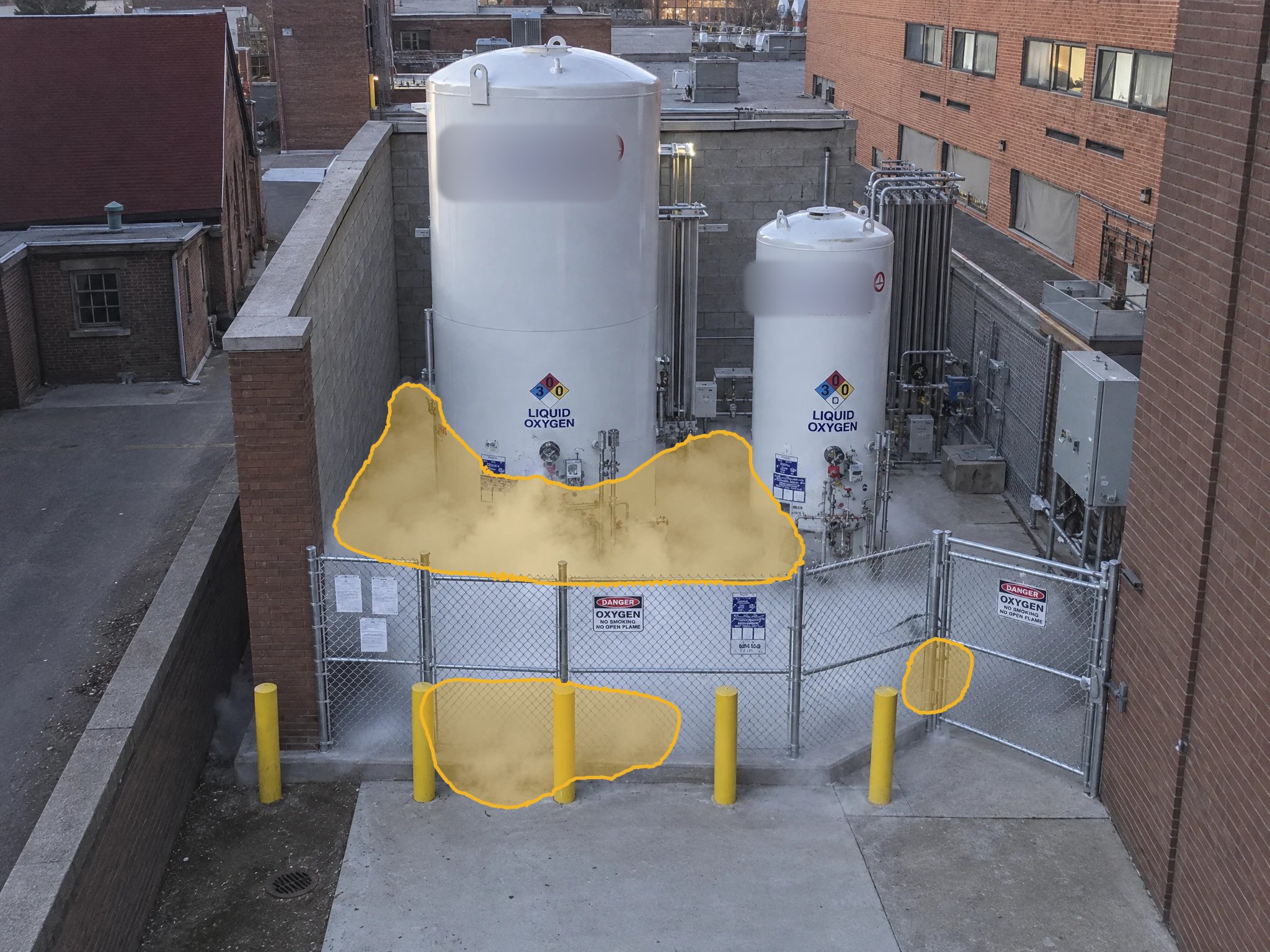
    Hospital bulk liquid oxygen tank with the V4 overlay marking visible vapor at the base of the tank.
    Hospital bulk liquid oxygen tank with the V4 overlay marking visible vapor at the base of the tank.

    Where leaks start in healthcare and campuses

    A hospital or a campus is a small city with one facilities team. The central utility plant moves chilled water, hot water, steam, condensate and glycol through pumps, strainers and valves that run every hour of the year; the bulk oxygen tank is filled by a tanker in the dark; mechanical rooms on every floor hold air handlers, coils and pumps over a drain that may be blocked. Releases start at pump seals and strainer blow-downs in the plant, at coil drain pans and relief valves in the mechanical rooms, at the cryogenic fill connection, and in corridors and lobbies where a roof drip or a mop bucket meets a polished floor. Facilities finds most of them when someone calls.

    Sites and assets

    • Central utility plants: chillers, boilers, pumps, heat exchangers
    • Chilled-water, hot-water, steam and condensate loops
    • Glycol loops and cooling towers
    • Bulk liquid oxygen tanks, cryogenic fill connections and vaporizers
    • Mechanical rooms, air handlers and coil drain pans
    • Emergency generator rooms and day tanks
    • Parking structures and ramps
    • Loading docks and waste holding areas
    • Corridors, lobbies, cafeterias and elevator lobbies
    • Research and clinical labs and lab corridors

    What V4 watches for

    • Puddle: chilled water, condensate, glycol or boiler feedwater on a plant floor; water from a drain pan or a relief valve in a mechanical room; diesel at a day tank; vehicle fluids in the garage; water on a lobby or corridor floor; a reagent spill in a lab corridor.
    • Spray: a pressurized fan from a pump seal, a flange on a chilled-water header, a strainer, a relief line or a burst hose.
    • Vapor: visible vapor at the bulk oxygen tank's fill connection or piping, steam at a boiler or a condensate line, or refrigerant vapor at a chiller when a release is visible. V4 does not detect a gas that cannot be seen, and it does not identify which liquid is on the floor.

    Use cases

    The central utility plant

    The CUP runs with a single operator on nights and weekends, watching the BAS, not the floor. A chilled-water pump seal, a strainer blow-down valve, a glycol make-up line or a condensate receiver puts liquid on the plant floor, and the BAS shows a low make-up alarm an hour later. V4 watches the pump row and the chiller pad from the plant cameras, with interest zones on the pump bases and the floor drains. A puddle or a spray is reported in seconds to the VMS and, by webhook, to the BAS as an alarm point with the snapshot.
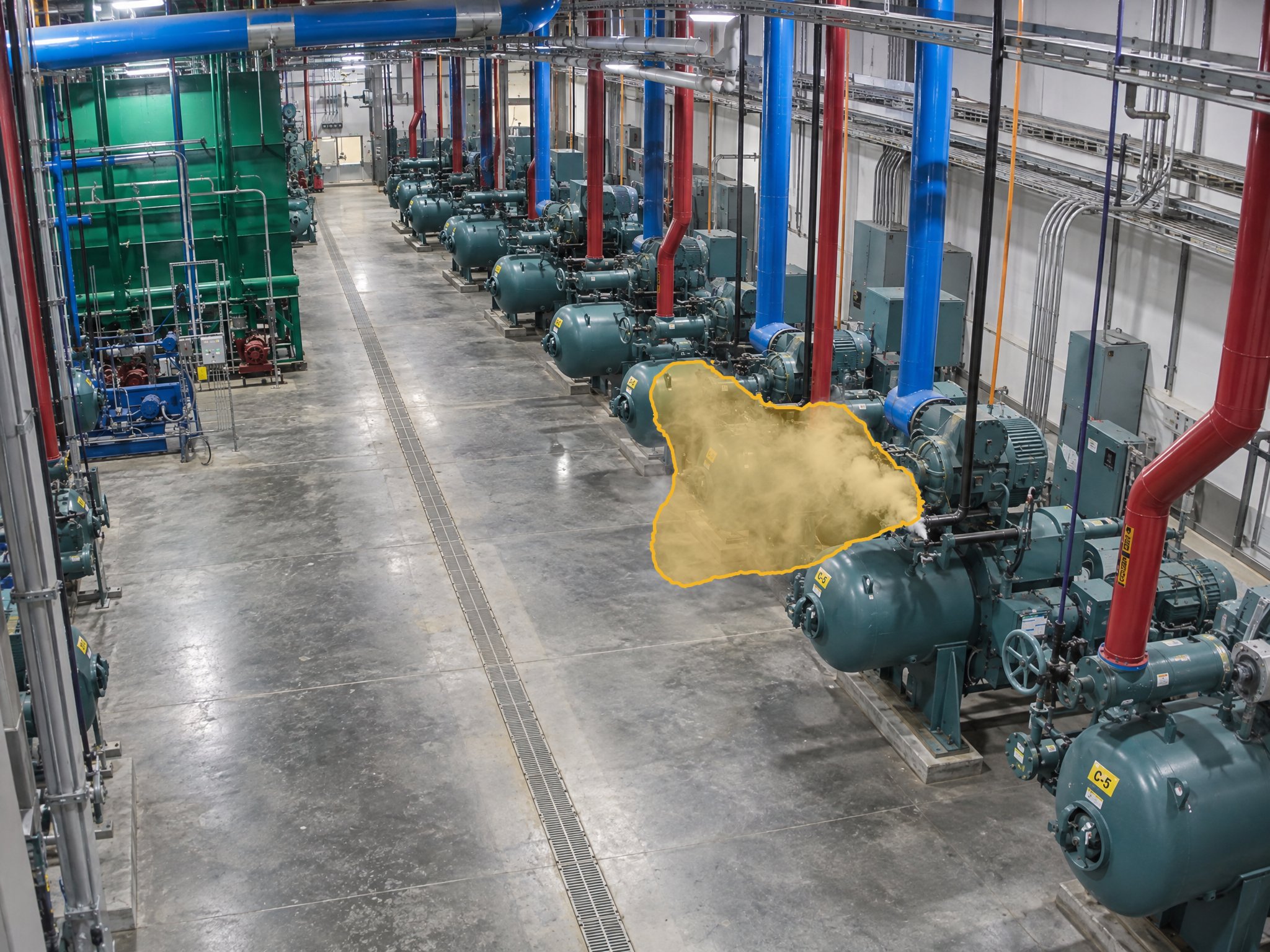
    Chiller plant — visible vapor detected
    Chiller plant — visible vapor detected

    Bulk liquid oxygen tanks

    The LOX pad sits outside the fence and is filled by a tanker driver who leaves when the transfer is done. Normal venting is part of a cryogenic system; vapor at the fill connection, along the piping or at the tank base after the tanker has gone is not. V4 watches the pad from the camera that already covers the fence line, with an interest zone on the fill connection, piping and tank base and an exclusion zone on the vent stack. Visible vapor inside the zone is reported to the VMS and plant ops with a timestamped snapshot.

    Bulk liquid oxygen tank — visible vapor detected
    Bulk liquid oxygen tank — visible vapor detected

    Mechanical rooms and boiler rooms

    A boiler relief valve lifts, a coil drain pan overflows, a pump seal lets go, and the mechanical room on the fourth floor has water on the floor and a drain under a pallet. The room is entered once a week and the ceiling below it is the first to know. A camera in the mechanical room, or a PTZ touring several, gives V4 a view of the floor around the air handler and the boiler. A puddle that appears and grows is reported before it reaches the slab penetration.

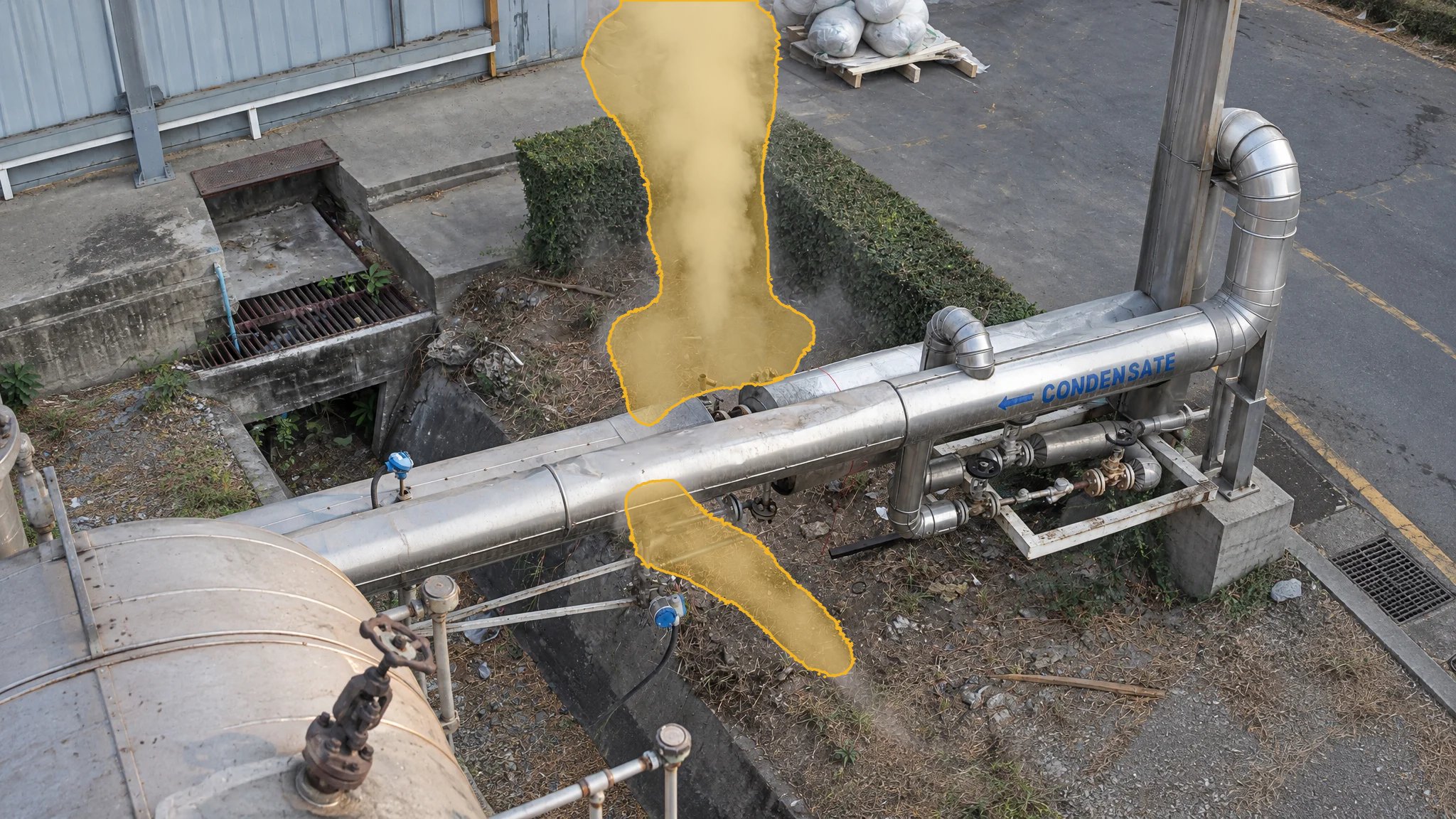
    Boiler room steam line — visible vapor detected
    Boiler room steam line — visible vapor detected

    Corridors, lobbies and cafeterias

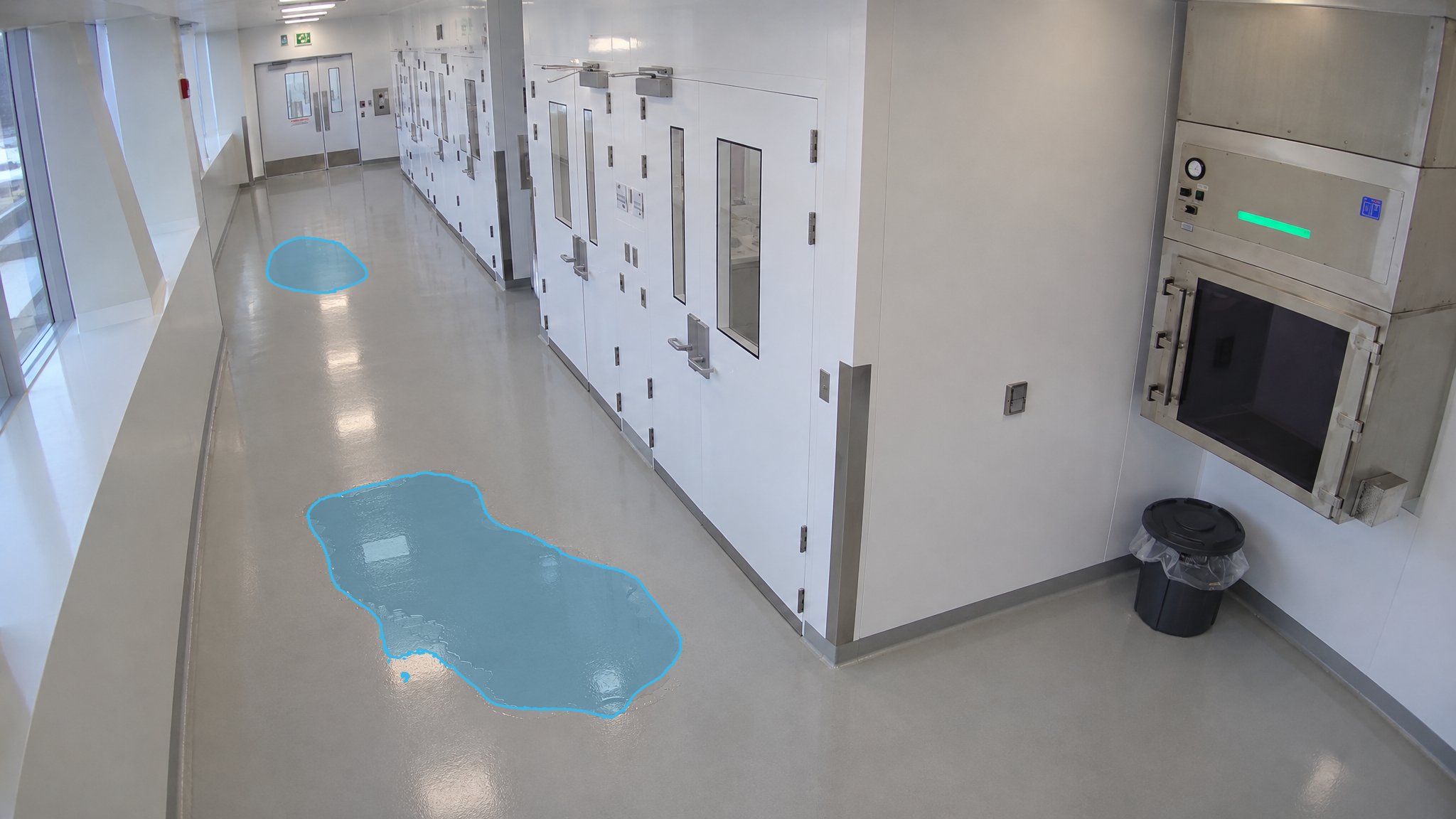
    Water on a polished floor is the slip hazard security cannot see on a monitor wall. A roof drip at the entrance on a wet day, an ice machine overflow outside the cafeteria, a mop bucket left by the elevator: each is a puddle on a floor that patients, visitors and staff cross. V4 runs on the corridor and lobby cameras security already has, with interest zones on the floor and exclusion zones on the furniture. The puddle is reported to the VMS and, by webhook, to the environmental services dispatcher with the snapshot that says which corridor.

    Facility corridor — puddle detected
    Facility corridor — puddle detected

    Why it matters in healthcare and campuses

    Bulk oxygen is regulated equipment.

    OSHA's bulk oxygen standard, 29 CFR 1910.104, applies to systems on institutional premises with more than 13,000 cubic feet of oxygen connected in service, requires them to be located above ground outdoors or in a dedicated noncombustible building, and sets 50 feet as the distance from combustible structures. NFPA 55, the Compressed Gases and Cryogenic Fluids Code, covers bulk oxygen systems, and NFPA 99 is the Health Care Facilities Code.

    Utility systems are surveyed.

    The Joint Commission's utility systems standard, EC.02.05.01, is the one under which the hospital manages the risks of its utility systems, and the Joint Commission's own guidance says it requires monitoring of those systems; a finding at certain elements of performance results in a Condition Level Deficiency and a Medicare follow-up survey. OSHA's walking-working surfaces rule requires floors to be kept clean and, to the extent feasible, dry, free of leaks and spills, and inspected regularly.

    The record is written the moment it is seen.

    Every V4 alarm carries a timestamp and the original and overlay snapshots, so the time water appeared on a plant floor or a lobby floor is on file before the work order and before the incident report. The same record shows the floor was dry on the shifts when nothing happened.

    How it is deployed in healthcare and campuses

    On-camera

    Axis ARTPEC-9 cameras run V4 now; Hanwha Wisenet 9 cameras ship November 15, 2026. This is the fit for the outdoor cameras at the LOX pad, the generator yard and the garage ramps, and for a campus that standardizes on one camera make, where the alarm leaves as a native camera event into the VMS security already runs. Interest zones and exclusion zones are drawn on the camera's own picture. Nothing is processed in the cloud, and no video leaves the site unless you send it.

    On-server

    For a hospital or campus with cameras of several makes and ages on one VMS, one server watches many camera channels: an Emerson PACEdge industrial PC, an x86 server with an integrated Intel GPU or an NVIDIA GPU, or an NVIDIA Jetson, all shipping November 15, 2026, taking RTSP from any H.264 camera. The server sits in the security equipment room or the data center beside the VMS, and an overlay RTSP stream per channel can go onto the security monitor wall. Plant ops gets the alarm on the BAS through a webhook, or as MQTT where the plant has a broker.

    Integrations

    Native camera events into the VMS (Axis event engine, Hanwha camera events); on-server, alarm triggers into Nx Witness, Wisenet WAVE, Milestone and AXIS Camera Station and an overlay RTSP stream per channel; MQTT as JSON or Sparkplug B, pre-mapped for Ignition, and into DeltaV over MQTT on Emerson; HTTPS webhooks to email, SMS, ticketing or a BMS.

    Rain

    The LOX pad, the garage ramps and the dock get a rain gate that pauses detection while it rains and is forgiving for a window afterwards, fed by a rain sensor on the camera's I/O port, an I/O module or a weather service; a failed weather lookup never blocks detection.

    Measured, not promised

    Measured on 9,147 previously unseen frames, including true positives and negatives, out of the box with no per-site training, before the alarm engine is applied.

    F-scoreDetection rateFalse positive rate
    Puddle0.88997.1%0.8%
    Spray and visible vapor0.92398.1%3.7%

    F-score is the pixel-level harmonic mean of precision and recall. Frame-level figures; the alarm engine's staging, persistence and color-confidence checks exist so that a false frame does not become a false alarm.

    Scenarios outside those tested are not covered by these figures.

    Detection within seconds · Installed and configured in under 30 minutes · About 25 pixels per foot on target, nothing else

    Detection depends on the view, lighting and image detail. VisionAery Liquid Leak Detection does not identify chemical composition, detect invisible gas or measure concentration, depth or volume. It supports, not replaces, inspections, required instrumentation, cleanup protocols and safety procedures.

    Questions

    Frequently asked questions

    The LOX tank vents all the time. Will that alarm?

    Draw the interest zone on the fill connection, the piping and the tank base, and an exclusion zone on the vent stack and the vaporizer frost. Detection only happens inside an interest zone, and the alarm engine's persistence check means a brief wisp does not become an alarm. V4 reports visible vapor where you have told it vapor should not be; it does not know what the vapor is or measure it.

    Can it tell water from glycol, or oil from coolant?

    No. V4 reports that liquid is pooling, spraying or forming a visible plume inside a zone, and where. The snapshot and the room tell the plant operator what it is. V4 measures neither volume nor concentration.

    Does it work on the cameras security already has?

    Yes, in one of two ways. On Axis ARTPEC-9 and Hanwha Wisenet 9 cameras it runs on the camera itself. For everything else it runs on a server that takes the RTSP stream from any H.264 camera, which is the usual fit for a campus with a mixed fleet. No video goes to the cloud in either case.

    How does plant ops get the alarm?

    As a native event in the VMS, and through an HTTPS webhook that posts JSON, with snapshots if you want them, to the BAS, to email, to SMS or to the work-order system. Where the plant runs an MQTT broker, the alarm publishes as JSON or Sparkplug B.

    Does it help with my Environment of Care (EOC) or OSHA records?

    VisionAery makes no compliance claim. What V4 gives you is a continuous watch on plant rooms and floors that are walked on a schedule, and a timestamped record with the original and overlay snapshots for every alarm. How that fits your utility management plan and your walking-working surface inspections is your decision.

    Put a continuous watch on the plant rooms, the LOX pad and the floors your team walks once a shift.