VisionAery

    Industries · Data centers

    Chilled water and coolant seen before they reach the racks

    A CRAH condensate pan overflows at two in the morning. A CDU quick-connect weeps onto the one tile with no cable under it. The aisle camera is already looking.

    Data center aisle with the VisionAery overlay marking a water puddle on the floor.
    Data center aisle with the VisionAery overlay marking a water puddle on the floor.

    Where leaks start in data centers

    A data center is a building that moves heat with water. Chilled water risers and headers run above or below the white space. CRAC and CRAH units line the perimeter with condensate pans and drain lines that clog and overflow. In a liquid-cooled hall, CDUs, manifolds, hoses and rear-door heat exchangers bring the coolant loop to the rack itself. The gray space holds the chiller plant, the pump gallery, the cooling towers and the makeup water, and the yard holds diesel in bulk tanks and day tanks. Leak-detection cable runs where someone laid it years ago; a roof drain or a mechanical room above the hall does not read that drawing. The first person to know is usually the technician on a walk-through.

    Sites and assets

    • Raised-floor and slab halls, hot and cold aisles
    • CRAC and CRAH units, condensate pans and drain lines
    • CDUs, direct-to-chip manifolds and hoses, rear-door heat exchangers
    • Chilled water risers, headers, valves and strainers
    • Chiller plant, pump gallery and condenser water lines
    • Cooling towers, basins and makeup water
    • Generator yard: day tanks, bulk tanks, transfer pumps and fuel lines
    • Roof drains and mechanical rooms above the hall
    • Humidifiers and boiler lines in the plant

    What V4 watches for

    • Puddle: chilled water and condensate on raised-floor tiles or slab; coolant, with or without glycol, under a CDU or at the back of a rack; cooling-tower and makeup water on the pad; diesel on the generator pad.
    • Spray: a failed flange, coupling or pump seal on a chilled water or condenser water line in the gallery.
    • Vapor: visible steam at a humidifier or boiler line; refrigerant when a release forms a visible plume at a chiller.

    Use cases

    CRAC and CRAH units and condensate

    A condensate pan drain clogs, a float switch sticks or a humidifier line splits, and water runs out from under the unit along the perimeter tiles. The cable, if there is one, is under the floor; the water is on top of it. V4 runs on the aisle camera that is already in the hall, with an interest zone on the floor along the perimeter units and an exclusion zone on the units themselves. The puddle is reported as it appears, the alarm posts a native event into the VMS, and a webhook raises the ticket in the DCIM or the BMS with the original and overlay snapshots attached.
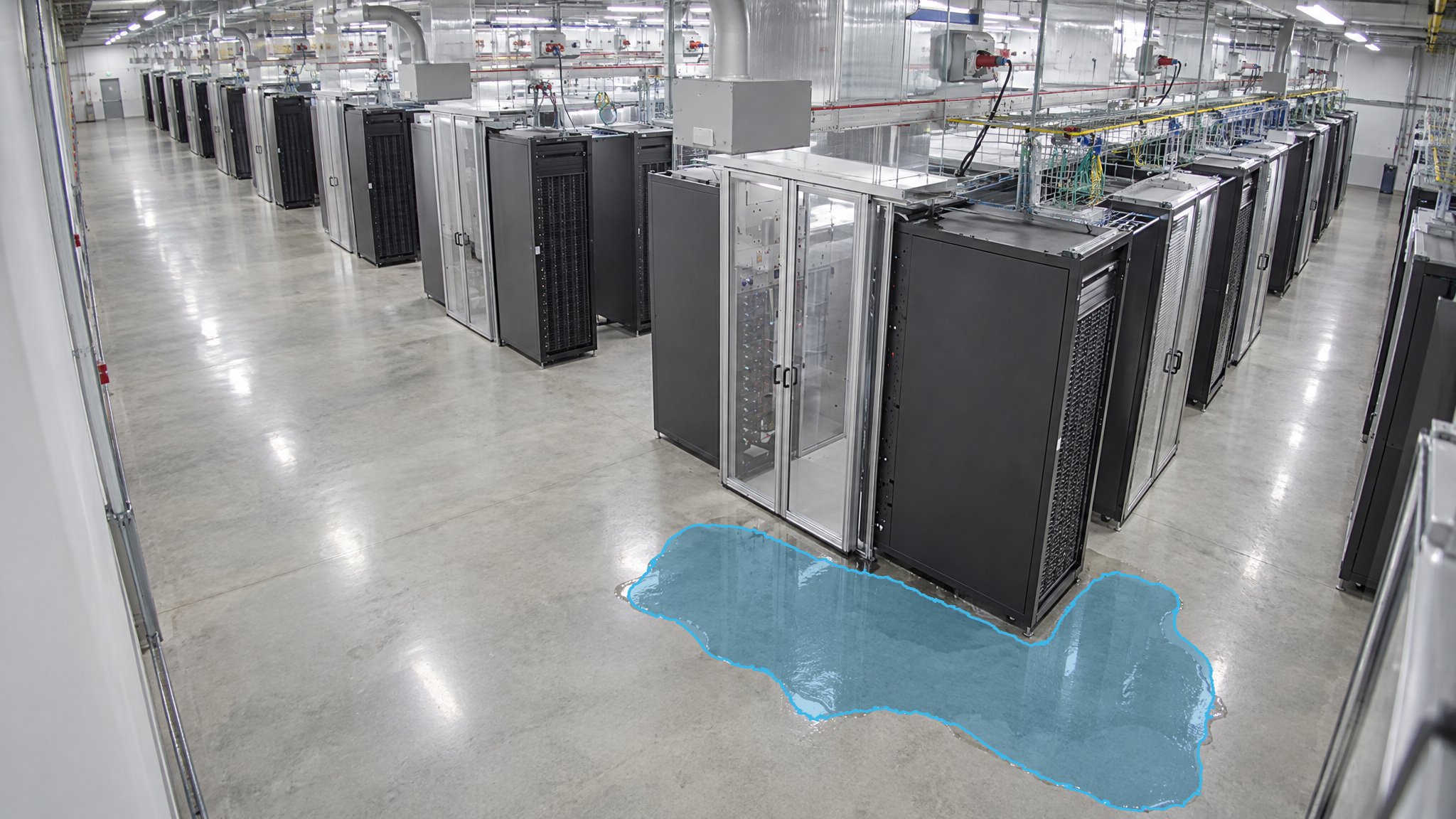
    Data hall — water puddle detected
    Data hall — water puddle detected

    Chiller plant and pump gallery

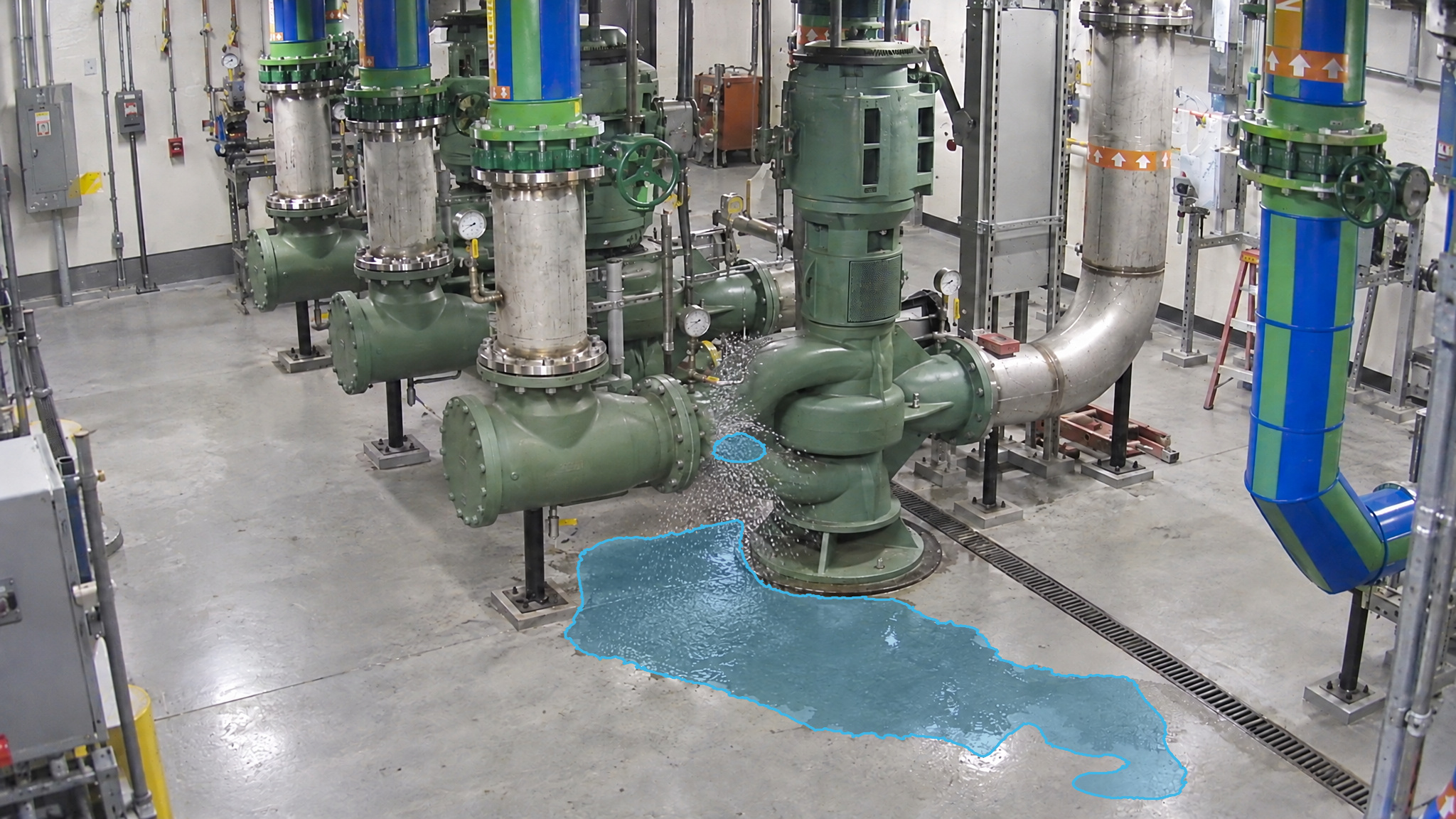
    The chilled water and condenser water pumps, the strainers and the valve trains in the gallery run under pressure, and a failed gasket or seal is a spray before it is a pool. The plant that sets the site's PUE is loud and visited on a round. V4's Spray / Vapor class picks up a fan of water from a flange or a seal from a fixed camera along the pump row, and the Puddle class reports the standing water spreading across the slab toward the drain. Steam at a humidifier or boiler line is reported as visible vapor on the same channel. The alarm reaches the BMS by webhook, or the plant's Ignition gateway over MQTT.

    Pump room with spray beside a pump flange and blue detection overlays marking puddles on the floor.
    Pump gallery — spray and puddle detected

    Cooling towers and makeup water

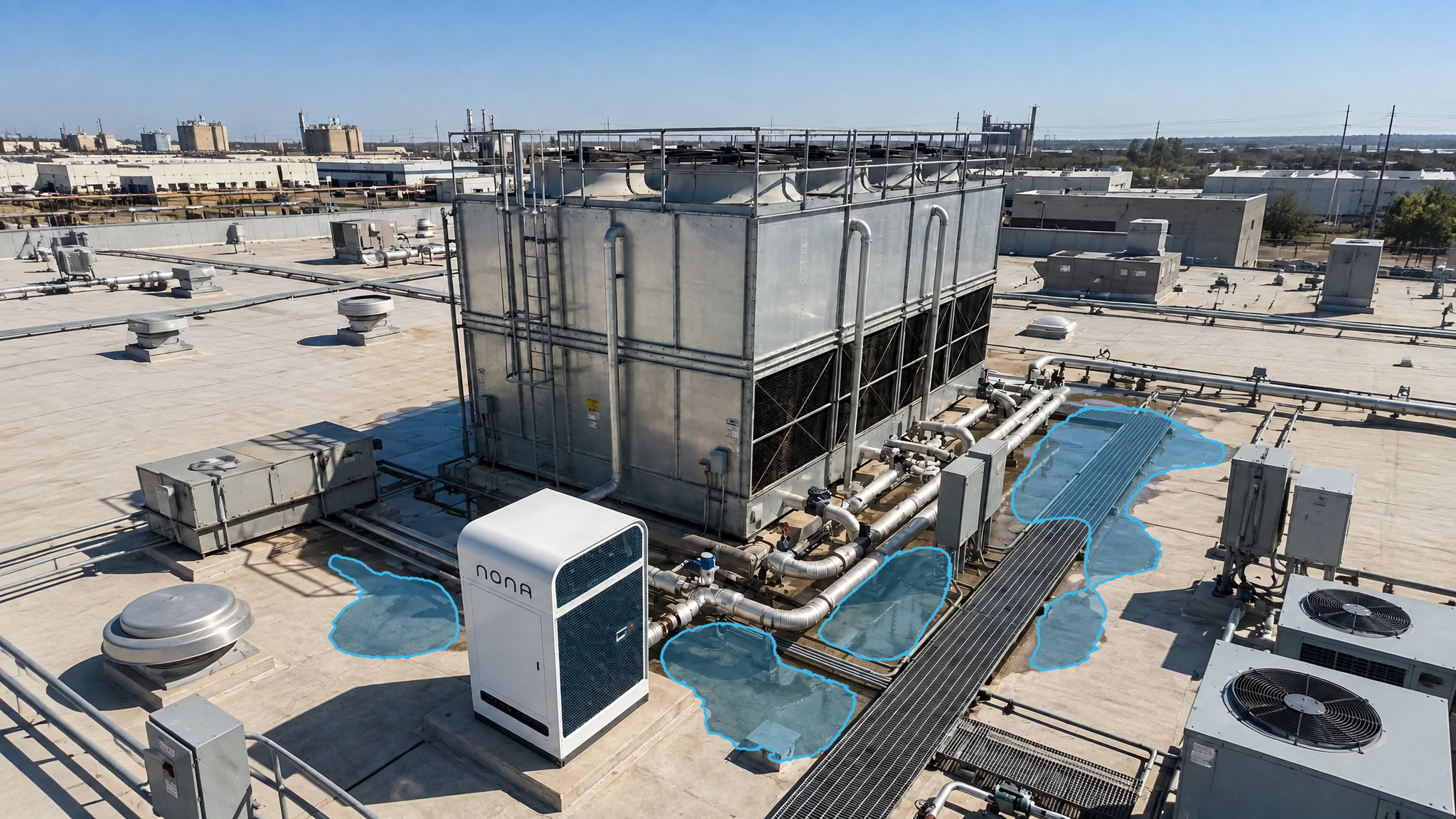
    Tower basins overflow when a float valve fails, makeup water lines leak at the meter and the backflow preventer, and condenser water sheets over the basin lip onto the roof or the pad. The tower deck is outdoors and visited less than the hall. V4 runs on the roof or yard camera with a rain gate from a rain sensor or a weather service, so a wet deck after a storm is not an alarm, and reports standing water that appears while it is dry. The alarm reaches the BMS and the VMS.

    Rooftop cooling tower and pipework with blue detection overlays marking puddles across the roof.
    Cooling tower — puddle detected

    Generator yard: day tanks and bulk tanks

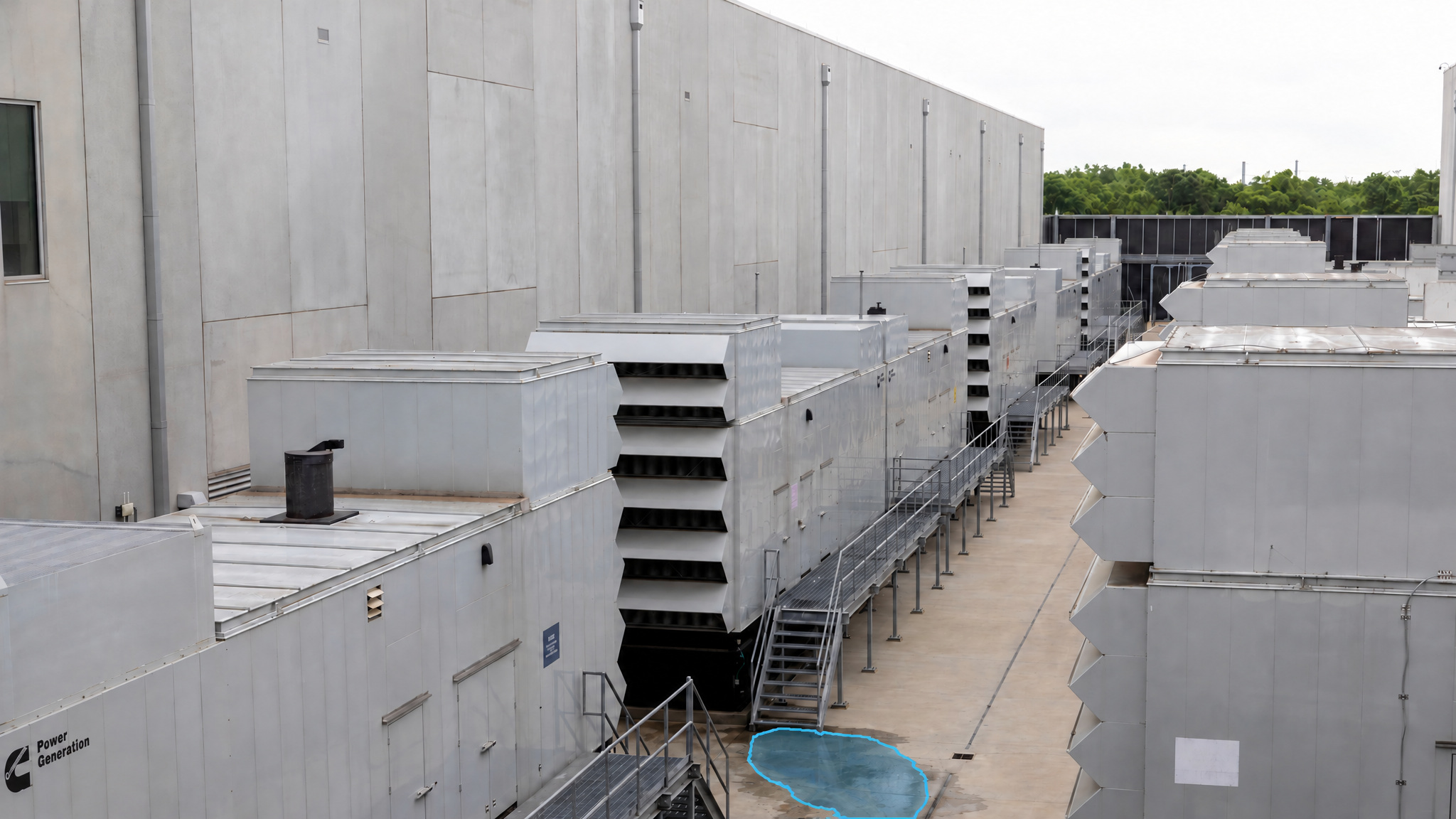
    Every generator has a day tank, a fuel line and a transfer pump, and the yard has the bulk tanks that feed them. Fittings, sight glasses and the fill connection leak diesel onto the pad, and the pad is visited at the monthly test run. V4 watches the generator enclosures and the fill area from the yard camera and reports the puddle as it appears, with the rain gate holding the alarm during a storm. The alarm goes to the VMS and to facilities by email or SMS with the snapshots, so the record of when the puddle started exists before anyone drives out.

    Outdoor generator yard with a blue detection overlay marking a puddle on the concrete between generator enclosures.
    Generator yard, day tank — puddle detected

    Why it matters in data centers

    Generator fuel is SPCC oil.

    Under EPA's SPCC rule a facility with more than 1,320 U.S. gallons of aggregate aboveground oil storage, counting containers of 55 gallons or more, is subject to 40 CFR part 112; a generator yard with bulk tanks and day tanks gets there quickly. Bulk storage containers must have secondary containment sized for the entire capacity of the largest container plus freeboard for precipitation, and inspection and test records must be kept with the SPCC Plan for three years (40 CFR 112.8(c)(2), 112.7(e)). These tanks feed the systems that NFPA 110, Standard for Emergency and Standby Power Systems, covers.

    The hall floor is a walking-working surface.

    OSHA requires workroom floors to be kept clean and, to the extent feasible, dry, walking-working surfaces kept free of hazards including leaks and spills, and hazardous conditions corrected before an employee uses the surface again (29 CFR 1910.22(a), (d)). A puddle on a raised-floor tile is a slip hazard on top of whatever is under the tile.

    The record is written at detection.

    Every alarm carries a timestamp and the original and overlay snapshots. When the post-incident review asks when the water started and what was done, the answer is already in the ticket.

    How it is deployed in data centers

    On-camera

    Aisle domes and plant-room cameras run V4 on Axis ARTPEC-9 today and on Hanwha Wisenet 9 from November 15, 2026. Nothing leaves the camera but the event and the snapshots, nothing is processed in the cloud, and no server goes into the hall. This suits a site where the security team owns the cameras and the facilities team wants the alarm without a new device on the raised floor.

    On-server

    An x86 server with an integrated Intel GPU or an NVIDIA GPU in the gray space takes RTSP from the existing H.264 cameras of any make and scales to a campus with many halls. An NVIDIA Jetson suits an edge or colocation site with a handful of channels, and an Emerson PACEdge industrial PC suits a mechanical plant already on Ignition. All on-server platforms ship November 15, 2026.

    Integrations

    On-camera, native events into the VMS through the Axis event engine or Hanwha camera events. On-server, alarm triggers into Nx Witness, Wisenet WAVE, Milestone and AXIS Camera Station, and an overlay RTSP stream per channel. MQTT as JSON or Sparkplug B, pre-mapped for Ignition, for the plant SCADA; HTTPS webhooks to the BMS, the DCIM, the ticketing system, email or SMS.

    Rain

    Cooling-tower and generator-yard channels take a rain gate from a rain sensor on the camera's I/O port, an I/O module or a weather service; a failed weather lookup never blocks detection.

    Measured, not promised

    Measured on 9,147 previously unseen frames, including true positives and negatives, out of the box with no per-site training, before the alarm engine is applied.

    F-scoreDetection rateFalse positive rate
    Puddle0.88997.1%0.8%
    Spray and visible vapor0.92398.1%3.7%

    F-score is the pixel-level harmonic mean of precision and recall. Frame-level figures; the alarm engine's staging, persistence and color-confidence checks exist so that a false frame does not become a false alarm.

    Scenarios outside those tested are not covered by these figures.

    Detection within seconds · Installed and configured in under 30 minutes · About 25 pixels per foot on target, nothing else

    Detection depends on the view, lighting and image detail. VisionAery Liquid Leak Detection does not identify chemical composition, detect invisible gas or measure concentration, depth or volume. It supports, not replaces, inspections, required instrumentation, cleanup protocols and safety procedures.

    Questions

    Frequently asked questions

    We already have leak-detection cable under the floor. Why a camera?

    The cable reports where it is laid. The camera watches the floor it can see, above the tiles and in the rooms, aisles and yards where no cable was ever run. V4 does not replace leak-detection cable, flow or pressure instrumentation, or the walk-through; it adds a continuous watch where those stop.

    Water on a gray tile is almost invisible. Can the camera see it?

    V4 was measured on 9,147 previously unseen frames at the detection and false-positive rates in the table above. A clear puddle reads as a change in reflection and tone, and a color-confidence check separates liquid from shadow and stain. It needs about 25 pixels per foot on the floor it is watching; an aisle camera usually has that. Scenarios outside those tested are not covered by the figures.

    Does it tell glycol from water, or diesel from rain?

    No. It reports a puddle, a spray or visible vapor, where it is and how it is growing, and the snapshots show the color and the location. V4 does not identify the liquid or measure volume or concentration.

    Will it alarm on a sweating chilled-water pipe or the drip under a CRAH drain?

    Exclusion zones cover the pipe and the unit; the interest zone is the floor. A puddle has to appear inside the interest zone and persist before the alarm stages up, and the staging from green to red is set per zone.

    How does it reach the BMS or the DCIM?

    An HTTPS webhook posts JSON, with snapshots if you want them, to any URL, so a BMS, a DCIM or a ticketing system that accepts a webhook gets the alarm directly. The VMS gets a native camera event. A mechanical plant on Ignition gets the alarm as a Sparkplug B tag over MQTT.

    Put a continuous watch on every aisle, every plant room and the generator yard.