VisionAery

    Industries · Commercial and retail

    Spills on the floor, found before the fall.

    The same liquid leak detection that watches oilfield tank pads runs on the cameras already in your store, on your forecourt, at your dock and in your lobby. It marks the puddle the moment it forms and tells the nearest person where it is.

    Grocery store aisle from a ceiling camera with the V4 overlay marking a puddle on the floor.
    Grocery store aisle from a ceiling camera with the V4 overlay marking a puddle on the floor.

    Where leaks start in commercial and retail

    Most of the liquid on a retail floor comes from the building, not the customer. Refrigerated cases weep at the kick plate when a drain line blocks. Walk-ins and ice machines in the back of house overflow at the threshold. Roof drains back up over the front end on a wet day and the entrance mats stop short of the puddle. On the forecourt, a nozzle left on the ground, a split hose or a tanker drop that overflows the spill bucket puts fuel on the concrete. At the dock, a forklift hydraulic line, a crushed pallet or condensation off a reefer trailer pools on the plate. Each is in view of a camera installed for loss prevention, and each is found today by whoever walks past first.

    Sites and assets

    • Grocery and big-box sales floors: refrigerated cases, produce misting, seafood counters, aisles and endcaps, the front end
    • Back of house: walk-in coolers and freezers, compressor racks, ice machines, receiving
    • Convenience stores and forecourts: dispensers and nozzles, dispenser sumps, fill ports and spill buckets, STP sumps, truck lanes
    • Car wash tunnels and bays, chemical totes and dosing lines
    • Loading docks, warehouses and cold storage: dock levelers, trailers, racking, forklift lanes
    • Parking structures and lots: ramps, decks, low spots
    • Offices, airports, transit stations, arenas and malls: lobbies, concourses, corridors, food courts

    What V4 watches for

    • Puddle: water, milk, cooking oil, glycol, fuel, hydraulic oil, coolant and wash chemicals pooling on tile, concrete, dock plate or asphalt
    • Spray: a pressurized fuel hose or hydraulic line letting go in a directional fan
    • Vapor: visible vapor at a cold-store evaporator or a cryogenic delivery, where the camera can see it

    Use cases

    Grocery and big-box floors

    A case leak starts as a thin sheet along the aisle edge and runs for hours. A dropped jug in dairy, a roof drip over the front end, meltwater at the seafood counter, overspray from the produce misters: each waits for an associate or a customer to find it. V4 runs on the ceiling dome that already covers the aisle, or on a server fed by it, and marks the puddle as it forms. The alarm names the camera, carries a snapshot and lands in the store's incident system, an email or SMS to the floor lead, or the VMS that LP already watches.
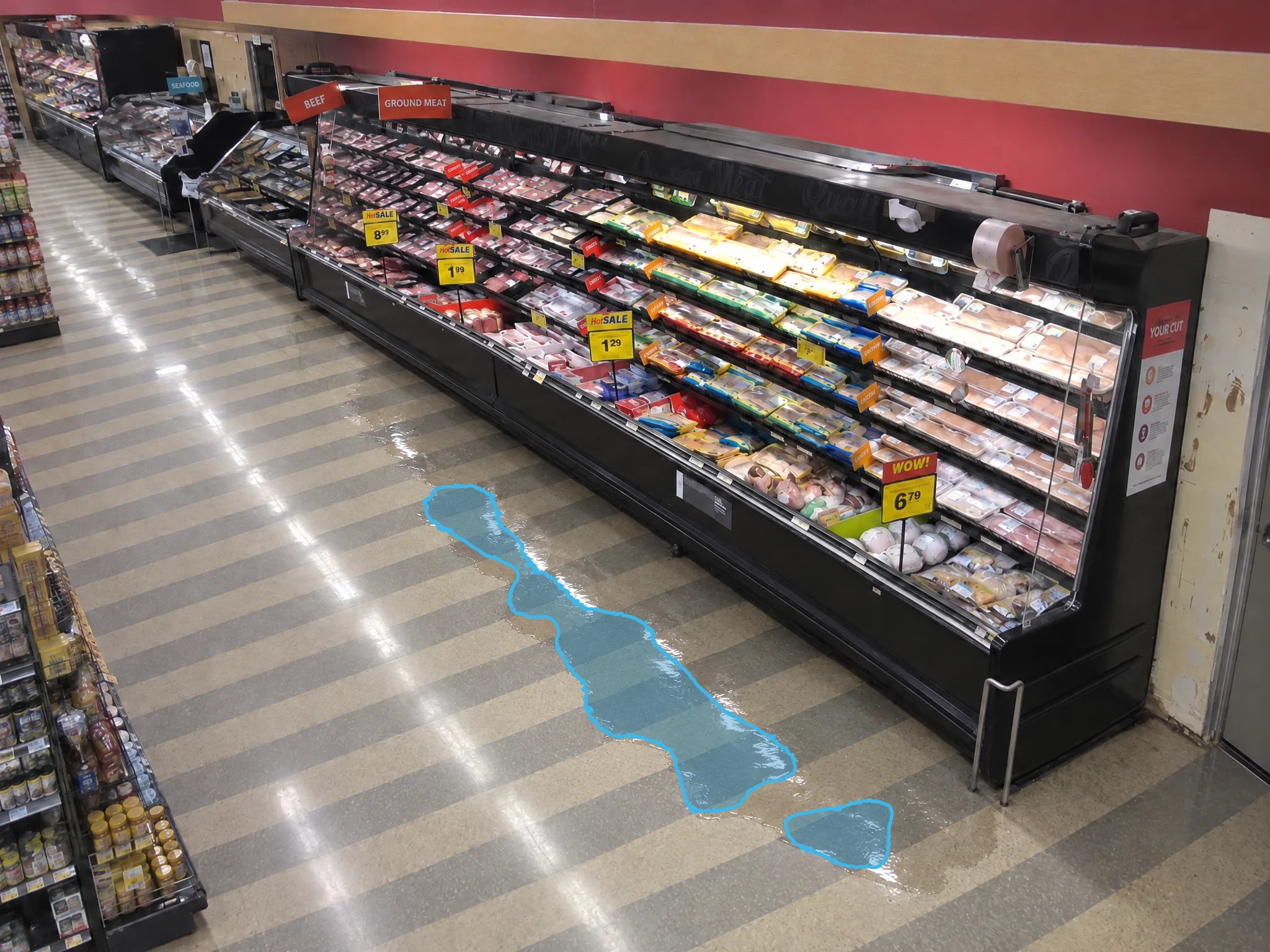
    Refrigerated case aisle with the V4 overlay marking a puddle in front of the case.
    Refrigerated case aisle — puddle detected

    Convenience stores and forecourts

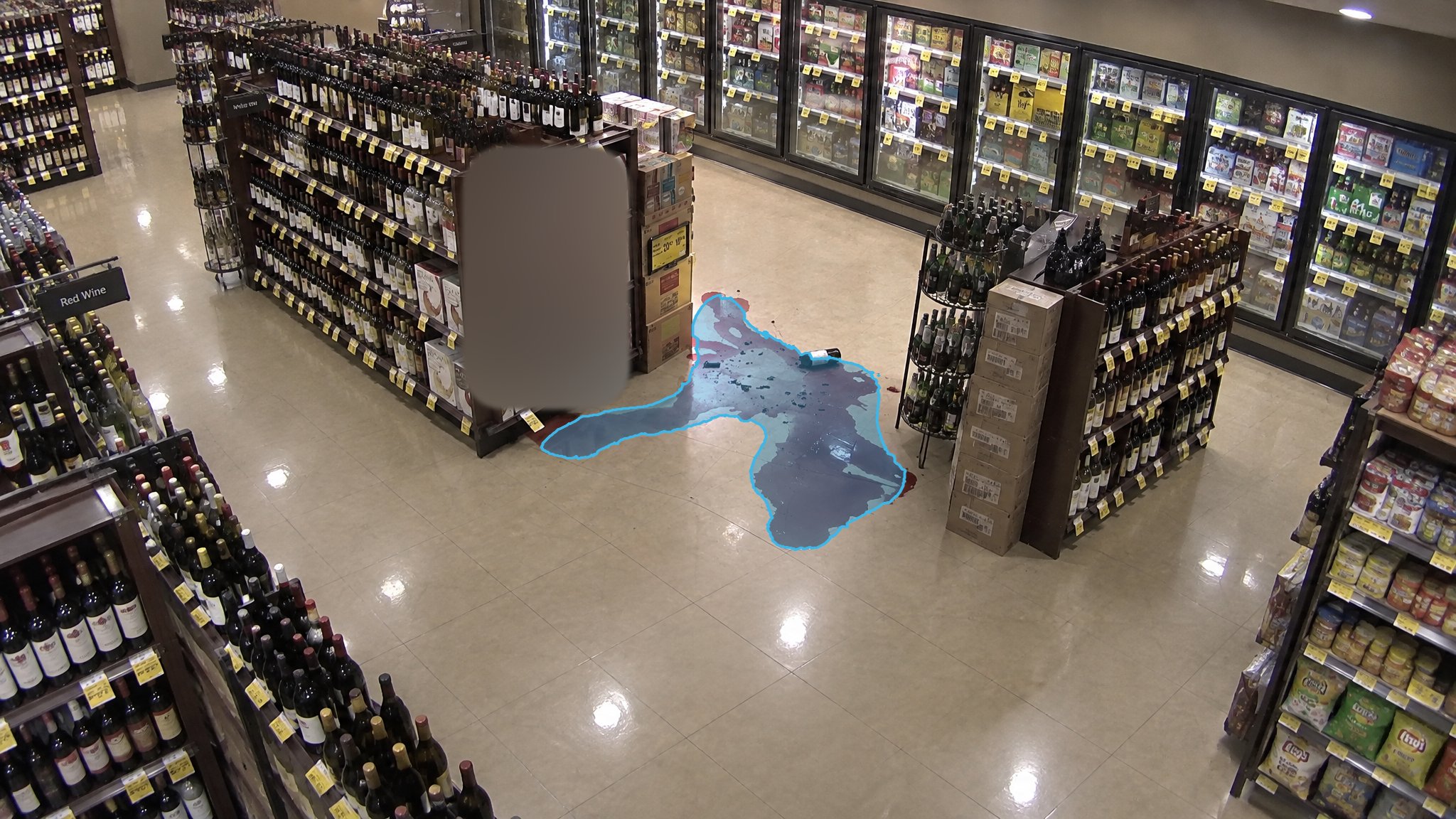
    Fuel on the forecourt comes from a nozzle left on the ground, an overfilled tank, a hose or breakaway failing at the dispenser, or a tanker drop that overflows the spill bucket at the fill port. In the car wash, chemical totes and dosing lines leak into the bay. The canopy camera that watches the islands for drive-offs can also watch the concrete. V4 reports a puddle at the dispenser base, in the truck lane or at the fill port in seconds, with the snapshot the incident report needs, to ticketing, email or SMS and to the VMS.

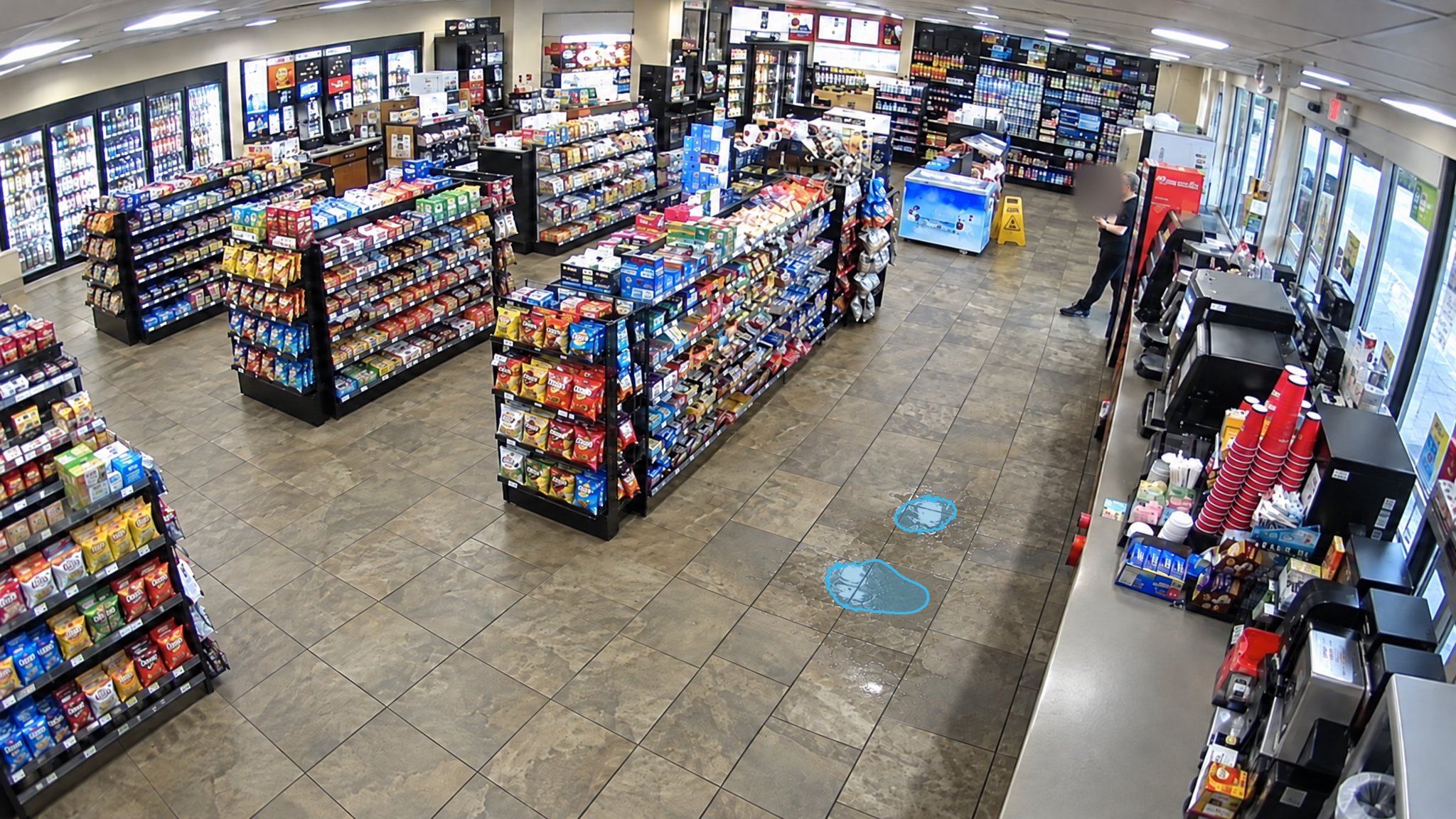
    Convenience store interior with blue detection overlays marking puddles on the floor beside the beverage counter.
    Convenience store — puddle detected

    Loading docks, warehouses and cold storage

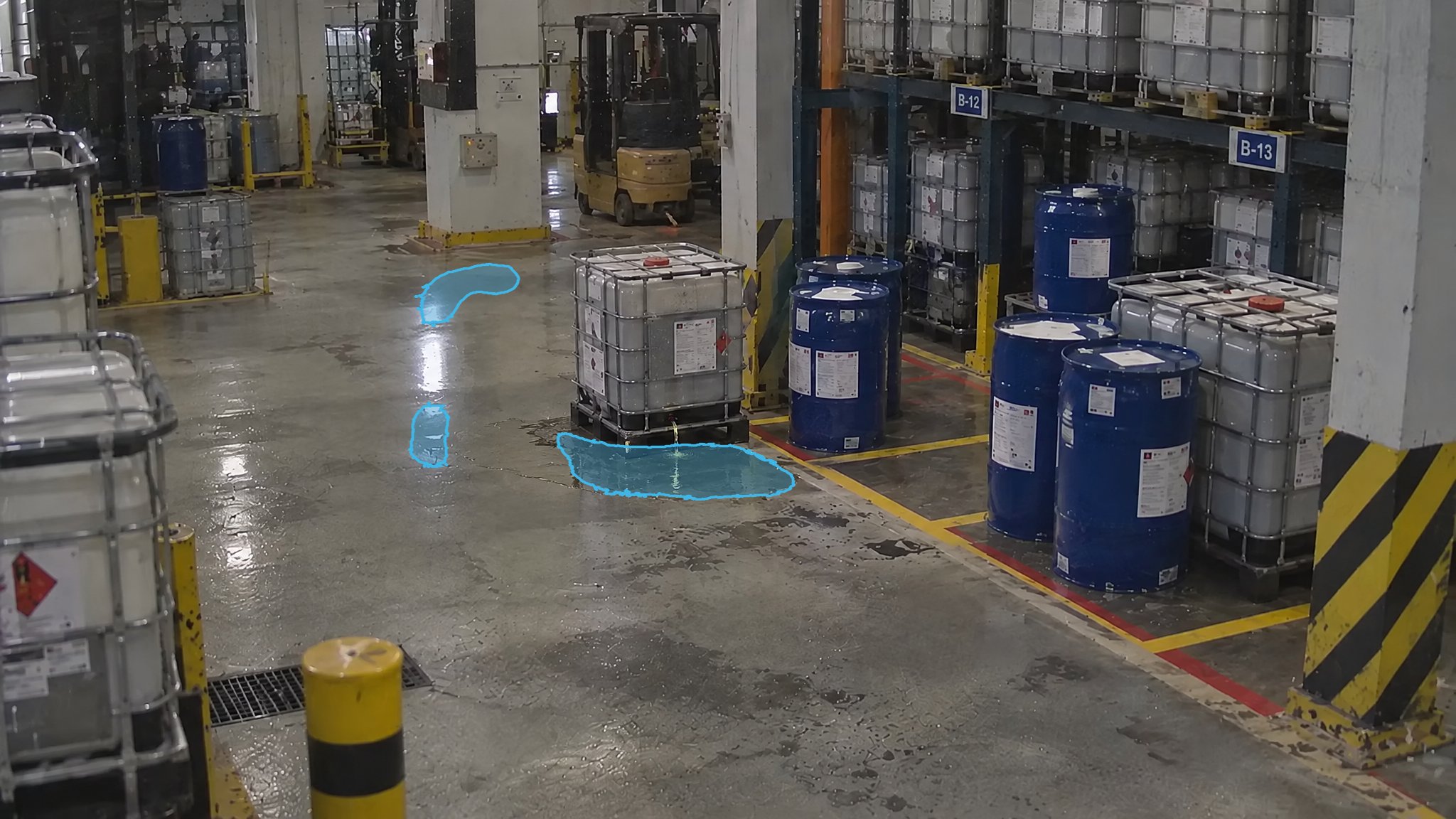
    A forklift leaves a trail of hydraulic oil down the aisle and a puddle where it parks. A crushed pallet foams across the dock plate. In cold storage, defrost water and condensation from the dock leveler refreeze at the door. The dock camera that already records trailers and seals can report what is on the floor. V4 watches the dock plate, the forklift lanes and the racking aisles and sends the alarm to facilities ticketing or the VMS with the original and overlay snapshots attached.

    Warehouse floor with the V4 overlay marking a puddle beside a chemical tote.
    Warehouse tote storage — puddle detected

    Offices, airports, transit and venues

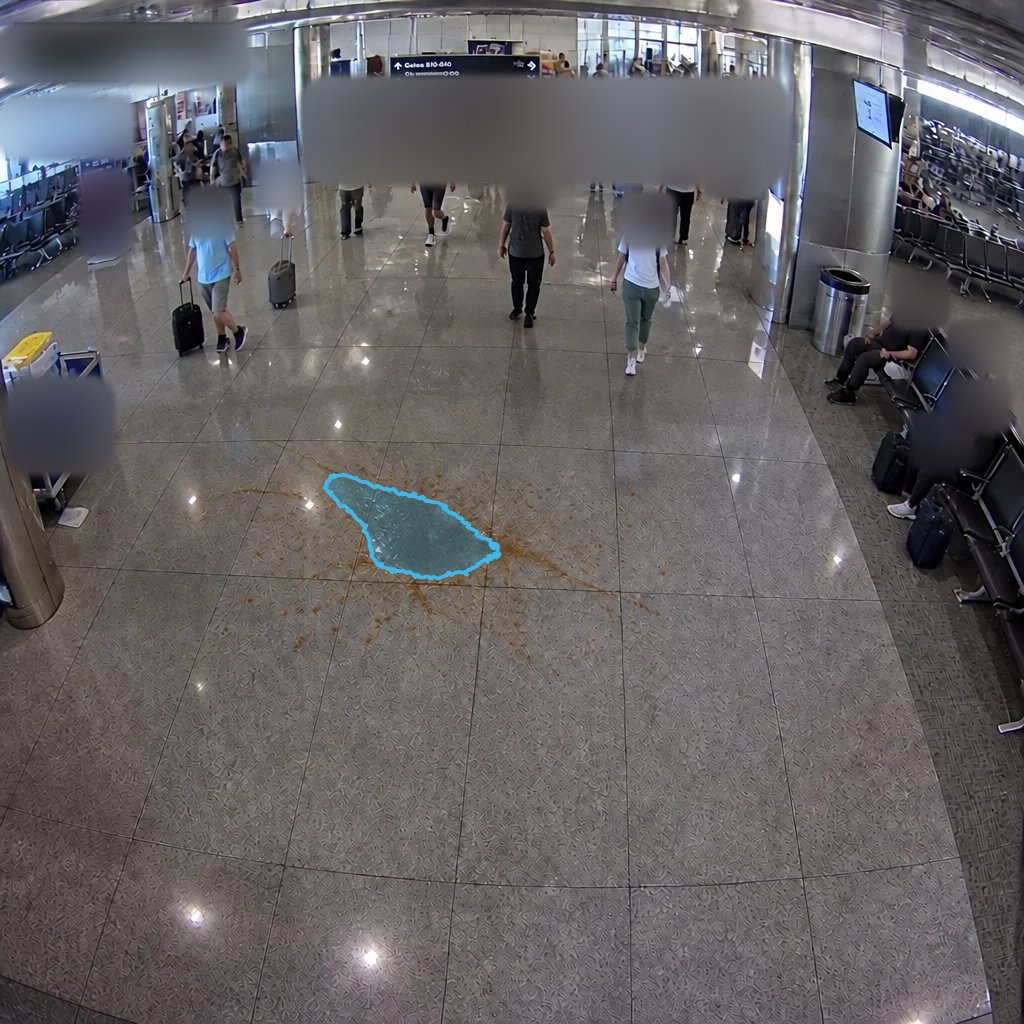
    A roof drip at a gate, a restroom overflow spreading under the door into the corridor, a water cooler leaking onto carpet, a dropped tray in the food court. Lobbies and concourses are the most-watched floors in the building. V4 runs on the cameras that cover them and reports the puddle as it forms, so facilities sends someone to the spot. The alarm reaches the work-order system, the BMS or the security desk's VMS.

    Airport terminal concourse with the V4 overlay marking a puddle on the floor.
    Airport terminal — puddle detected

    Why it matters in commercial and retail

    Slip-and-fall exposure

    In 2018 the Bureau of Labor Statistics counted 34,190 retail-trade injuries involving days away from work that came from falls, slips or trips. A spill nobody has seen yet is the one someone walks into; V4 reports it as soon as it forms.

    A floor the rules expect to be dry

    OSHA's walking-working surfaces rule (29 CFR 1910.22) requires employers to keep workroom floors clean and, to the extent feasible, dry, to keep walking-working surfaces free of hazards such as leaks and spills, and to inspect them regularly. On the forecourt, EPA's underground storage tank rules (40 CFR 280) require spill prevention equipment at the fill pipe and a report within 24 hours of a petroleum spill or overfill over 25 gallons; a continuous watch on the fill port helps you see a spill while it is small.

    Documented evidence

    Every alarm carries a timestamp and the original and overlay snapshots. When the spill was detected, what it looked like and where it was are on record the moment it happened.

    How it is deployed in commercial and retail

    On-camera

    Where the site runs Axis ARTPEC-9 cameras (available now) or Hanwha Wisenet 9 cameras (ships November 15, 2026), the app installs on the camera itself. No server, no extra hardware, nothing leaves the building.

    On-server

    Where the site has a mixed camera fleet, one box in the IT closet runs V4 and takes RTSP streams from the cameras you already have: an Emerson PACEdge industrial PC, an x86 server with an integrated Intel GPU or an NVIDIA GPU, or an NVIDIA Jetson, all shipping November 15, 2026. The fit is usually whatever matches the IT team's standard; the stream count per box is sized at quote.

    Integrations

    On-camera, native camera events go into the VMS. On-server, alarm triggers go into Nx Witness, Wisenet WAVE, Milestone and AXIS Camera Station, with an overlay RTSP stream per channel so the spill is marked in the recording. MQTT as JSON or Sparkplug B, pre-mapped for Ignition, where the site runs one. HTTPS webhooks to email, SMS, ticketing or a BMS.

    Rain

    On forecourts, lots and open docks, a rain gate pauses detection while it rains and is forgiving for a window afterwards, taking its signal from a rain sensor, an I/O module or a weather service. Indoor channels do not need it.

    Measured, not promised

    Tested on the real thing. V4 was evaluated against real grocery-floor and fuel-island spill imagery and performed consistently across every case we tested. It is the same model that runs on oilfield tank pads: trained on real footage, never synthetic, with no per-site training needed. Install it, draw your zones, and it is watching in under 30 minutes.

    Measured on 9,147 previously unseen frames, including true positives and negatives, out of the box with no per-site training, before the alarm engine is applied.

    F-scoreDetection rateFalse positive rate
    Puddle0.88997.1%0.8%
    Spray and visible vapor0.92398.1%3.7%

    F-score is the pixel-level harmonic mean of precision and recall. Frame-level figures; the alarm engine's staging, persistence and color-confidence checks exist so that a false frame does not become a false alarm.

    Scenarios outside those tested are not covered by these figures.

    Detection within seconds · Installed and configured in under 30 minutes · About 25 pixels per foot on target, nothing else

    Detection depends on the view, lighting and image detail. VisionAery Liquid Leak Detection does not identify chemical composition, detect invisible gas or measure concentration, depth or volume. It supports, not replaces, inspections, required instrumentation, cleanup protocols and safety procedures.

    Questions

    Frequently asked questions

    Does it work indoors under store lighting?

    Yes. V4 was tested on real indoor spill imagery from grocery floors and performed consistently across every case we tested. It needs about 25 pixels per foot on the floor you want to watch, which a standard ceiling-mounted store camera provides for the aisle below it.

    Will it alarm on a mopped floor?

    A mop pass does not look like a spill to the alarm engine. Alarms stage up from green to red on puddle growth and persistence, and a wet patch that is drying does not grow, so it never stages up. A color-confidence check also separates liquid from shadow, stain and worn flooring.

    Can it tell fuel from rainwater on the forecourt?

    No. V4 detects that liquid is pooling and where; it does not identify the liquid or measure depth, volume or concentration. The snapshot shows the sheen and the origin, and the person who responds makes the call. The rain gate keeps the channel quiet while it rains.

    Can it send to our incident system?

    Yes. On every alarm V4 posts JSON, with the original and overlay snapshots if you want them, to any URL you give it. Point the webhook at your incident system, a ticketing tool, an email or SMS gateway, the BMS or your own service. There is a test button so you can confirm the route before the first real spill.

    Do we need new cameras?

    Usually not. If the site runs Axis ARTPEC-9 cameras, V4 installs on them today; Hanwha Wisenet 9 cameras follow on November 15, 2026. Any other camera that streams RTSP is watched by V4 running on a server in the IT closet. Cameras and servers come from your integrator or distributor; we sell the software.

    What does it cost per camera?

    $500 per camera channel per year with support and updates included, or $1,500 perpetual with a 10% annual support fee. Same price on every platform, on-camera or on-server. A 30-day trial is free, longer on request.

    Find the spill before a customer does.