VisionAery

    Industries · Manufacturing

    Coolant, oil and condensate on the floor, seen in seconds

    A hose fitting on a press weeps overnight. A trap on the steam header fails open. The floor tells you first, and the camera over the cell is already looking at it.

    Machine floor with the VisionAery overlay marking a coolant puddle beside a machining center.
    Machine floor with the VisionAery overlay marking a coolant puddle beside a machining center.

    Where leaks start in manufacturing

    A plant is a building full of pressurized liquid. Hydraulic power units on presses and molding machines run at pressures where a hose fitting fails as a spray before it is a puddle. Machining centers circulate water-soluble coolant that reaches the floor through a split return line, an overfilled sump or a chip conveyor. Steam headers and condensate return lines let go at traps, unions and valve packing, and the release shows as visible vapor. Chiller plants and compressed-air systems put water and oil on the pad, and refrigerant when a release forms a visible plume. Outside, compressors and pad-mounted transformers sit on gravel that hides a leak until it is large. Most of these are found by whoever walks past next.

    Sites and assets

    • Hydraulic presses, injection molding cells and their HPUs
    • CNC and machining cells, coolant sumps and chip conveyors
    • Paint lines, wash lines and parts washers
    • Gearboxes and lubrication systems on conveyors and drives
    • Boiler houses, steam headers, traps and condensate return
    • Compressor rooms and compressed-air oil separators
    • Chiller plants and cooling towers
    • Outdoor utility yards: compressors, pad-mounted transformers, fuel for yard equipment
    • Loading docks, dock levelers and receiving

    What V4 watches for

    • Puddle: hydraulic oil, machine and gearbox oil, coolant, wash water, paint and resin, condensate and cooling-tower water pooling on the floor, the pad or the gravel.
    • Spray: pressurized hydraulic oil at a hose fitting, a burst wash-bay hose, a flange on a process water line.
    • Vapor: live steam at a trap, union or packing gland; refrigerant when a release forms a visible plume.

    Use cases

    Hydraulic presses and molding cells

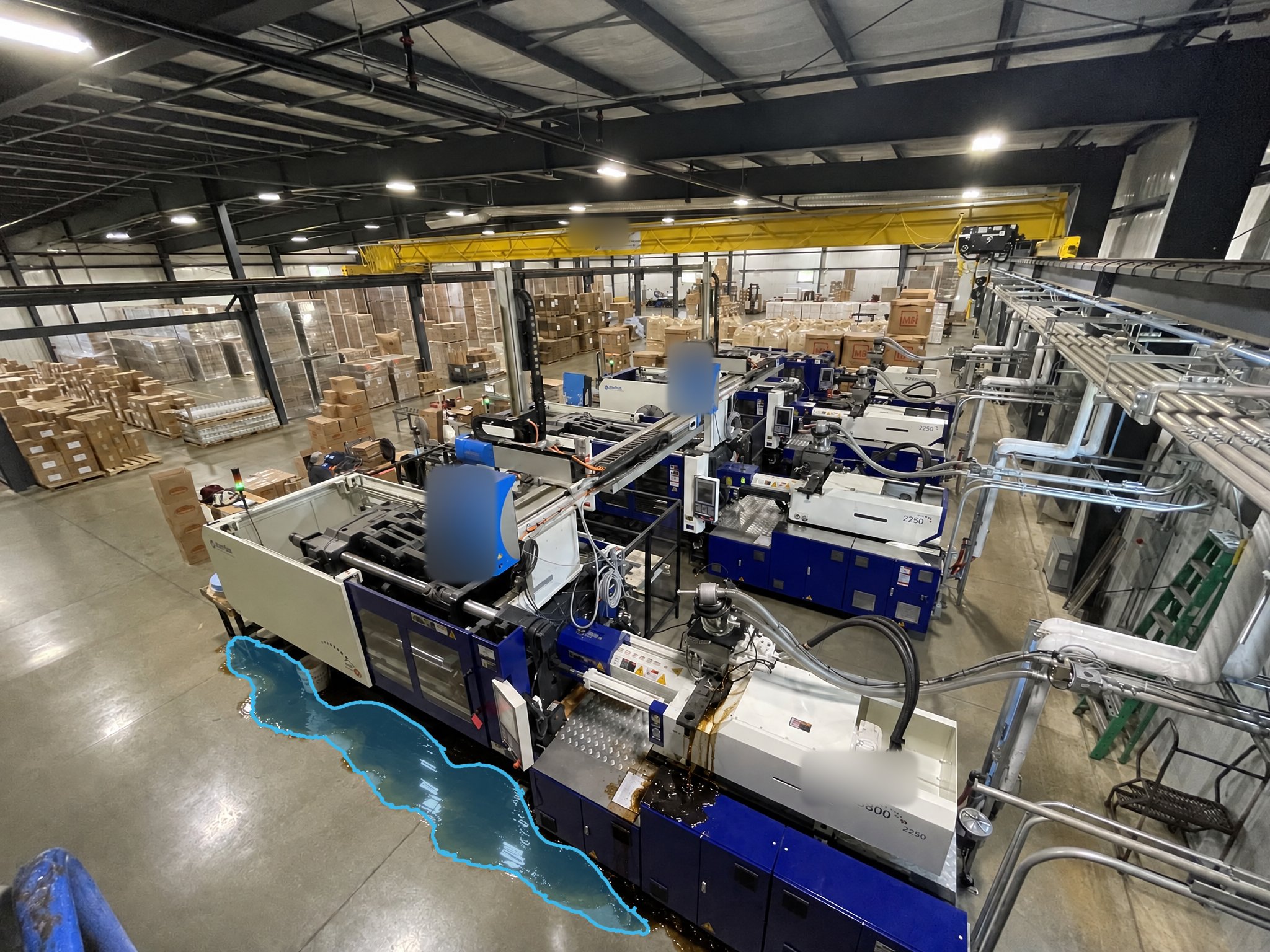
    An HPU hose fails at the crimp or at the adapter under the press bed. On a running line it starts as a drip, becomes a dark, glossy pool under the machine, and is found at the shift change or when a forklift tracks it down the aisle. By then the reservoir is low and the press is the reason the line is down. V4 runs on the ceiling camera that already covers the cell, with an interest zone drawn on the floor around the HPU and an exclusion zone on the machine's own wet surfaces. The alarm stages from green to red as the pool grows, posts a native camera event into the VMS, and can open a work order in the CMMS through a webhook.
    Machine floor, hydraulic oil — puddle detected
    Machine floor, hydraulic oil — puddle detected

    Coolant on the machine floor

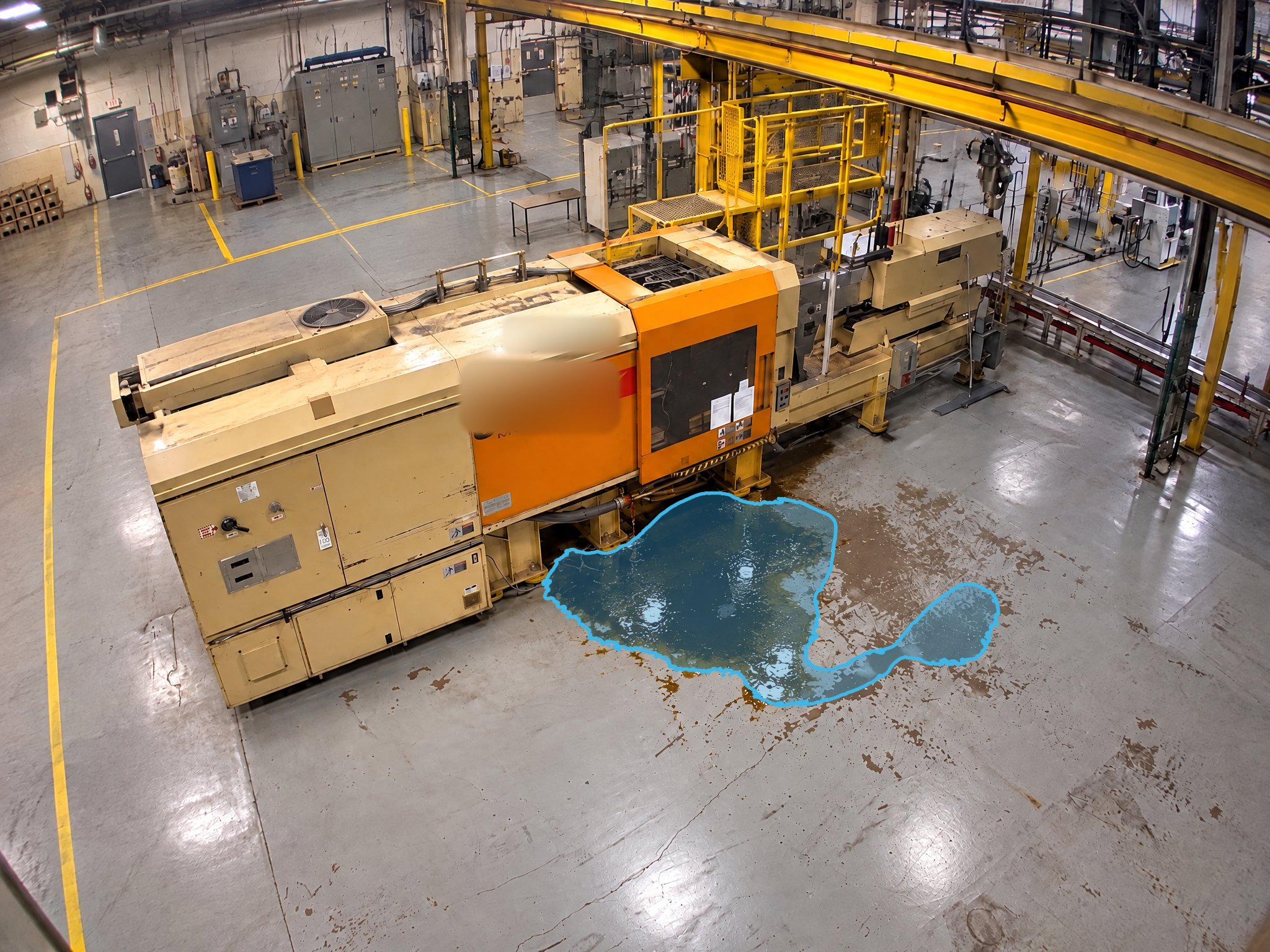
    Water-soluble coolant leaves a CNC cell through a split return hose, an overflowing sump or a tank that was topped up and forgotten. It spreads thin, follows the floor slope toward the drain, and is the slip hazard every 5S audit flags and every TPM board carries a tag for. V4 watches the floor between machines from the existing camera and reports the puddle while it is still one machine wide. The alarm lands in the VMS, and over MQTT it shows up as a tag in Ignition beside the cell's own counts, so the person watching the line is the person who sees the leak.

    Machining cell — coolant puddle detected
    Machining cell — coolant puddle detected

    Steam headers, traps and condensate return

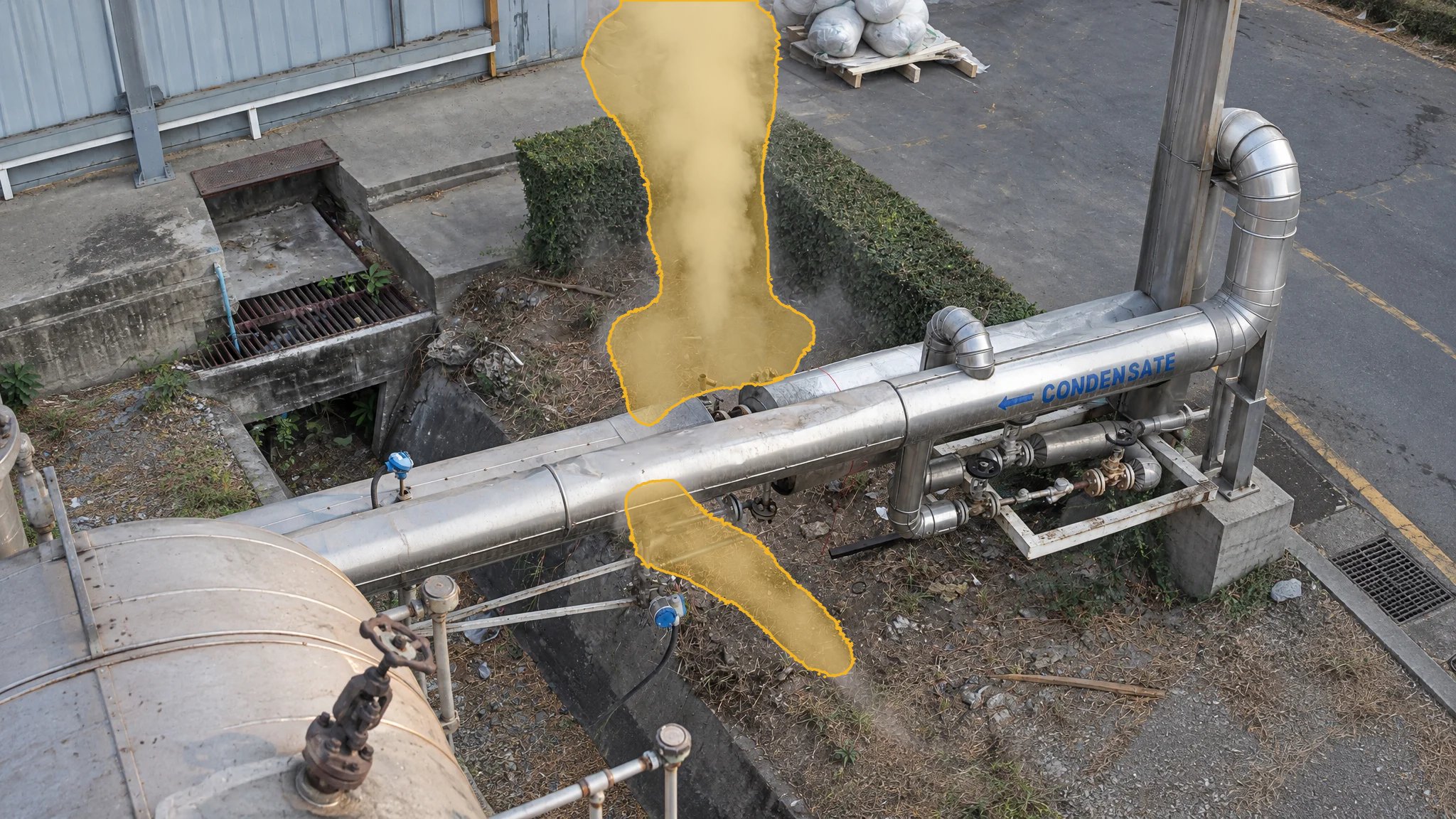
    A trap that fails open, a union that lets go on a condensate return line or packing on a header valve puts live steam into the room. Nobody stands long in a boiler house or a utility corridor, so the plume is seen by whoever opens the door next. V4's Spray / Vapor class picks up visible vapor from a fixed camera looking along the pipe rack, and the condensate pooling below it is reported by the Puddle class on the same channel. On an Emerson PACEdge server the alarm reaches DeltaV over MQTT; anywhere else it reaches the control room as Sparkplug B or JSON, or as a webhook.

    Steam line — visible vapor detected
    Steam line — visible vapor detected

    Chiller plants, compressed air and plant utilities

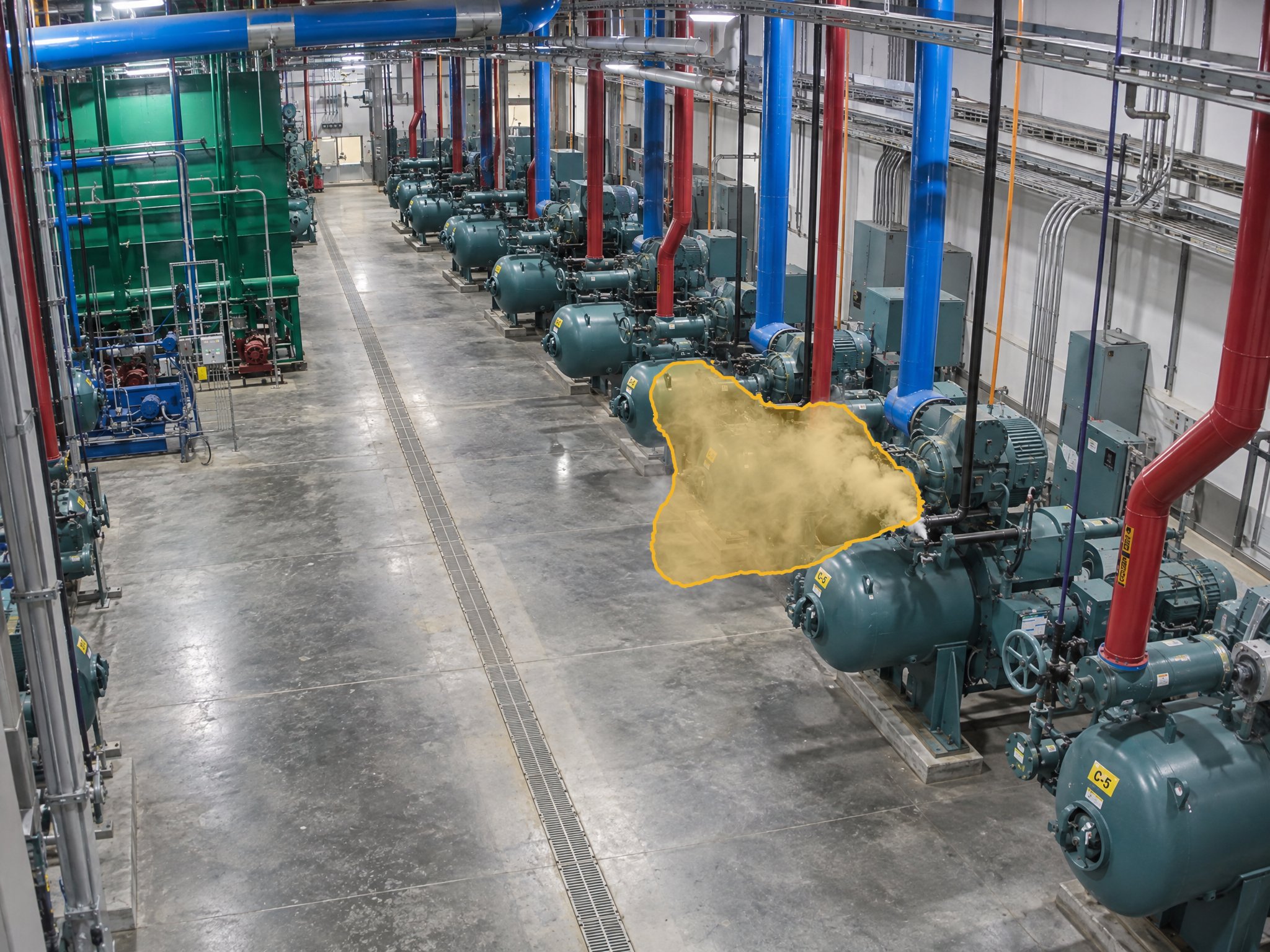
    The chiller plant and compressor room hold the plant's water, oil and refrigerant. Condenser water pumps leak at seals, compressed-air oil separators and drains leave oil on the pad, and when a refrigerant release forms a visible plume at a flange, the camera sees it. V4 watches the plant room floor and the pipe runs from a wall or ceiling camera and reports both signatures. The alarm reaches the BMS through a webhook or the plant SCADA over MQTT, and the maintenance planner gets the original and overlay snapshots with it.

    Chiller plant — refrigerant vapor detected
    Chiller plant — refrigerant vapor detected

    Why it matters in manufacturing

    Floors kept free of leaks and spills.

    OSHA's walking-working surfaces rule requires that the floor of each workroom be kept clean and, to the extent feasible, dry, that walking-working surfaces be kept free of hazards including leaks and spills, and that they be inspected regularly and hazardous conditions corrected before an employee uses the surface again (29 CFR 1910.22(a)(2), (a)(3), (d)). A camera that reports the puddle in seconds shortens the time between the spill and the correction.

    The oil inside the machines counts.

    Under EPA's SPCC rule a facility with more than 1,320 U.S. gallons of aggregate aboveground oil storage, counting only containers of 55 gallons or more, is subject to 40 CFR part 112, and EPA treats hydraulic systems, gearboxes, machining coolant systems and transformers as oil-filled operational equipment. A facility that uses the qualified oil-filled operational equipment alternative to secondary containment must document inspection procedures or a monitoring program to detect equipment failure or a discharge (40 CFR 112.7(k)(2)(i)).

    The record is written at detection.

    Every alarm carries a timestamp and the original and overlay snapshots. Whether the question comes from the safety committee, an insurer or an inspector, what was seen and when is already on file.

    How it is deployed in manufacturing

    On-camera

    Fixed domes over cells, in plant rooms and on the dock run V4 on Axis ARTPEC-9 today and on Hanwha Wisenet 9 from November 15, 2026. Nothing leaves the camera but the event and the snapshots. This suits a plant that adds coverage cell by cell as cameras are refreshed, and plant rooms where there is no space for a server.

    On-server

    An Emerson PACEdge industrial PC, an x86 server with an integrated Intel GPU or an NVIDIA GPU, or an NVIDIA Jetson takes RTSP from the H.264 cameras the plant already has, of any make, which suits a mixed fleet where the floor, the yard and the docks were installed in different years. PACEdge is the natural fit where the plant already runs DeltaV or an Ignition gateway. All on-server platforms ship November 15, 2026.

    Integrations

    On-camera, native events into the VMS through the Axis event engine or Hanwha camera events. On-server, alarm triggers into Nx Witness, Wisenet WAVE, Milestone and AXIS Camera Station, and an overlay RTSP stream per channel. MQTT as JSON or Sparkplug B, pre-mapped for Ignition, and into DeltaV over MQTT on Emerson. HTTPS webhooks to email, SMS, the CMMS or the BMS.

    Rain

    Yard and dock channels take a rain gate from a rain sensor on the camera's I/O port, an I/O module or a weather service, so a wet pad after a storm does not raise an alarm.

    Measured, not promised

    Measured on 9,147 previously unseen frames, including true positives and negatives, out of the box with no per-site training, before the alarm engine is applied.

    F-scoreDetection rateFalse positive rate
    Puddle0.88997.1%0.8%
    Spray and visible vapor0.92398.1%3.7%

    F-score is the pixel-level harmonic mean of precision and recall. Frame-level figures; the alarm engine's staging, persistence and color-confidence checks exist so that a false frame does not become a false alarm.

    Scenarios outside those tested are not covered by these figures.

    Detection within seconds · Installed and configured in under 30 minutes · About 25 pixels per foot on target, nothing else

    Detection depends on the view, lighting and image detail. VisionAery Liquid Leak Detection does not identify chemical composition, detect invisible gas or measure concentration, depth or volume. It supports, not replaces, inspections, required instrumentation, cleanup protocols and safety procedures.

    Questions

    Frequently asked questions

    Will it alarm on the coolant that is supposed to be inside the machine?

    No. The interest zone is drawn on the floor, the pad or the walkway, and an exclusion zone covers the machine's own wet surfaces, the sump and the chip conveyor. V4 alarms when a puddle appears inside the interest zone and persists; a color-confidence check separates liquid from shadow and stain.

    Parts of our floor are wet by design. What then?

    Draw the interest zone where the floor should be dry. In a wet-process area the drainage and the dry standing places are yours to manage; V4 watches the floor outside them and reports a puddle that appears where there should not be one.

    Does it tell me whether it is coolant, hydraulic oil or water?

    No. It reports a puddle, a spray or visible vapor, where it is and how it is growing. The original and overlay snapshots show the color and the location, and the person who responds identifies the liquid. V4 does not measure volume or concentration.

    Can it open a work order in the CMMS?

    Yes, if the CMMS accepts an HTTPS webhook. V4 posts JSON, with snapshots if you want them, to any URL. The same alarm can go to the VMS, to Ignition as a tag, and to the maintenance planner by email or SMS at the same time.

    How many cameras does a plant need?

    V4 needs about 25 pixels per foot on the floor you want to watch. A camera over a cell covers the floor around a few machines; a long aisle or a plant room is covered by a second camera or a PTZ on a tour, with its own zones at each preset. Each channel takes under 30 minutes to install and configure.

    Put a continuous watch on every cell, every plant room and the yard.