VisionAery

    Industries · Mining

    Slurry lines, pumps and leach fields, watched on the cameras you already have.

    VisionAery Liquid Leak Detection runs on the plant's existing security cameras to watch slurry and tailings lines, slurry pumps and leach fields for visible puddles and spray between walk-downs.

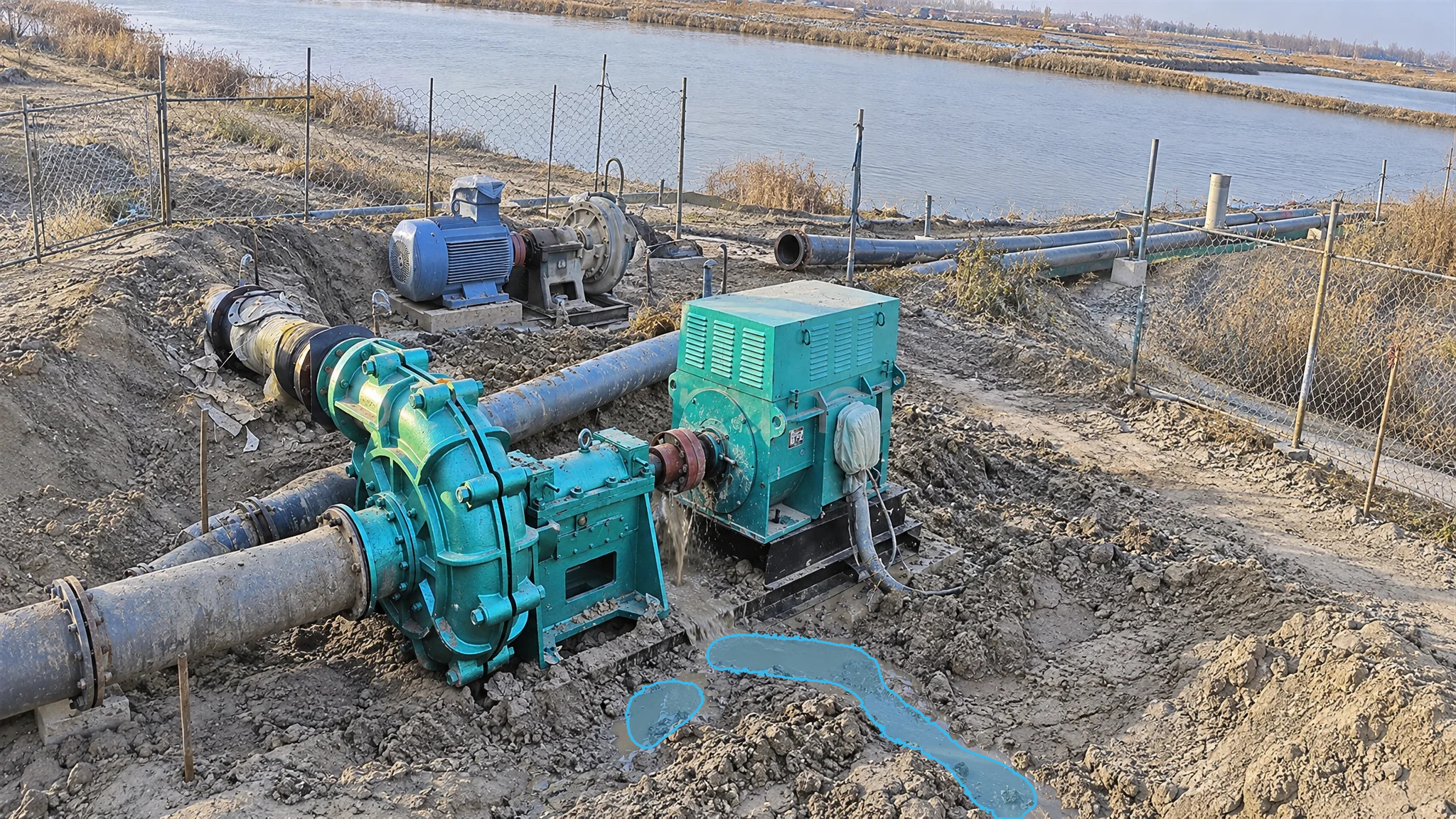
    Green outdoor slurry pump beside a pond, with blue detection overlays marking liquid on the ground below the pump.
    Green outdoor slurry pump beside a pond, with blue detection overlays marking liquid on the ground below the pump.

    Where leaks start in mining

    A mine moves more liquid than most people picture: slurry through the mill circuit, thickener underflow to tailings, reagents and flocculant to flotation, gland water to every slurry pump, hydraulic oil through every shovel, drill and haul truck, and diesel by the tanker load. Abrasive slurry eats pipe at every elbow and gland. Hydraulic hoses chafe and burst on mobile equipment. Lube systems on SAG and ball mills weep at the trunnion. Reagent totes and fuel transfer hoses drip at the coupling. Most of it is found on a walk-down or when a sump pump runs too long, hours after it started.

    Sites and assets

    • Mill: SAG and ball mill lube and hydraulic skids, trunnion seals, launders, pump boxes
    • Slurry, tailings and reclaim-water lines, pipe racks and booster stations
    • Thickeners, flotation cells, reagent and flocculant preparation
    • Leach pads, solution ponds and pump stations
    • Truck shops, lube bays, tire bays and wash bays
    • Fuel farms, fuel islands and lube-oil storage
    • Conveyor drive stations, gearboxes and hydraulic take-ups
    • Crushers and screening plants
    • Frac-sand plants, dryers and rail or truck load-out

    What V4 watches for

    • Puddle: hydraulic oil, gear oil or diesel on a shop floor, apron or pad; slurry or process water pooling under a pipe or on a walkway; reagent on a containment floor
    • Spray: a directional jet from a slurry pipe joint, a pump gland, a hydraulic hose or a fuel coupling under pressure
    • Vapor: a plume that is visible to the camera at a steam line, a hot process vessel or a reagent transfer

    Use cases

    Slurry and tailings lines

    A tailings line runs for miles past nobody. A pinhole at a worn elbow starts as a fine spray that cuts a wider hole, and the grey fan on the ground is found by whoever drives the line next. The pole camera at the booster station or the pipe rack already frames the joints. V4 draws an interest zone along the line and the ground below it, reports a spray within seconds and a puddle as it spreads, and sends the alarm over MQTT with the overlay snapshot so the control room sees which joint before anyone is dispatched.
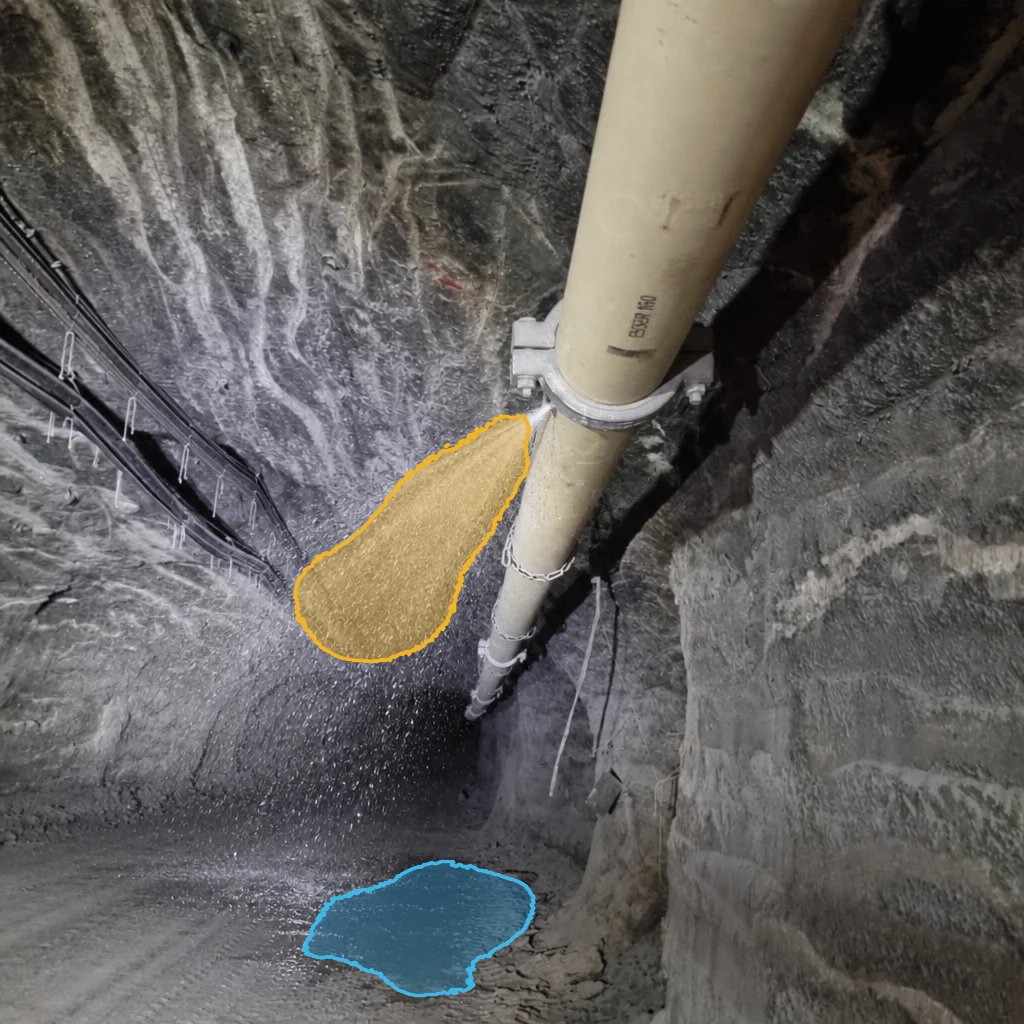
    Slurry line — spray and puddle detected
    Slurry line — spray and puddle detected

    Slurry pumps

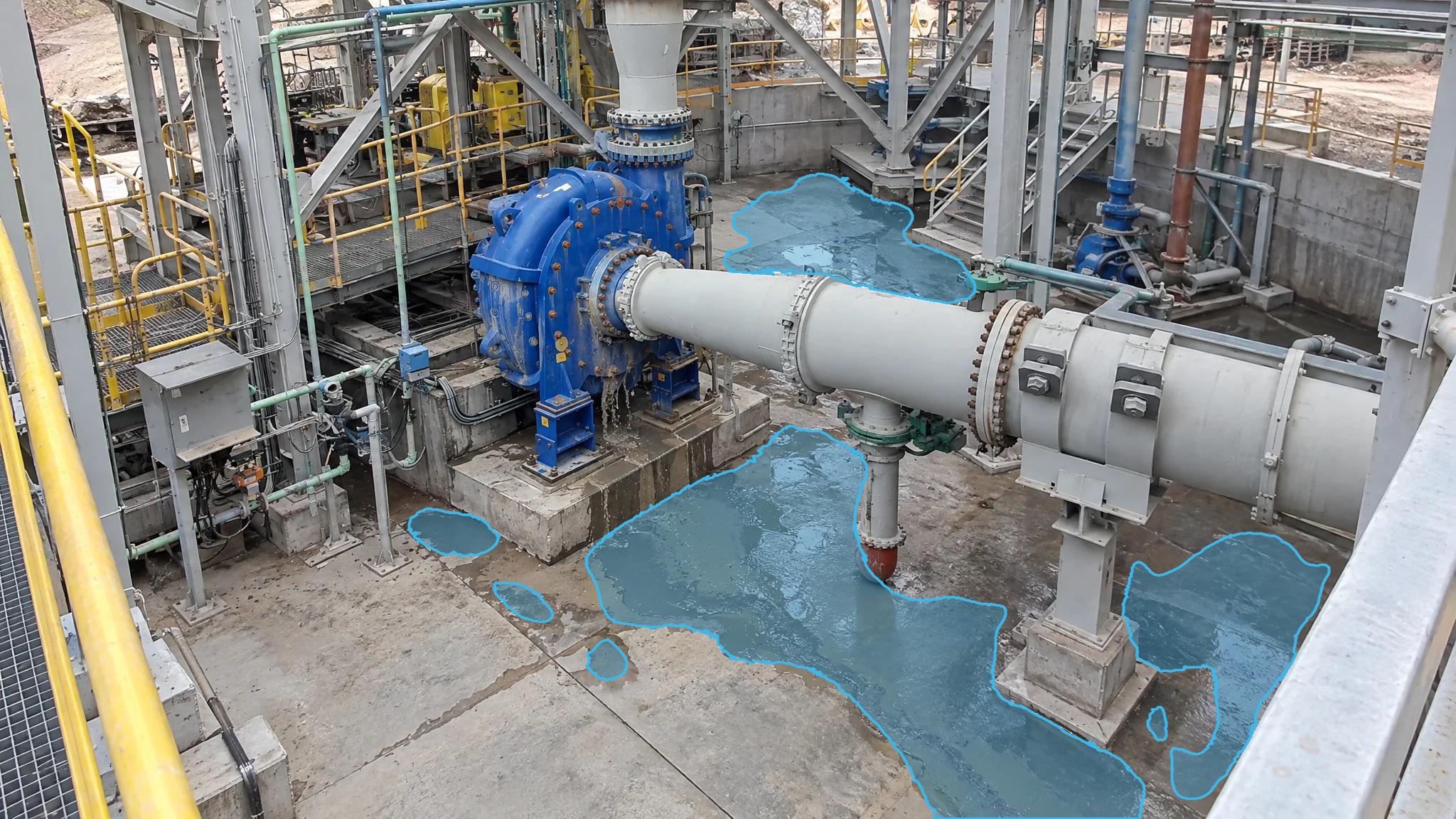
    Abrasive slurry eats pipe at every elbow and gland. V4 watches for slurry or process water pooling under a pump and spray from a pump gland, with interest zones on the pump box and the surrounding floor. The alarm lands in the VMS and, over Sparkplug B, in Ignition on the operator's screens.

    Blue slurry pump in a mill with blue detection overlays marking liquid pooling across the concrete floor.
    Mill slurry pump — puddle detected

    Leach fields

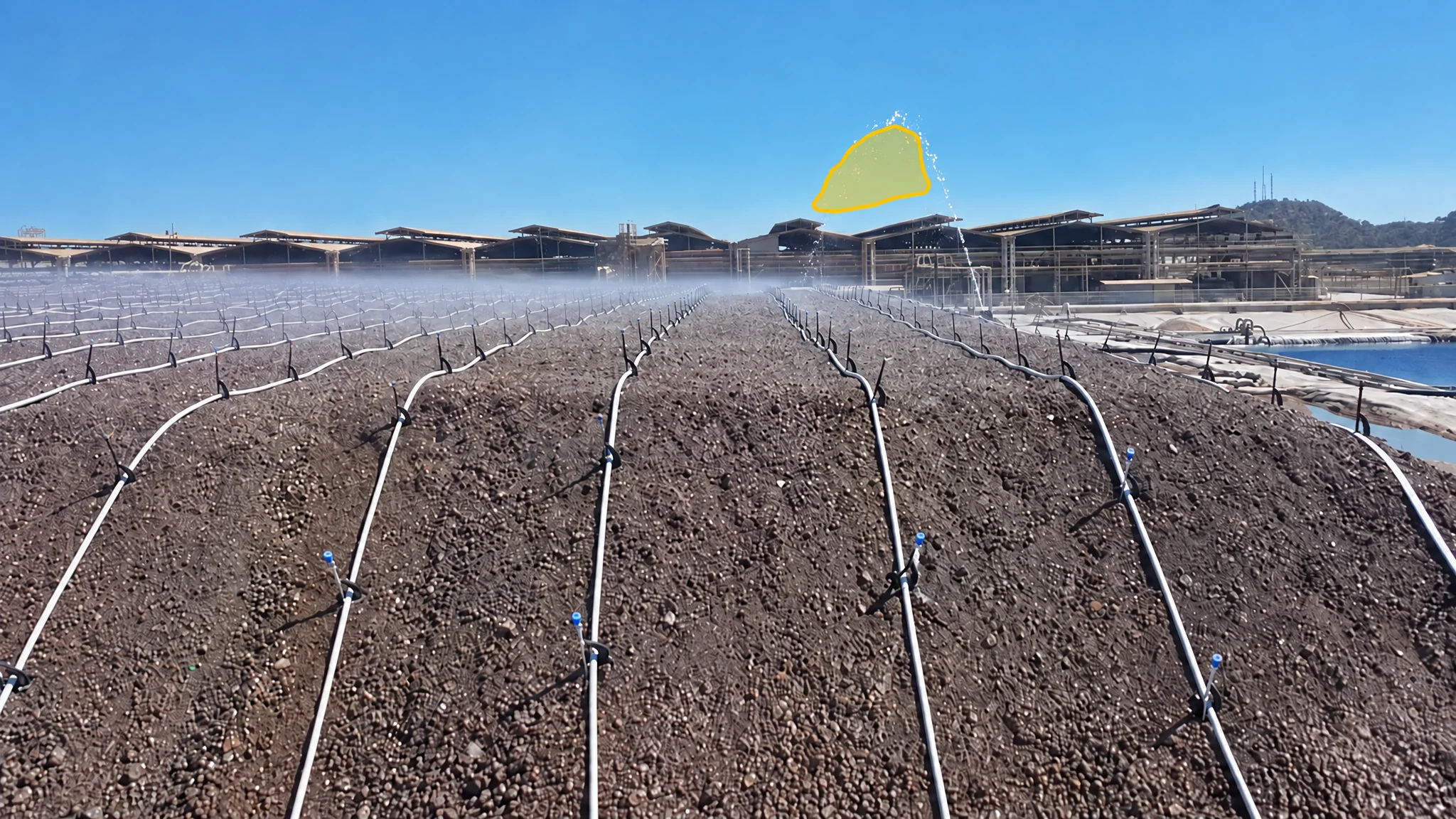
    At leach pads and pump stations, interest zones define the areas of the camera's view to watch for a puddle or spray. Alarms reach the VMS and the control room with a timestamp and snapshots. V4 does not identify the liquid or measure its concentration.

    Leach pad irrigation lines with a yellow detection overlay marking the elevated spray from a malfunctioning spray line.
    Leach field — spray detected

    Why it matters in mining

    Housekeeping is a rule, not a preference.

    MSHA requires that workplaces and passageways at every mining operation be kept clean and orderly, that the floor of every workplace be kept clean and, so far as possible, dry, and that safe means of access be provided and maintained to all working places. A puddle on a walkway is a citation and a slip before it is a cleanup.

    Fuel and lube storage carries its own duties.

    MSHA requires tanks, piping, valves and fittings for flammable and combustible liquids to be maintained in a manner that prevents leakage, with containment for the full capacity of the largest tank where escaping liquid could endanger people. Where a site stores more than 1,320 gallons of oil above ground and could reach navigable waters, an SPCC plan adds regular inspection of containers, valves and piping and prompt correction of visible discharges.

    Every alarm is evidence.

    Each alarm carries a timestamp, the original frame and the overlay frame, written the moment the release is detected. The record of what was seen, and when, is there for the incident report, the insurer and the next shift.

    How it is deployed in mining

    On-camera

    Outdoor assets with a single camera on a pole, such as a tailings booster station, a fuel island, a leach pad pump station or a remote conveyor drive, run VisionAery Liquid Leak Detection on the camera itself: Axis ARTPEC-9 today, Hanwha Wisenet 9 from November 15, 2026. Zones are drawn once on the pipe, the apron or the containment, and the alarm travels over the same radio or fiber link that already carries the camera. A PTZ on a tour around a fuel farm gets its own zones at each preset.

    On-server

    The mill, the truck shop and the process plant usually have a mixed camera fleet on an existing VMS. There V4 runs on-server, on Emerson PACEdge industrial PCs, an x86 box with an integrated Intel GPU or an NVIDIA GPU, or an NVIDIA Jetson, all shipping November 15, 2026. The server takes RTSP from any H.264 camera, including the cameras in rated housings in the mill and the reagent area, watches many channels at once and returns an overlay stream per channel to the VMS.

    Integrations

    On-camera, alarms are native camera events into the VMS through the Axis event engine or Hanwha camera events. On-server, alarm triggers go into Nx Witness, Wisenet WAVE, Milestone and AXIS Camera Station with an overlay RTSP stream per channel. Alarms publish over MQTT as JSON or Sparkplug B, pre-mapped for Ignition, and into DeltaV over MQTT on Emerson; HTTPS webhooks reach email, SMS, ticketing or a BMS.

    Rain

    Outdoor channels use a rain gate that pauses detection while it rains and for a forgiving window afterwards, fed by a rain sensor on the camera's I/O port, an I/O module or a weather service. A failed weather lookup never blocks detection.

    Measured, not promised

    Measured on 9,147 previously unseen frames, including true positives and negatives, out of the box with no per-site training, before the alarm engine is applied.

    F-scoreDetection rateFalse positive rate
    Puddle0.88997.1%0.8%
    Spray and visible vapor0.92398.1%3.7%

    F-score is the pixel-level harmonic mean of precision and recall. Frame-level figures; the alarm engine's staging, persistence and color-confidence checks exist so that a false frame does not become a false alarm.

    Scenarios outside those tested are not covered by these figures.

    Detection within seconds · Installed and configured in under 30 minutes · About 25 pixels per foot on target, nothing else

    Detection depends on the view, lighting and image detail. VisionAery Liquid Leak Detection does not identify chemical composition, detect invisible gas or measure concentration, depth or volume. It supports, not replaces, inspections, required instrumentation, cleanup protocols and safety procedures.

    Questions

    Frequently asked questions

    The mill floor is always wet. Will it alarm all day?

    A wet floor on its own does not trigger an alarm. A color-confidence check separates liquid from shadow and a wet stain, and the alarm engine requires a detection to persist and grow before it stages from green to red. Interest zones go on the skid, the pump box and the walkway you care about; exclusion zones cover the launder and the wash-down area that is always running.

    Can it tell hydraulic oil from slurry or water?

    No. V4 reports a puddle, a spray or visible vapor and where in the frame it is. It does not identify the liquid, measure volume or concentration, or read a sight glass. The snapshot tells your people which pump, which hose or which tote to walk to; they decide what it is.

    Will it work on the cameras in the mill building and the reagent area?

    On-server, yes: the server takes RTSP from any H.264 camera, so the cameras already in rated housings stay where they are. On-camera deployment is for Axis ARTPEC-9 and Hanwha Wisenet 9 cameras.

    How much of a tailings line can one camera cover?

    What matters is pixels on target: about 25 pixels per foot on the pipe and the ground you want to watch. A fixed camera at a booster station or a pipe-rack crossing covers the joints it can see at that density; a PTZ on a tour covers several stretches with zones bound to each preset. Distance and leak size do not matter on their own.

    Does this change our MSHA inspections?

    No. Workplace examinations and housekeeping are your program and your decision. V4 is a continuous watch between them that gives each alarm a timestamp and a pair of snapshots. VisionAery makes no regulatory or compliance claim.

    Put a continuous watch on the lines, skids and bays that a walk-down sees once a shift.