VisionAery

    Industries · Battery energy storage

    Glycol and transformer oil on the yard, seen in seconds

    An enclosure's thermal management loop drips glycol onto the pad between O&M visits. The MV transformer radiator weeps into the gravel. The yard cameras see it the day it starts.

    Battery energy storage yard with the VisionAery overlay marking a puddle beside an enclosure.
    Battery energy storage yard with the VisionAery overlay marking a puddle beside an enclosure.

    Where leaks start in battery energy storage

    A utility-scale storage or renewables site is a yard of sealed enclosures with liquid inside them. Each BESS enclosure carries a thermal management system with a liquid coolant loop, usually a water-glycol mix, with a chiller unit on the end wall, hoses, quick-connects and a pump. PCS and inverter skids are increasingly liquid-cooled. Every block has an MV transformer, and the site has a collector substation with a main transformer full of mineral oil. At a wind site each turbine has a gearbox and hydraulic systems whose oil runs down the tower to the base. The yard is unstaffed, visited on an O&M schedule, and the gravel and the pad show the leak only to whoever is looking.

    Sites and assets

    • BESS container and cabinet yards, enclosure thermal management systems and chiller units
    • PCS and inverter pads, liquid-cooled inverter skids
    • MV transformers and switchgear on each block
    • Collector substations at solar, wind and storage sites: main transformer, breakers, containment
    • Wind turbine tower bases and nacelle gearbox and hydraulic oil at ground level
    • Solar inverter pads and central inverter stations
    • Commissioning laydown: glycol totes, fill carts and hose couplings
    • O&M laydown and spare equipment pads

    What V4 watches for

    • Puddle: glycol and coolant under an enclosure's chiller end, a PCS skid or an inverter; mineral oil at the base of an MV or main transformer; gearbox and hydraulic oil at a turbine base; diesel at a site generator.
    • Spray: pressurized coolant from a hose or quick-connect on a thermal management loop; hydraulic oil at a crane or a turbine base.
    • Vapor: visible steam or vapor at any release that forms a plume the camera can see.

    Use cases

    Enclosure thermal management loops

    The thermal management system on each enclosure moves coolant through hoses, quick-connects and a pump to a chiller unit on the end wall. A coupling weeps, a hose chafes on a bracket, a drain valve is left cracked after service, and the coolant runs down the end wall onto the pad. Bright glycol on concrete is easy to see when someone is there; nobody is. V4 runs on the yard cameras that already watch the rows, with an interest zone on the pad along the chiller ends and an exclusion zone on the enclosures. The puddle is reported as it appears, posts into the VMS, and reaches the site SCADA as a Sparkplug B tag beside the enclosure's own alarms.
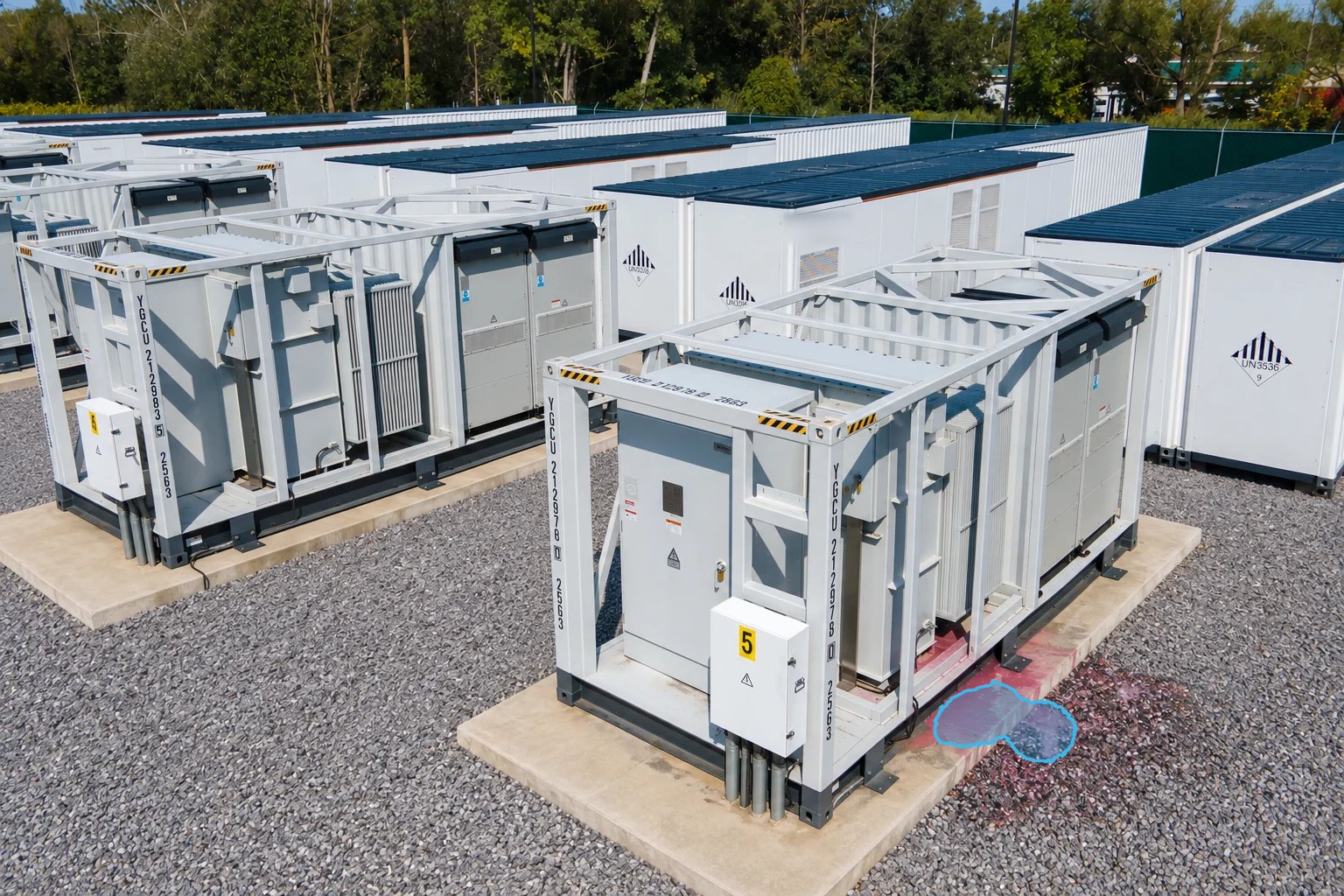
    Battery energy storage yard — puddle detected
    Battery energy storage yard — puddle detected

    PCS and inverter pads

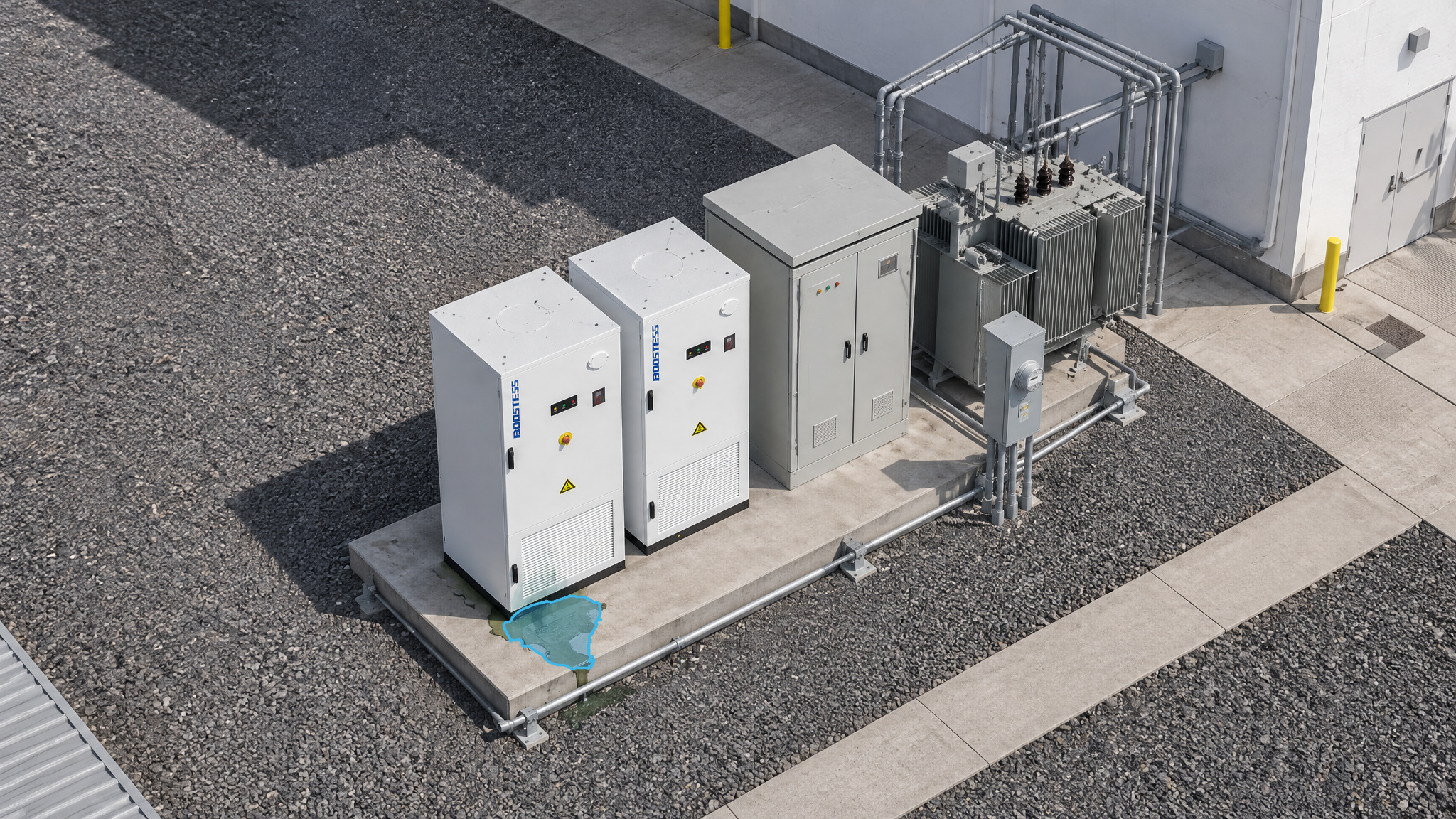
    A liquid-cooled PCS or central inverter has its own coolant loop and its own radiator, and the skid sits on a pad with a transformer beside it. A leak here shows as coolant at the skid base or oil at the transformer base, and the pad is visited when something trips. The same yard camera, or a PTZ with a preset on each pad, gives V4 a view of the skid base and the transformer pad together. The alarm reaches the O&M provider by webhook with the original and overlay snapshots, so the dispatcher knows what the truck is going to find.

    Electrical equipment and a transformer on a concrete pad with a blue detection overlay marking a puddle beside the cabinets.
    PCS pad — coolant puddle detected

    MV transformers and the collector substation

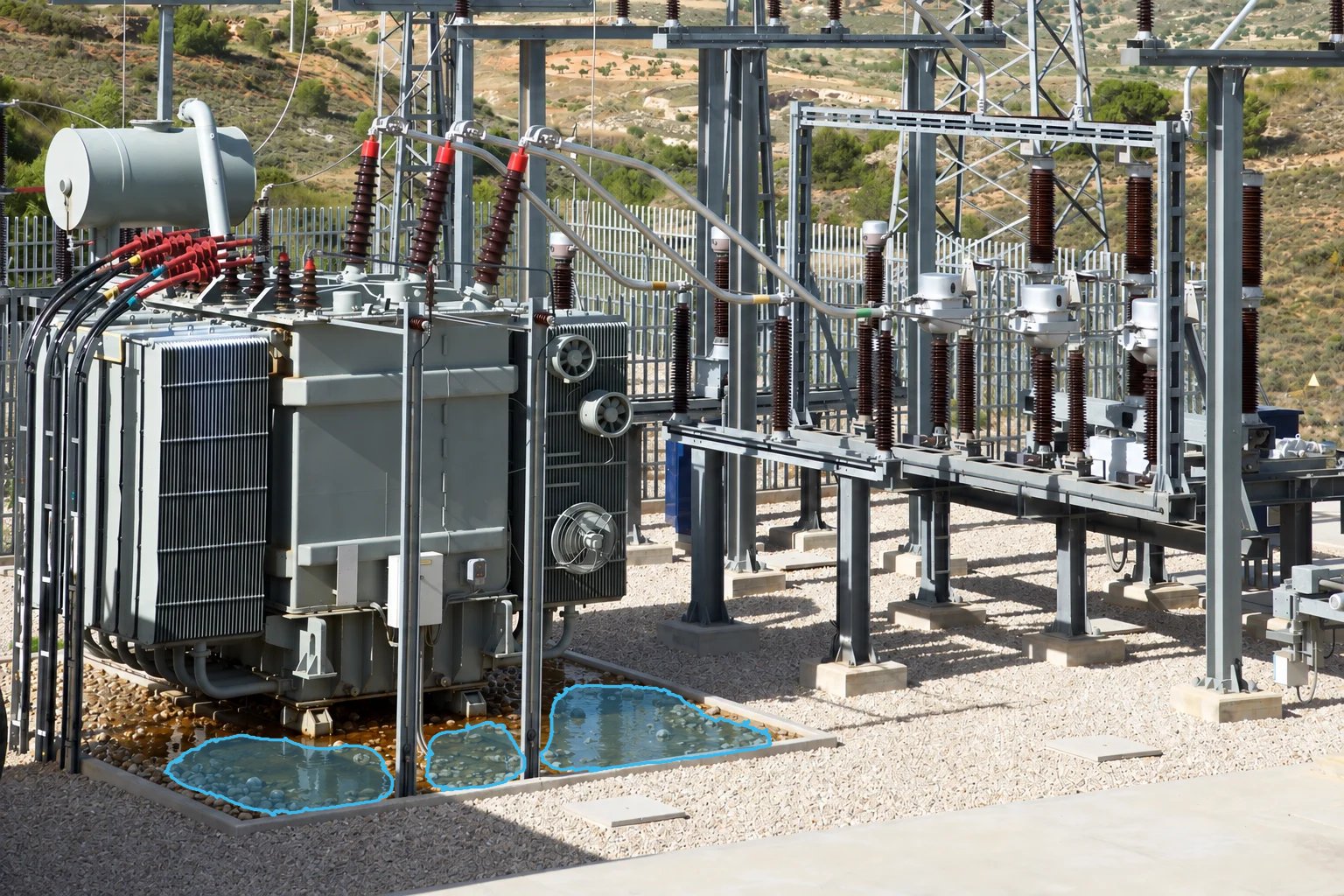
    Every block's MV transformer and the site's main transformer hold mineral oil, and they leak at the same places any transformer does: radiator welds and valves, bushing gaskets, drain valves. The substation is fenced, remote and walked on the O&M schedule, and the gravel hides the weep until it is large. V4 watches the base of each unit from the substation cameras, with an exclusion zone on the tank and the radiators, and the rain gate holds the alarm while it rains. The alarm lands in the VMS and the site SCADA over MQTT, and the containment pit, where there is one, gets its own interest zone.

    Substation transformer — oil puddle detected
    Substation transformer — oil puddle detected

    Wind turbine bases

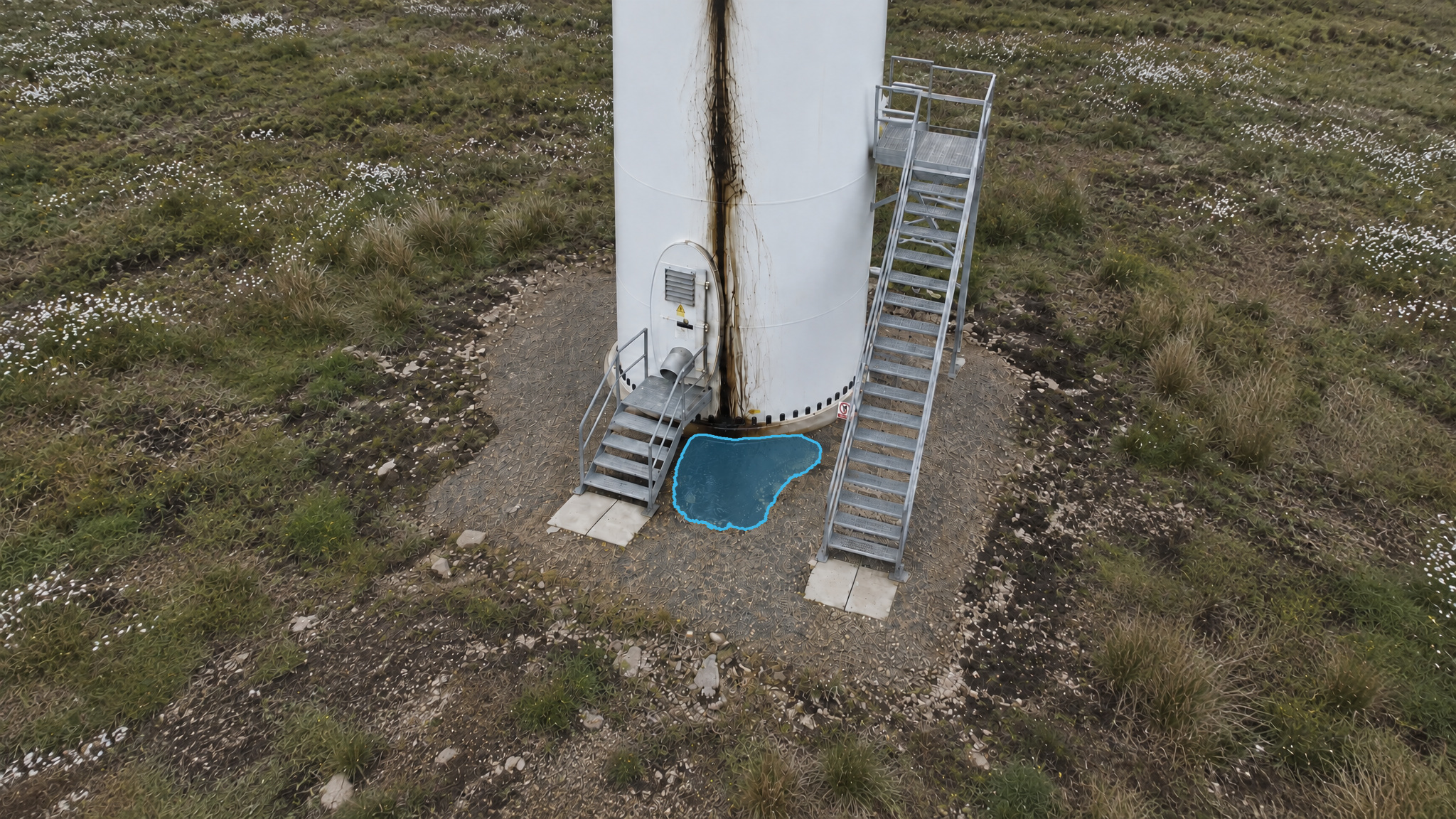
    The gearbox, the hydraulic pitch and brake systems and the yaw drives in the nacelle all hold oil, and when a seal or a hose fails the oil runs down the inside of the tower and out at the base, or down the outside of the tower to the pad. From the ground the sign is a streak on the tower and a dark patch at the door. V4 runs on a camera on the pad or the met mast looking at the base and reports the puddle at the door and the streak as it reaches the ground. The alarm reaches the wind farm SCADA over MQTT and the O&M crew by SMS.

    Wind turbine base with a dark streak down the tower and a blue detection overlay marking a puddle below the access door.
    Wind turbine base — oil puddle detected

    Why it matters in battery energy storage

    The installation standard sets the site out; the liquid side still leaks.

    NFPA 855, Standard for the Installation of Stationary Energy Storage Systems, is the installation standard for stationary storage. After commissioning, the thermal management loops, the PCS coolant and the transformers are O&M assets on a site that is visited on a schedule, and a leak between visits is found at the next one.

    The transformers count toward SPCC.

    EPA treats transformers as oil-filled operational equipment, counts any unit of 55 gallons or more, and applies 40 CFR part 112 to a facility with more than 1,320 U.S. gallons of aggregate aboveground oil. A facility that relies on the qualified oil-filled operational equipment alternative to secondary containment must document inspection procedures or a monitoring program to detect equipment failure or a discharge, and keeps that status only while it has had no single discharge over 1,000 gallons and no two over 42 gallons in any twelve months over three years (40 CFR 112.7(k)).

    The record is written at detection.

    Every alarm carries a timestamp and the original and overlay snapshots. The O&M provider, the owner and the offtaker all get the same answer to when the leak started and what was seen.

    How it is deployed in battery energy storage

    On-camera

    Yard, substation and turbine-base cameras run V4 on Axis ARTPEC-9 today and on Hanwha Wisenet 9 from November 15, 2026, with only the event and the snapshots going back over the site network. Nothing is processed in the cloud and there is no per-site training, which suits a site with no server room and a thin link. A PTZ on a tour binds its interest and exclusion zones to each preset, so one camera covers several pads in turn.

    On-server

    An x86 server with an integrated Intel GPU or an NVIDIA GPU, an NVIDIA Jetson in the site control enclosure, or an Emerson PACEdge industrial PC takes RTSP from the existing H.264 cameras of any make. This suits a site whose cameras came with the EPC package as a mixed fleet, and an owner that already runs Ignition for site SCADA. All on-server platforms ship November 15, 2026.

    Integrations

    On-camera, native events into the VMS through the Axis event engine or Hanwha camera events. On-server, alarm triggers into Nx Witness, Wisenet WAVE, Milestone and AXIS Camera Station, and an overlay RTSP stream per channel. MQTT as JSON or Sparkplug B, pre-mapped for Ignition, into the site SCADA, and into DeltaV over MQTT on Emerson. HTTPS webhooks to the O&M provider's ticketing, email or SMS.

    Rain

    Every outdoor channel takes a rain gate from a rain sensor on the camera's I/O port, an I/O module or a weather service; a failed weather lookup never blocks detection.

    Measured, not promised

    Measured on 9,147 previously unseen frames, including true positives and negatives, out of the box with no per-site training, before the alarm engine is applied.

    F-scoreDetection rateFalse positive rate
    Puddle0.88997.1%0.8%
    Spray and visible vapor0.92398.1%3.7%

    F-score is the pixel-level harmonic mean of precision and recall. Frame-level figures; the alarm engine's staging, persistence and color-confidence checks exist so that a false frame does not become a false alarm.

    Scenarios outside those tested are not covered by these figures.

    Detection within seconds · Installed and configured in under 30 minutes · About 25 pixels per foot on target, nothing else

    Detection depends on the view, lighting and image detail. VisionAery Liquid Leak Detection does not identify chemical composition, detect invisible gas or measure concentration, depth or volume. It supports, not replaces, inspections, required instrumentation, cleanup protocols and safety procedures.

    Questions

    Frequently asked questions

    Does it tell glycol from rainwater on the pad?

    It reports a puddle and where it is; it does not identify the liquid. The color-confidence check separates liquid from shadow and stain, the rain gate holds the alarm while it rains and for a window afterwards, and the snapshots show the O&M dispatcher what the camera saw.

    Can it see a leak inside the enclosure?

    No. V4 sees what the camera sees: the pad, the chiller end, the skid base, the transformer base. It does not see through walls, and it does not replace the enclosure's own thermal management instrumentation. It watches the ground where a leak ends up.

    Our site has no SCADA yet. Can we start during commissioning?

    Yes. On-camera, V4 needs the camera and a network link; events go into the VMS from the first day. When SCADA is commissioned, the MQTT feed is added and the alarms appear as Sparkplug B tags in Ignition.

    How does the alarm reach site SCADA and the O&M provider?

    Over MQTT as JSON or Sparkplug B, to your broker or to an embedded broker on the camera that bridges to yours, pre-mapped for Ignition. For the O&M provider, an HTTPS webhook posts JSON, with snapshots if you want them, to its ticketing system, or the alarm goes out by email or SMS.

    How many cameras does a yard need?

    V4 needs about 25 pixels per foot on the pad you want to watch, not on the whole yard. A fixed camera covers the chiller ends of a row; a PTZ on a tour covers several pads and the substation with its own zones at each preset. Each channel takes under 30 minutes to install and configure.

    Put a continuous watch on every block, every pad and the substation between O&M visits.