

VisionAery Analytic
Live Demo AvailableFlare Monitoring — what your SCADA can't see
Continuous edge-AI computer vision for flare-stack flame, pilot, ignition, smoke, and wind-out — independent visual confirmation that cross-confirms the SCADA pilot-thermocouple value, with timestamped compliance logs aligned to NSPS Subpart OOOOa and EPA Method 22.
Edge Hardware
Hardware Flare Monitoring runs on
Flare Monitoring runs at the edge, right at the stack. Deploy it on a fanless Jetson box or a smart camera's onboard compute — choose what fits the flare-pad power and connectivity you already have, and we'll deploy it.
_1779202116804-C31fGfYV.png)
ARM SoC · GPU + DLA
NVIDIA Jetson Orin
Fanless edge inference box at the flare pad. The reference platform — best performance per watt for remote installs.

On-camera inference
Axis ARTPEC-8
VisionAery Flare runs directly on Axis ARTPEC-8 cameras for sites that prefer a single-device install with no separate edge box.
VisionAery Flare in the field
Flame, smoke, and area — measured frame by frame
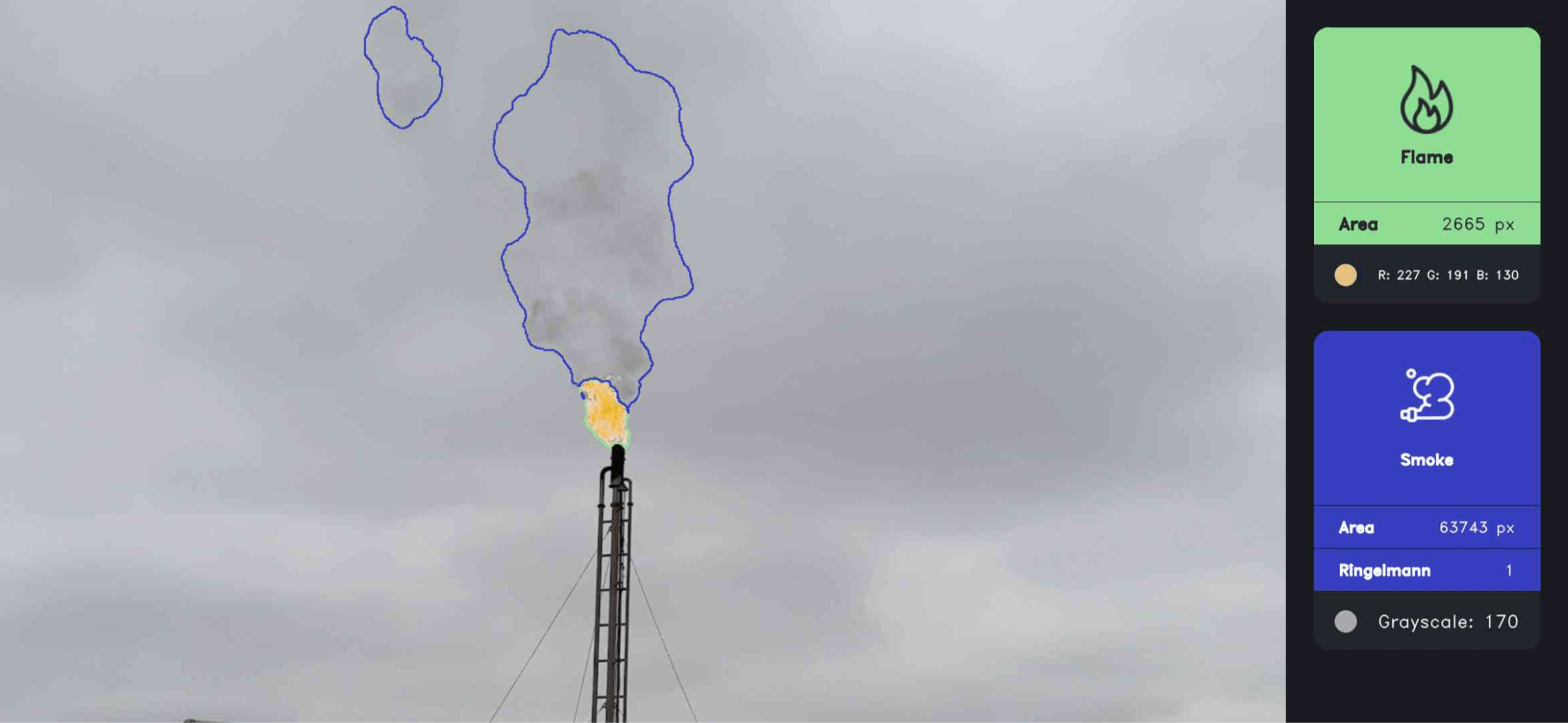
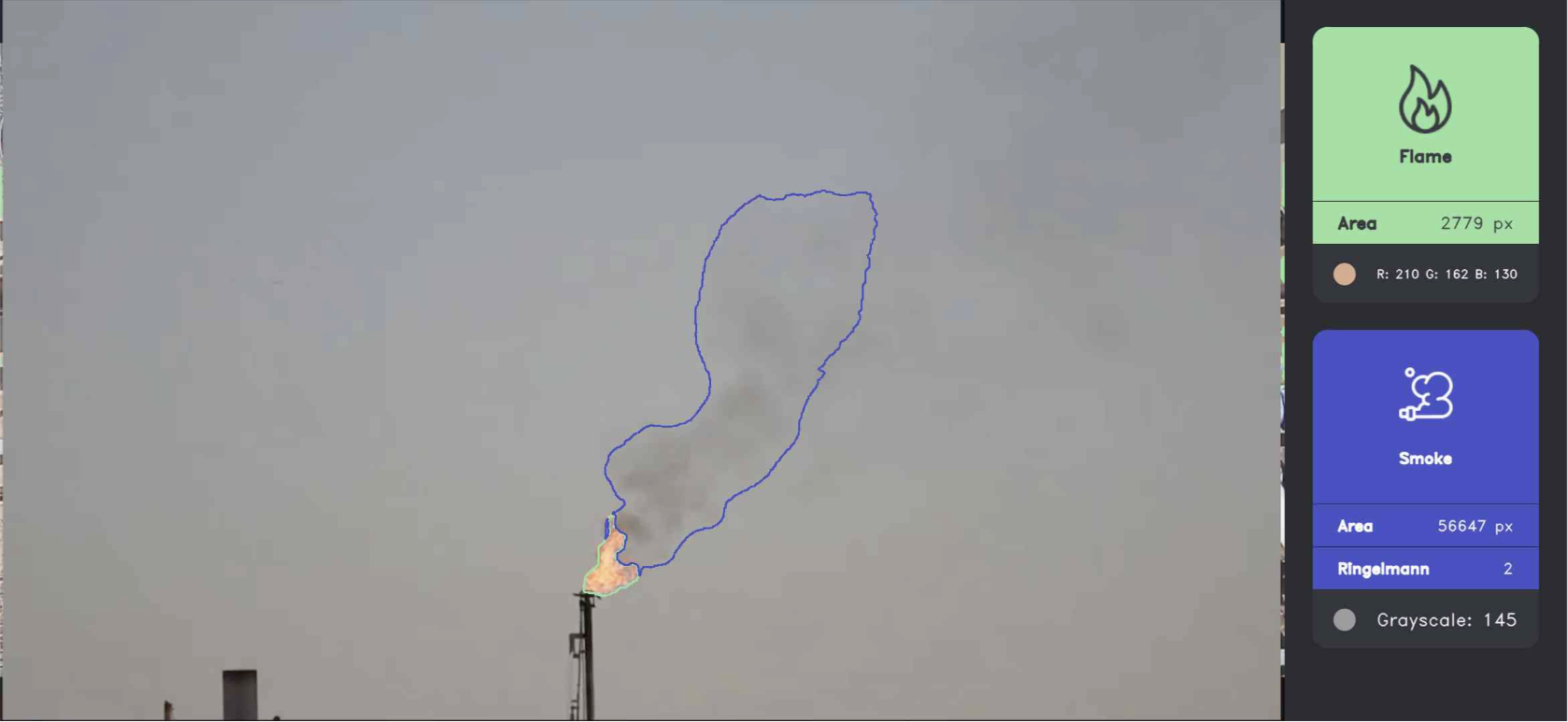
The model outputs a flame mask and a smoke mask on every frame, with pixel-area and Ringelmann-shade readouts — so a flame area dropping toward zero, or a smoke area trending up, becomes a measurable, alarmable, time-stamped event instead of an operator hunch.
Live overlay shown here is captured straight from a production VisionAery edge box — no post-processing, no compositing. Every VisionAery model is trained on real oilfield imagery only — never synthetic data.
 Flare · Analytics overlay
Live model output
Short loops captured on production flare stacks — flame and smoke overlays drawn by the VisionAery model frame-by-frame, no post-processing. Includes Eagle Ford and LYB Mio Poly sites under varied wind, lighting, and combustion conditions.
Want to see Flare Monitoring on your own footage?
Upload a short clip from one of your flare stacks and watch the model draw flame and smoke overlays on a live stream — same model, same overlays, running on your video.
Smart Alarms, Dashboards & Method 22-Style Reports
From a pixel detection to a filed compliance report
Detection is only useful if the right people see it and the regulator-facing paperwork falls out the back end. VisionAery Flare Monitoring ships with a smart-alarm engine, a flare-health dashboard, and automated report generation — including Method 22-style PDF reporting (formal EPA approval pending) produced from the same observation window the camera was watching.
Smart Alarms
Define alarm criteria the way your operations team thinks — by flame state, smoke density, smoke color, accumulative duration, time of day, or a combination. Conditions are evaluated continuously at the edge and fired only when the criteria you set are met.
Rolling-Window Thresholds
Alarm on accumulative smoke time over rolling windows — for example, more than X seconds of dense smoke in any 6-minute window — exactly the way EPA Method 22 frames the observation. Window length, threshold, and dwell are all tunable per camera.
Dashboard & Historian Integration
VisionAery streams every flame, smoke, and wind-out telemetry value out over MQTT (or Modbus TCP) so it lands in your existing SCADA and historian — no data silo, no separate analytics database to maintain. The VisionAery dashboard surfaces live state and recent history; long-term storage and trending live in the customer's historian.
Automated Method 22-Style Reports
Schedule or on-demand request a smoke-frequency report — VisionAery records the data needed for an EPA Method 22 report and delivers it as a PDF (sample on this page). This is Method 22-style PDF reporting, with formal EPA approval pending; customers deploy it today for internal validation, compliance preparedness, and to reduce reliance on manual observer logs.
Sample Method 22 Report
Method 22-style PDF — auto-generated from a real VisionAery observation window
Total sample time, total emission time, emission frequency, sky/wind conditions, and start/end + min/max smoke frames — all populated automatically from the same camera feed that fired the alarm. This sample is a real report generated by VisionAery on a test flare in West Texas.
Note: this is Method 22-style PDF reporting, with formal EPA approval pending. Customers deploy it today for internal validation, compliance preparedness, and to reduce reliance on manual observer logs.
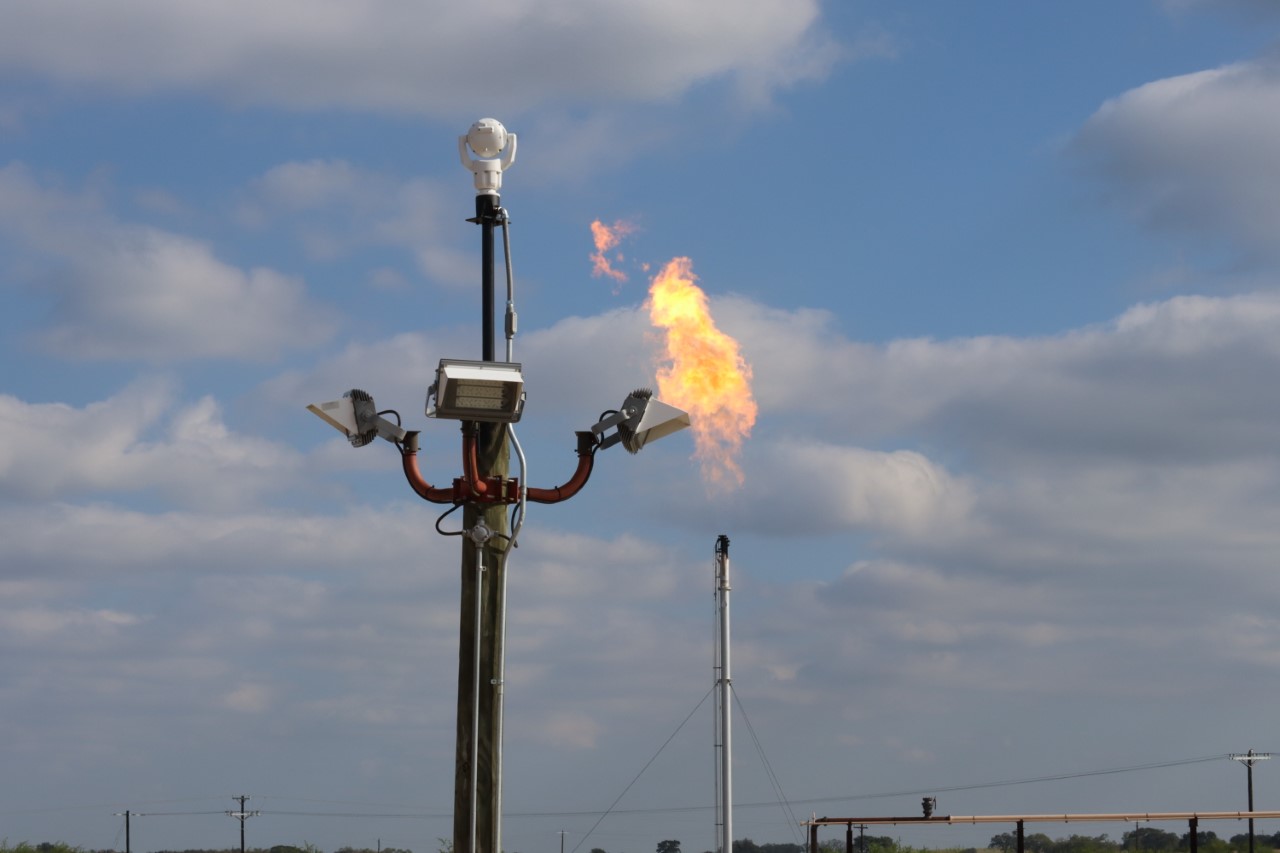
VisionAery field crew commissioning a VisionAery flare-monitoring camera on a production stack.
Field-testedSchedule a POC
See how Flare Monitoring performs on one of your sites
A VisionAery field crew comes to a representative flare on your facility, stands up VisionAery on the existing flare-stack camera (or a temporary one), and runs the analytic against your real conditions — your tip geometry, your wind regime, your steam, your pilot-thermocouple SCADA tag. You see flame, pilot, smoke, and wind-out detections wired through SCADA cross-confirmation end-to-end before any commitment.
- Flare-stack camera survey and AOI selection by a VisionAery engineer
- Live flame, pilot, smoke, and wind-out inference on your actual flare
- SCADA pilot-thermocouple cross-confirmation wired into your historian
- POC report with detection samples, compliance-log preview, and a deployment plan
What it does
Six capabilities that define VisionAery Flare Monitoring
One model, six things it does well — mapped end to end.
VisionAery
FLARE
Flame Presence, Size & Color
Reports flame-present, flame-out, flare-too-large, and flame-color shifts from the pixels — not just the thermocouple.
Ignition State & Re-Light Events
Flags ignitions, dropouts, re-lights, and pilot-to-main-flame handoffs as timestamped VMS bookmarks.
Smoke Size, Color & Density
Measures smoke area, color, and density — with rolling-window thresholds so accumulative smoke time becomes an alarm.
Wind-Out & Tip Integrity
Catches wind-out, misshapen flame envelopes, and off-axis flame conditions before an unlit-flare event.
SCADA Pilot-Thermocouple Cross-Confirm
Cross-confirms the visible flame state against the SCADA pilot thermocouple — disagreement raises an alarm.
VMS, SCADA & Compliance Integration
Publishes flame, smoke, and wind-out events into VMS bookmarks, SCADA tags, and Method 22-style PDF reporting (formal EPA approval pending).
VisionAery Flare Monitoring runs continuous inference on the flare-stack camera feed and reports flame-present, pilot-present, and unlit-flare states in real time. It also measures flame-envelope area (in pixels, convertible to square meters using camera optics and stack distance) so a flare-too-large or oversized release is alarmable, and reports the average flame color as RGB values that can be trended over time. The pilot-flame thermocouple SCADA value tells you the pilot is hot — not whether the flare flame itself is visible or behaving normally. VisionAery closes that loop with the pixels. Visible-spectrum RGB cameras only — VisionAery Flare Monitoring is not a thermal, OGI, or IR analytic.
The transitions matter. VisionAery flags ignition events, momentary dropouts, re-lights, and pilot-to-main-flame handoff conditions — the kinds of state changes a thermocouple might miss but a camera can see. Each transition is timestamped and bookmarked in the VMS for engineering review and combustion-quality analysis.
An over-greased or fuel-rich flare produces visible black smoke long before downstream regulators or air-quality monitors catch it. VisionAery measures smoke area (in pixels — convertible to square meters using camera optics and stack distance) and a Ringelmann opacity score derived from the grayscale grading system applied to the detected smoke contour. Set alarms on accumulative smoke time over rolling windows — more than X seconds above a Ringelmann threshold in any 6-minute window — exactly the way EPA Method 22 frames the observation. Visible RGB cameras typically catch black smoke better than IR or VISR systems, which struggle with low-emissivity smoke in certain IR bands.
High wind, fuel-pressure swings, and tip damage all manifest visually — a blown-out flame, a misshapen flame envelope, an off-axis flame leaning toward equipment. VisionAery flags wind-out and tip-integrity anomalies so the operations team can intervene before an unlit-flare event releases unburned hydrocarbon to atmosphere.
The pilot thermocouple says hot; the camera says dark. Or the camera shows flame; the thermocouple is dropping. Either disagreement is a real operational signal. VisionAery publishes the visible flame state alongside the SCADA pilot-thermocouple reading and fires a cross-confirm alarm when the two diverge — surfacing failed thermocouples, blown-out flames the SCADA missed, and pilot-instrument drift before they become reportable events.
Flame-state, smoke-state, and wind-out events publish into the major VMS platforms (Genetec, Milestone, Avigilon, ExacqVision, Axis) as live alarms with the alarm frame attached and the timestamp bookmarked automatically for investigation, into SCADA via MQTT or Modbus TCP (also OPC UA / REST) for control-system integration, and into compliance-grade timestamped logs that drive automated reports — including Method 22-style PDF reporting (formal EPA approval pending) generated from the same observation window.
Frequently asked questions about VisionAery Flare Monitoring
See Flare Monitoring on footage from your sites
Run the live demo right now — upload a short flare clip and watch the analytic classify flame, pilot, smoke, and wind-out on a live stream. When you're ready to evaluate on your facility, schedule a POC and we'll walk through the SCADA cross-confirmation pattern with your control and EHS teams.