
VisionAery · AVA LLD
95%+ LLD AccuracyCurrently: Liquid Leak DetectionMeet AVA LLD — the Alarm Verification Agent for Liquid Leak Detection
Detection tells you something might be there. AVA LLD tells you whether it's real. A lightweight, reasoning-driven agent that verifies every Liquid Leak Detection alarm — separating true releases from the nuisance alarms that bury operators in noise. Deployed correctly, it raises Liquid Leak Detection accuracy to 95%+ in alarm detections. AVA is purpose-built for Liquid Leak Detection today, with more analytics on the roadmap.
_1781316097898-D8yuvuiE.webp)
Talk to AVA LLD
Ask AVA LLD anything
Meet AVA LLD in a live chat — ask how Liquid Leak Detection works, how it cuts nuisance alarms, and how it ties into your VMS, SCADA, and on-call notifications.

AVA LLD
Alarm Verification Agent · online
0/1500 · ⌘/Ctrl + Enter to send
AVA LLD is AI — verdicts and chat answers can be wrong, which is why every alarm is still batched for daily human review. For production guidance, contact our team.
Why AVA LLD exists
The three kinds of alarms every model creates
For many computer-vision models — but especially liquid leak detection — every alarm that fires falls into one of three buckets. Two of them are manageable. The third is the reason AVA LLD exists.
True-positive alarms
A real release. This is the entire point of the analytic — a genuine puddle, spray, or vapor event that an operator needs to act on. Every other alarm type is noise that competes with these for attention.
False alarms
The analytic fires on something that isn't a leak and isn't leak-like — a passing shadow, a vehicle, a reflection. These are largely solvable: with enough training data and counter-examples, the model learns to stop firing on them. For most use cases, false alarms can be trained out.
Nuisance alarms
The hard problem. These look almost exactly like the thing the model is built to detect, so you cannot simply train them away without also killing recall on real leaks. For liquid leak detection that means rain puddles, stains left by previous leaks, wash-down water, and standing water with no source. To a segmentation model, a rain puddle and an oil puddle are both 'liquid on the ground.'
AVA LLD was built for that third bucket. We needed a lightweight model that could use reasoning to decide whether an incoming alarm was a true positive, a false positive, or a nuisance — not just confirm that a shape on the ground matched a pattern.
How AVA LLD reasons
Context is the difference between "there's a puddle" and "there's a leak"
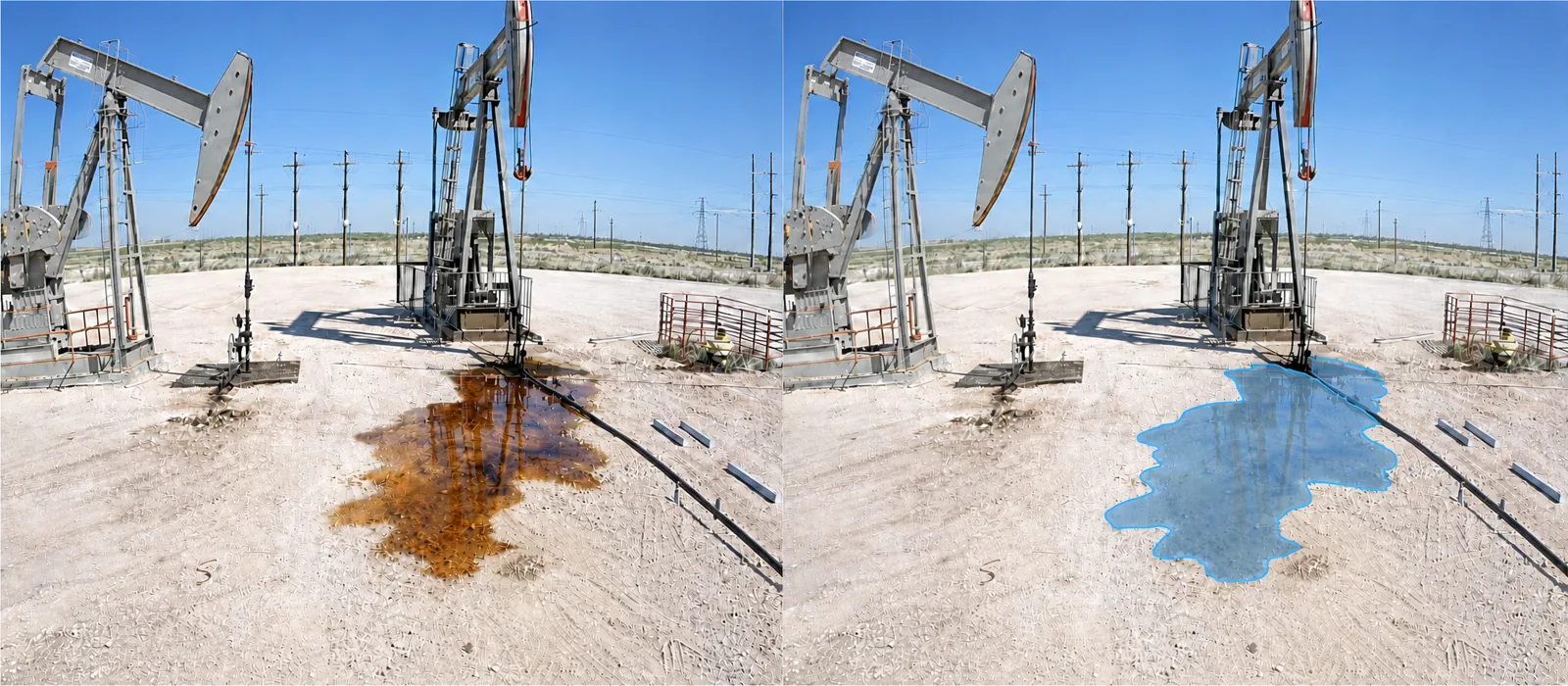
Standard segmentation computer vision can tell you yes-or-no whether there is a puddle. AVA LLD adds context and reasoning to determine whether the alarm is actually accurate — pulling in evidence a single frame can't provide.
Overlay vs. raw image
AVA compares what the analytic claims it sees in the detection overlay against what the raw, un-annotated frame actually shows — catching cases where the segmentation mask doesn't hold up under a second look.
Now vs. the last clean frame
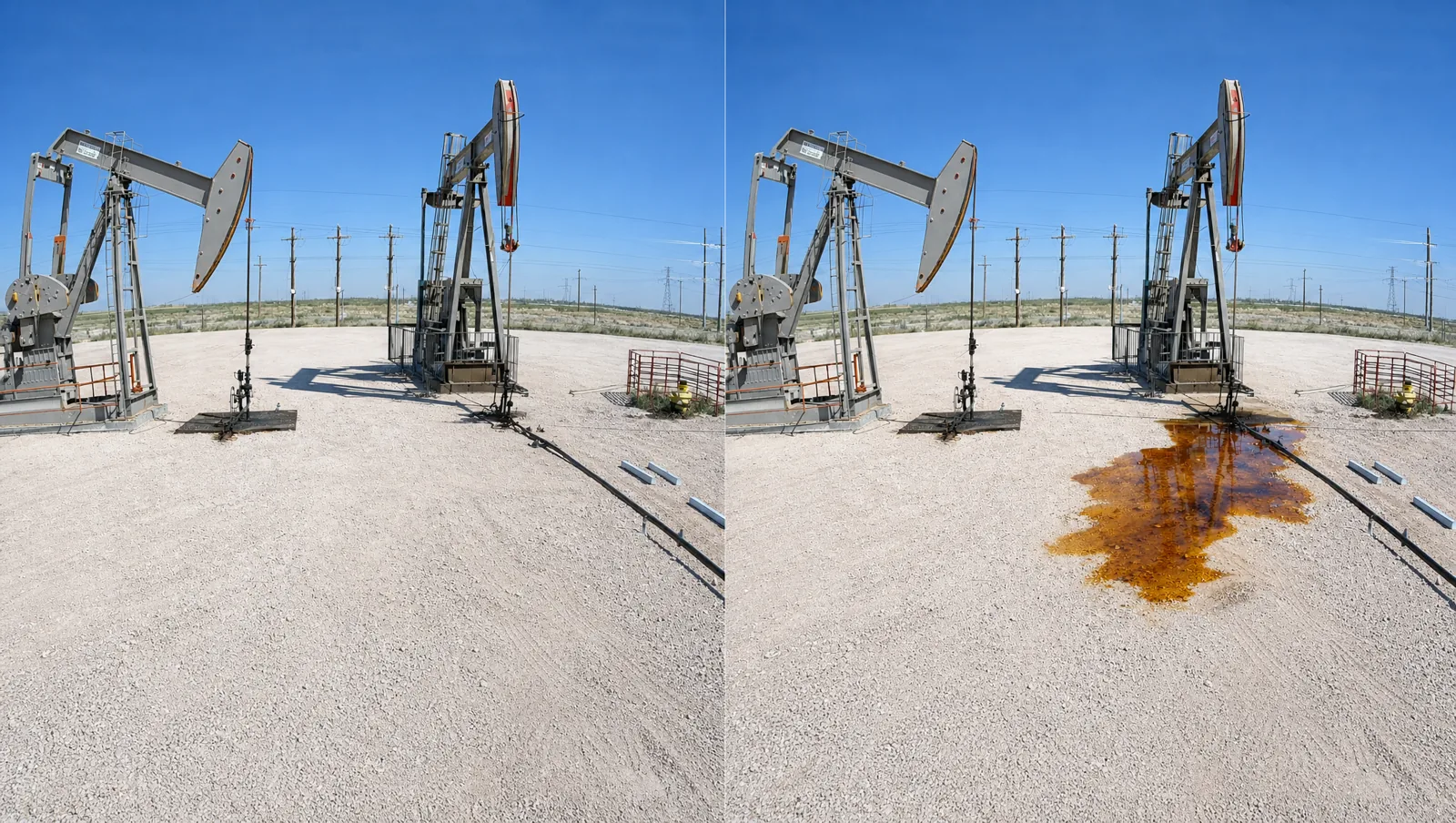
AVA pulls the previous raw image from the same camera and compares it to the alarm frame to isolate exactly what changed at the site — a new pool of liquid versus a stain that has been there for weeks.
Weather & precipitation context
AVA tracks weather through a weather API or an on-site edge precipitation sensor — how much it has rained and when it last rained — so a 'puddle' that appeared during a downpour is weighed very differently from one that appeared on a dry day.
_1781321626355-Cdk3IV3n.webp)
Alarm history & growth rate
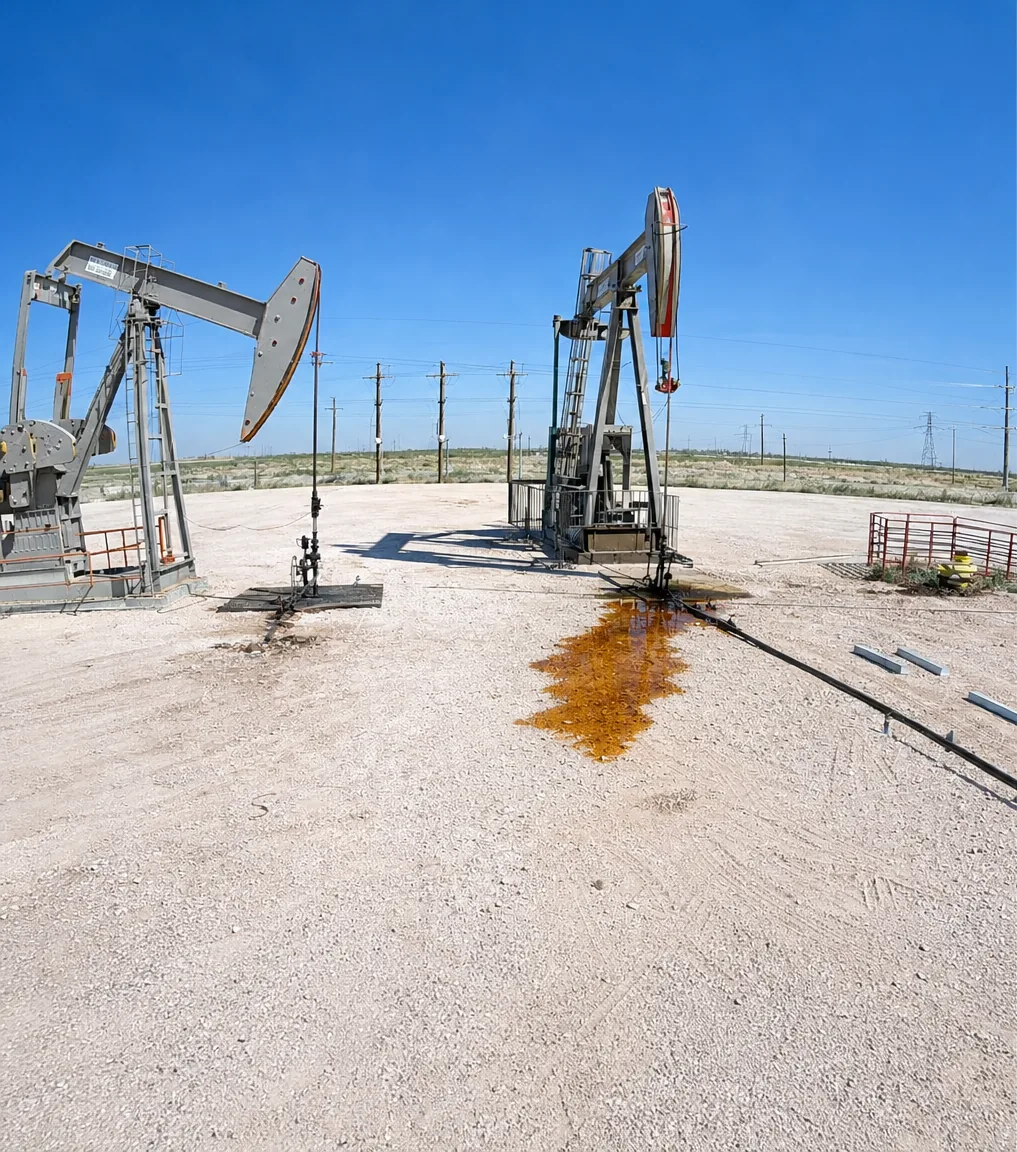
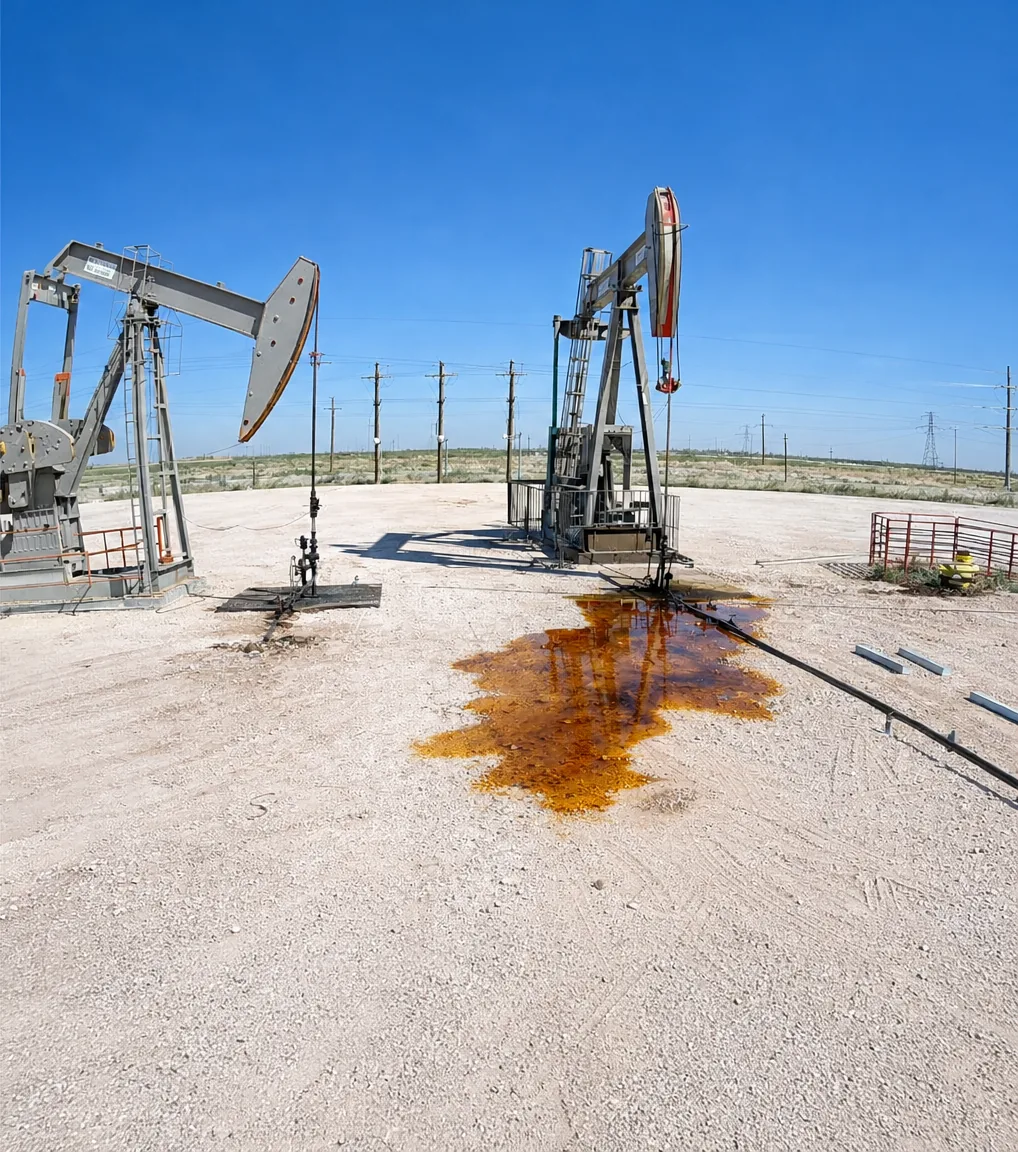
AVA checks when the last alarm fired on this camera to tell a net-new event from a slowly growing pattern — a spreading footprint over successive frames reads very differently from a one-off.
Origination point identification
AVA looks at whether the liquid in the frame is originating from equipment — a fitting, a valve, a seal — or simply sitting stagnant on the ground with no source. A leak has an origin; a rain puddle does not.
_1781321238412-mdRrJiKS.webp)
A reasoned verdict
AVA weighs all of this evidence and returns a structured verdict — true positive, false, or nuisance — so only alarms worth acting on reach an operator.
Built for the edge
Specialized and small enough to run in your control room
AVA was never going to work as a massive 500-billion-parameter model — that doesn't fit our edge-based deployment model with on-prem management. So we built AVA to be specialized, lean, and trained on the real thing.
Designed to run on a standard enterprise server in a control room — no hyperscale cloud required. Verification stays local, fast, and inside your network.
Trained entirely on real leaks across many different environments — so at ~10B parameters AVA is a specialist at confirming or denying leak alarms, far more accurate at this job than a general model like Gemini or ChatGPT.
Run AVA on-prem on the same edge-deployment and management model as the rest of the VisionAery stack, or let us host it in the cloud — whichever fits your sites and your network.
Even AVA LLD can be wrong — so a human still has the last word
AVA LLD removes alarm fatigue in real time, but no model is perfect. That's why every alarm is batched and sent once per day for a human to review — a safety net that keeps a person in the loop for detecting spills and leaks that even AVA LLD might misjudge.
The result: operators stop chasing nuisance alarms minute to minute, and the daily review preserves the safety guarantee that matters most.
Frequently asked questions
See what AVA LLD does to your nuisance-alarm rate
AVA LLD is purpose-built for Liquid Leak Detection — where deployed correctly, it raises alarm-detection accuracy to 95%+. Let's talk about your sites, your cameras, and the alarms your operators are tired of chasing.