

VisionAery Analytic
Live Demo AvailableFire & Smoke Detection — trained for industrial scenes
Continuous edge-AI computer vision for unintended flame, glow, and smoke on pad equipment, compressors, tank batteries, and processing skids — with per-camera suppression zones before alarming.
Edge Hardware
Hardware Fire & Smoke runs on
Fire & Smoke Detection runs on the edge hardware already mounted at your sites — on-camera compute, a pole-mount inference box, or a site server. Pick what fits your fleet and power budget, and we'll deploy it.
_1779202116804-C31fGfYV.png)
ARM SoC · GPU + DLA
NVIDIA Jetson Orin
Fanless on-camera or pole-mount inference box. The reference platform — best performance per watt for remote sites.

On-camera inference
i-PRO smart cameras
VisionAery Fire & Smoke runs directly on supported i-PRO smart cameras — no separate edge box required.
VisionAery Fire & Smoke in the field
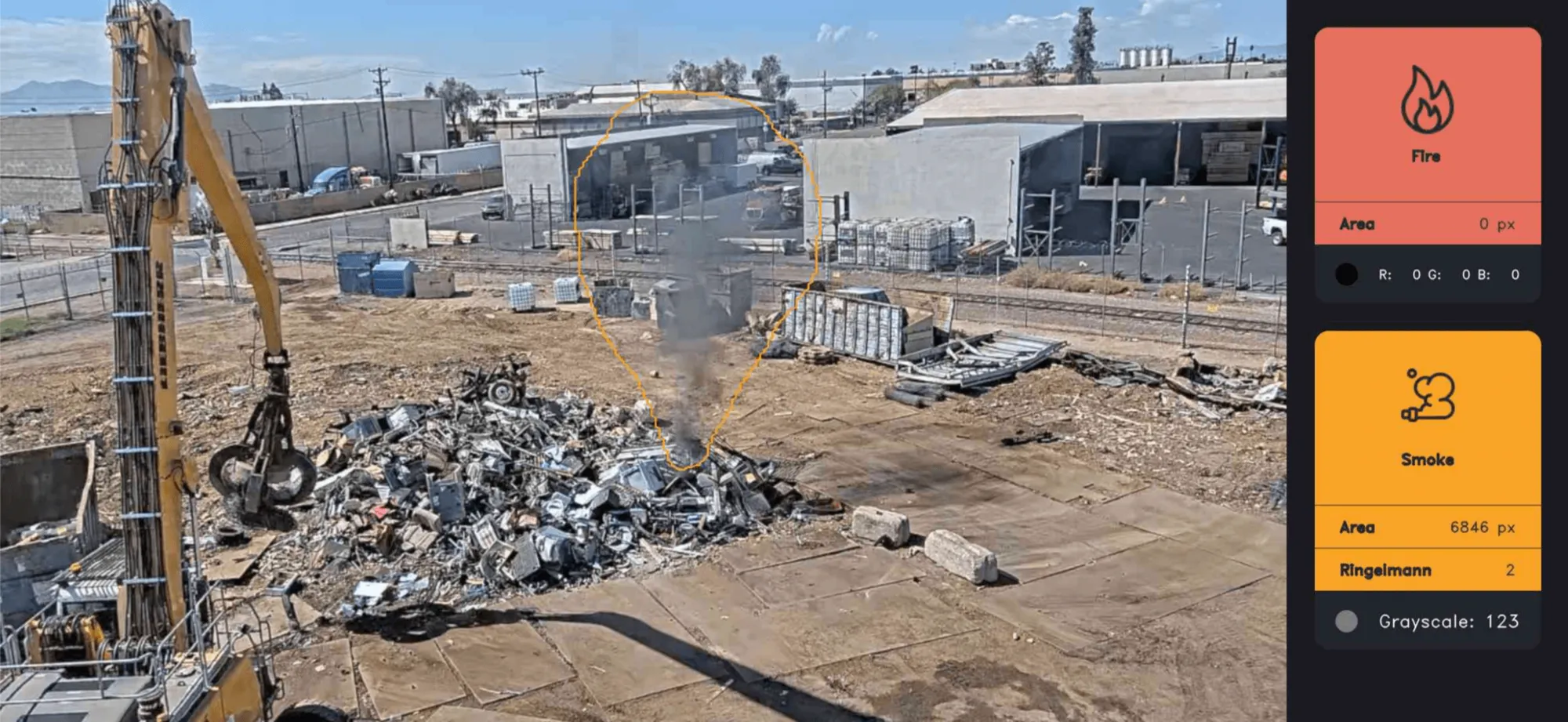
Detection on real industrial scenes
VisionAery Fire & Smoke is trained on real fire and smoke imagery from many industries — never synthetic data.
 Smoke
Smoke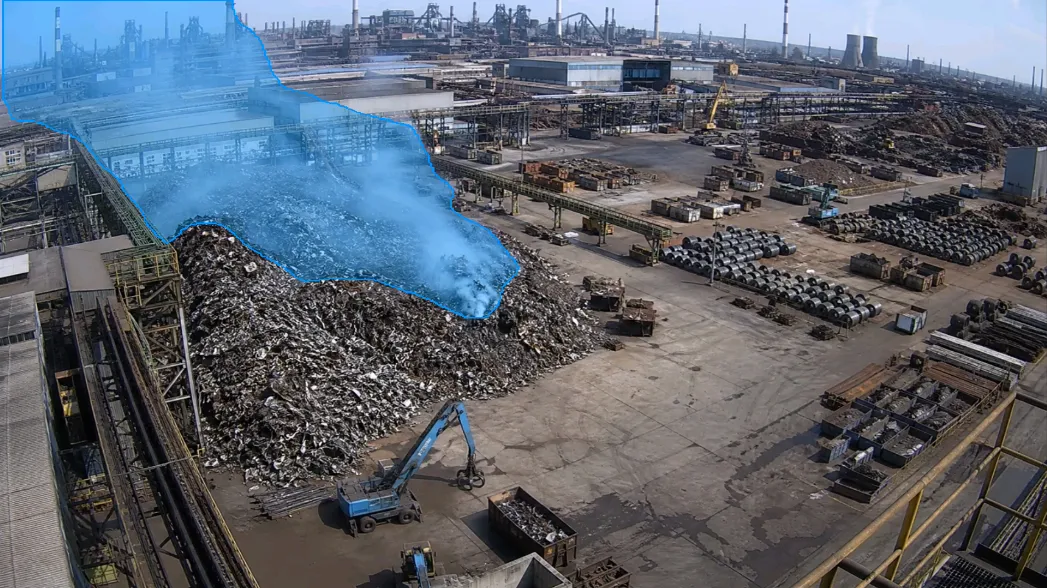 Smoke
Smoke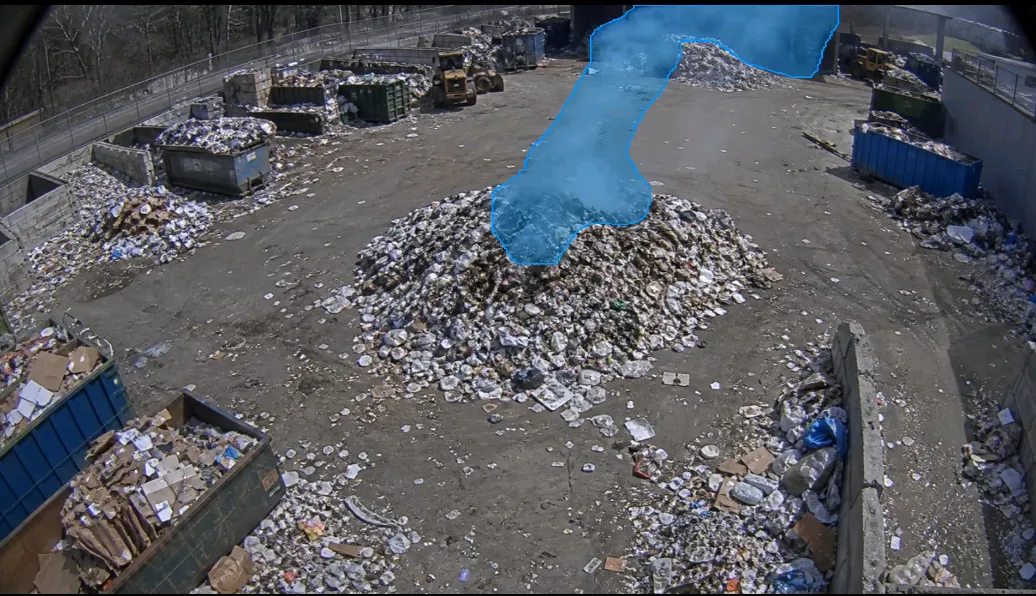 Smoke
SmokeLive model output
Run a live POC at one of your sites
A VisionAery field crew stands up Fire & Smoke on existing or temporary cameras at one of your sites and runs it live against your real equipment, lighting, and operating baseline. To validate detection safely, we use industrial-grade smoke bombs to simulate fire and smoke events — we never light real fires for a POC unless explicitly permitted by the end user. You see every detection, every dismissal, and a deployment plan at the end.
Joint Solution · VisionAery + FLIR
Dual-spectrum fire & smoke — visible plus thermal
VisionAery Fire & Smoke pairs with FLIR's early thermal fire detection to give operators dual-spectrum coverage on the same scene. VisionAery's computer-vision model quantifies the pixel area, color, and morphology of visible flame and smoke; FLIR's thermal imagers monitor for temperature anomalies and identify hot spots before a fire ever ignites. Together they cut detection latency and raise confidence on every alarm.
- Dual-spectrum imaging — thermal and visual on the same scene
- Early fire and smoke detection before ignition or full development
- High sensitivity to temperature anomalies for pre-ignition prevention
- Reliable performance in low-visibility and harsh weather conditions
- Faster, more confident decision-making for operators and emergency responders
_1779200894359-BniJ5tok.png)
FLIR bi-spectral camera — visible and thermal lenses in one housing, sharing a single field of view.
Partner HardwareCode & Integration
Built to integrate with your fire system
VisionAery Fire & Smoke complements — does not replace — code-required fire alarm and suppression systems. It is a continuous video detection layer that surfaces events conventional point-detector systems do not see.
Standard
National Fire Alarm Code
NFPA
72
Performance-based design for fire alarm & signaling — the framework VisionAery is built to satisfy.
01
Performance-based design
Engineered to satisfy NFPA 72 performance-based design requirements for fire detection in the spaces it monitors.
02
FACP relay-contact integration
Connects directly into the Fire Alarm Control Panel via a dry relay contact — no custom protocol work, no replacement of code-required hardware.
03
Higher accuracy than point detection
Continuous video-based detection sees flame, smoke plumes, and heat anomalies long before they reach a ceiling-mounted point detector.
Vision detection vs. point & spot detectors
How a whole-scene camera compares to point/spot fire detection
VisionAery Fire & Smoke can serve as the primary fire detection system where the Authority Having Jurisdiction (AHJ) approves a performance-based design backed by proof of performance, and it also works alongside conventional NFPA 72 alarm and suppression systems — adding a continuous visual detection layer that sees the whole scene and catches early visible smoke and flame at distance. The table below compares the coverage of conventional point/spot detectors and NFPA 72 panels against an outside-the-enclosure, whole-scene vision approach.
Concern
Point / spot detector
Point/spot sensors · NFPA 72 panel
VisionAery vision
Whole-scene camera AI · edge
Each detector covers a small fixed point or spot — large outdoor zones need many devices
One camera watches the whole scene — pad, yard, skid — in a single field of view
Smoke or heat must physically reach the sensor before it trips
Sees a rising smoke column or glow across the yard, often long before a point detector would trip
Point/spot detection is designed for enclosed spaces; open-air dispersion defeats it
Built for open outdoor scenes — wind and dispersion don't blind it
A panel trips with no image — operators dispatch blind
Every alarm carries the frame — operators see the flame or smoke before they roll a truck
Limited zoning — dust, steam, and hot-work can trip spot detectors
Per-camera suppression zones mask known steam and work areas so alarms stay actionable
Listed NFPA 72 detectors and panels satisfy the code-required detection and suppression duty
Can serve as the primary detection system where the Authority Having Jurisdiction (AHJ) approves a performance-based design backed by proof of performance
Hardwired into the FACP and suppression release
Integrates with the FACP through a relay contact, publishes into VMS/SCADA, and drives PLC/RTU shutdown via dry contact or protocol
VisionAery Fire & Smoke surfaces fire and smoke events conventional point detectors miss. It can serve as the primary detection system where the Authority Having Jurisdiction (AHJ) approves a performance-based design backed by proof of performance, and it integrates with FACP, VMS, and SCADA alarm and shutdown paths.
Live model output — daytime black-smoke detection captured on a production camera.
Field-testedSchedule a POC
See Fire & Smoke prove itself on your facility
A VisionAery field crew comes to one of your sites, stands up Fire & Smoke Detection on existing or temporary cameras, and runs the analytic on your actual equipment, lighting, weather, and operating baseline. You see how it performs on your videos and images — every detection, every dismissal, and the VMS/SCADA alarming end-to-end before any commitment.
- On-site camera survey and AOI selection by a VisionAery engineer
- Live flame, glow, and smoke inference on your actual scenes
- Per-camera suppression zones tuned to your facility
- POC report with detection samples, false-positive notes, and a deployment plan
What it does
Six capabilities that define VisionAery Fire & Smoke
One model, six things it does well — mapped end to end.
VisionAery
FIRE / SMOKE
Visible Flame & Glow Detection
Fires within seconds on unintended visible flame, glow, and ember conditions on pad equipment.
Smoke Plume Detection
Detects smoke morphology — rising column, drift, density — before it escalates to visible flame.
Site-Specific Suppression Zones
Per-camera masks let operators exclude known active areas so alarms only fire where they should.
Thermal Camera Pairing
Pairs with LWIR streams for night, smoke-obscured, and steam-obscured scenes with cross-confirm.
Edge Compute
On-site inference with no cloud dependency in the alarm path.
VMS, SCADA, PLC & On-Call Integration
Publishes confirmed alarms into VMS, SCADA, on-call paging, and PLC/RTU for shutdown logic.
VisionAery Fire & Smoke Detection runs continuous inference on the camera feed for unintended visible flame, glow, and ember conditions on pad equipment, compressor enclosures, processing skids, and storage yards. The model is trained on years of industrial flame imagery — equipment fires, electrical arcs, hot-work spark events, post-incident glow — and fires within seconds of a flame appearing on screen.
Smoke is the early-warning signal that arrives before flame. VisionAery is trained to detect smoke morphology — the rising column, the lateral drift, the density and color cues that distinguish smoke from steam, dust, and fog — across day and night scenes. Useful for catching smoldering equipment, electrical-cabinet fires, and combustion-quality issues before they escalate to visible flame.
Every site has areas where motion, flame, or heat is part of normal operations — and areas where it isn't. VisionAery Fire & Smoke supports per-camera suppression zones so operators can mask the regions of the field of view that shouldn't drive alarms (active work zones, vents, known steam plumes) and leave the rest of the scene fully armed. Zones are configurable per camera, per shift, and per time window so the analytic adapts to how the site actually operates.
Where the scene benefits from it, VisionAery Fire & Smoke pairs with thermal (LWIR) camera streams to extend detection into night, smoke-obscured, and steam-obscured conditions. The optical and thermal models can run concurrently on the same edge device, with cross-confirmation logic that raises confidence on detections corroborated across both spectra.
VisionAery Fire & Smoke runs on a fanless edge inference box deployed at the site — on the tower, on the skid, or in the comms shelter. Every model decision is made locally in sub-second latency, with no dependency on cloud reachability. If the WAN drops, the analytic keeps detecting and the alarm continues to publish into the local VMS and PLC/RTU paths the moment the link returns. Operators get the same response time regardless of backhaul quality, and bandwidth costs stay low because only alarm frames and short clips leave the site.
Confirmed fire and smoke alarms publish into the major VMS platforms (Genetec, Milestone, Avigilon, ExacqVision, Axis) as live alarms with the alarm frame attached, into SCADA via MQTT, OPC UA, Modbus, or REST, into on-call paging with the analytic frame embedded, and — where shutdown logic requires bypassing the network — directly to PLC and RTU via camera digital outputs.
Frequently asked questions about VisionAery Fire & Smoke
Put VisionAery Fire & Smoke on your sites
Fire & Smoke is in production today. Set up a POC and we'll run the analytic on video from one of your sites, integrate it with your FACP and VMS, and walk through deployment with your operations and IT teams.